
How to Become a Forward Deployed Product Manager at Ode by Anthropic (Resume Template + Project)
There’s a line in the forward deployed product manager posting at Ode with Anthropic that most applicants skim right past. They typically look for 4+ years in product, consulting or implementations, but they say they care more about what you’ve done than the label on your resume.
That line is your opening. Most people reading this have never run evals on a live AI system or built a ground-truth dataset with a client’s experts. Very few jobs have given anyone that experience yet.
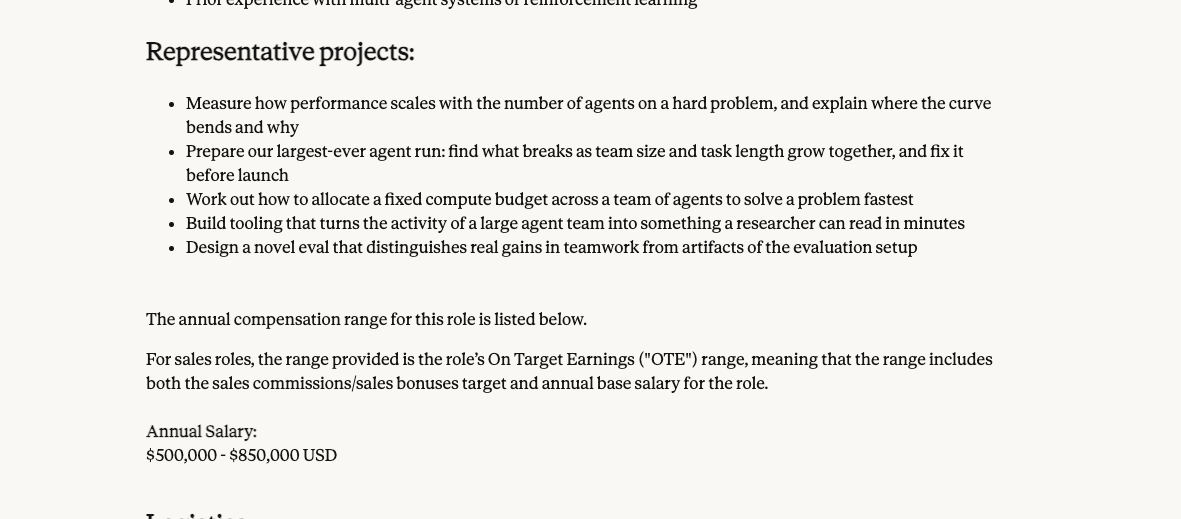
Anthropic knows that, which is why many of its job postings include a section called Representative Projects: concrete examples of the work they’d want to see, whether or not you did it on the job.
Here’s what the FDPM role is, what the hiring team is screening for, and the projects you can build right now to qualify.
Short answer: To become a forward deployed product manager at Ode with Anthropic, show you can take an ambiguous business problem all the way to a working AI system that people actually use. If you haven’t done that at work, build one representative project for a real client: define success, prototype it, build a ground-truth dataset, run evals, ship it, and drive adoption. Then write it up with real numbers.
Key Takeaways
- The FDPM role is three jobs in one: engagement manager, product manager and delivery manager.
- The hiring team cares more about what you’ve done than about your title.
- The rarest skills in the applicant pool are ground truth and evals. Build experience there first.
- One real project for one real client is worth more than five demos nobody used.
- Side projects belong in their own resume section, never under an employer.
- Pick one resume bullet per responsibility that you can defend in an interview for 2 minutes.
What is Ode with Anthropic?
Ode with Anthropic is Anthropic’s services venture. Backers include Anthropic, Blackstone, Hellman & Friedman and Goldman Sachs. It’s built on Fractional AI, an applied AI engineering firm, whose team now forms Ode’s core alongside engineers from Anthropic.
In plain terms, Ode embeds people inside companies to get Claude working in real operations. Selling API access doesn’t get AI into production. Someone has to sit with the client and make the system work, and that’s the job.
What Does a Forward Deployed Product Manager Do?
The posting describes the role as three jobs in one:
- Engagement manager: you’re the main point of contact with the client.
- Product manager: you decide what gets built and why.
- Delivery manager: you run execution end to end.
Day to day, that breaks down into this work:
- Turning vague business goals into problem statements, user journeys and success metrics
- Writing PRDs and running planning with engineers
- Prototyping early to find the hardest risks before the team commits to a build
- Building ground truth with client experts: the labeled examples that define what “correct” means for the AI
- Improving quality with engineers through prompts, context design, and offline and online evals
- Making product calls on model choice, retrieval, agent design and build vs. buy
- Running delivery across several AI products at once
- Driving rollout, enablement and adoption
- Keeping everyone clear on the plan when the client changes direction
- Building team playbooks and a shared AI toolkit
Numbers 4 and 5 are what separate this role from a traditional PM job.
Most PMs have never built a ground-truth dataset or traced an eval failure back to its cause. If you can show you have, you stand out right away.
Why “Representative Projects” Changes the Game
Many Anthropic job postings list representative projects to show the kind of work they want to see. One agents posting lists examples like designing complex agents, running quantitative prompting experiments, building model benchmarks and generating synthetic data.
The message is clear: you don’t need to have done this at a big company. You need to have done it somewhere. Here are five projects that map directly to the FDPM job description.
5 Representative Projects That Prove You Can Do the Job
1. Ship an AI agent for one real business
This is the one that matters most, because it covers almost every responsibility. Pick a local business, a friend’s startup or a nonprofit. Interview the owner, define success (bookings per week, missed calls answered, tickets resolved), prototype in Claude Code or Lovable, then ship it.
On my webinar with Cresta’s FDE recruiter, he mentioned a candidate who got hired after building voice agents for spas that booked real appointments and brought in revenue. A real client gives you real ambiguity, real constraints and real numbers to talk about.
2. Build a ground-truth dataset and eval suite
Pick a domain you know well. Write 100 questions with verified answers, write labeling guidelines, and have a friend label 20 of them independently so you can measure how often you agree. Then run 2–3 models against the set and publish the results.
This is the hardest skill to fake, and almost nobody applying has done it.
3. Run a hill-climbing log
Take the agent from Project 1 and track its accuracy against your ground truth. Each round, read the failures, sort them by root cause (retrieval miss, unclear prompt, missing context), make a fix and rerun. Then write it up: “Raised task success from 61% to 89% over 6 iterations.”
4. Write a technical decision memo
Build the same small agent two ways, such as RAG vs. a long-context prompt, or Claude vs. GPT vs. Gemini. Compare cost, speed and accuracy, then write a one-page memo explaining your call. That memo shows exactly what the “make product-level calls on model choice and build vs. buy” line in the posting is asking for.
5. Drive adoption, then teach it
Train the business’s staff on what you built and track usage for a month. Then host a live workshop showing others how you did it. A recording of you leading a room is proof of enablement skills that most candidates can’t show.
How to Reframe Experience You Already Have
You may have done more of this work than you think:
| If you’ve done this | It maps to |
|---|---|
| QA or writing test cases | Evals and ground truth |
| Support lead, FAQ or macro library | Defining correct answers |
| Consulting or client services | Problem framing and scope management |
| Writing SOPs | Requirements and user journeys |
| Rolling out an internal tool | Adoption and enablement |
| Comparing vendors | Build vs. buy decisions |
Describe the work in the role’s language, but keep your title accurate. Recruiters can spot inflated titles.
Resume Bullets You Can Adapt
Swap in your real numbers for the brackets:
- Partnered with [domain] experts to build a labeled evaluation dataset of [
] cases, auditing for coverage gaps and label conflicts and raising consistency from [X%] to [Y%]
- Ran offline evals against ground truth and monitored live traffic after launch, lifting task success from [X%] to [Y%] over [
] iterations
- Built working prototypes in Claude Code and Lovable within [X days], surfacing [
] technical risks before engineering committed to a build
- Evaluated [
] foundation models on cost, latency and accuracy, and recommended the option that met targets at [X%] lower cost
List side projects under their own heading, such as “AI Product Projects.” If the client was real, you can list “AI Product Consultant, [Business Name]” with dates. Add links to a GitHub repo, a Loom demo or your eval write-up so a recruiter can check your work in 2 minutes.
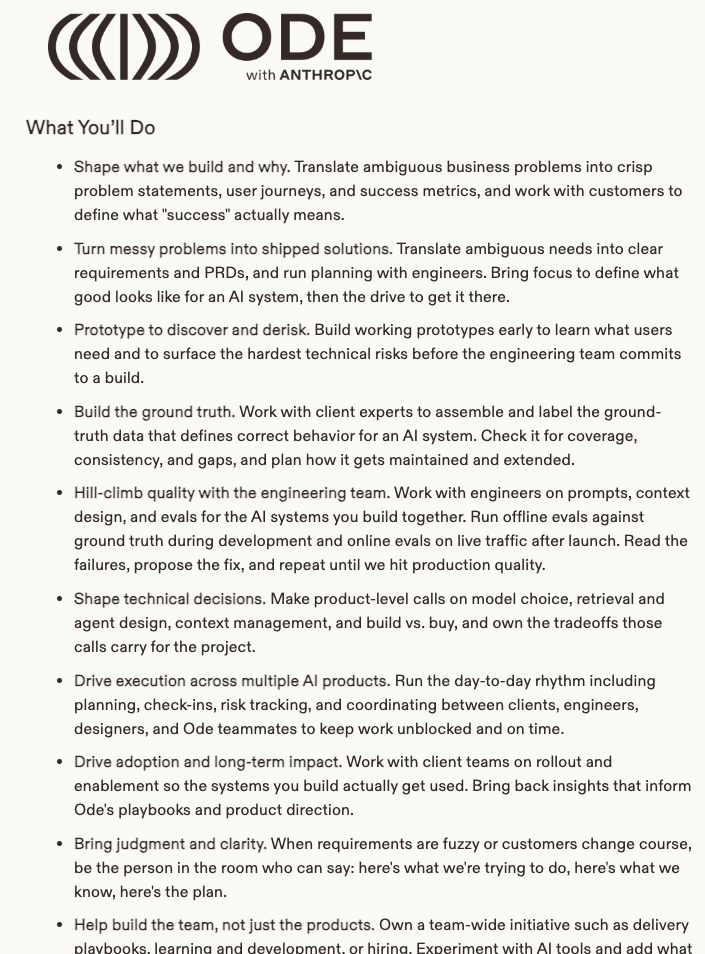
Here are some resume description bullets that you might be able to include in your resume.
They’re reworded so they don’t mirror the job description, but each one keeps the core keywords the ATS will look for (evals, ground truth, PRDs, RAG, prototypes and so on). Brackets are still placeholders for your real details.
1. Shape what we build and why
- Ran discovery with [
] enterprise clients to convert vague asks into defined problem statements, success metrics and end-to-end user journeys
- Facilitated workshops with [client] executives and frontline users to agree on what a successful AI rollout looked like, tied to [business KPI]
- Mapped current-state workflows for [team/function] and pinpointed the [
] highest-value moments for AI, which shaped the first release scope
- Set measurable targets for an AI [assistant/agent] with client stakeholders ([accuracy %, resolution rate, time saved]), giving the team one scorecard to build toward
2. Turn messy problems into shipped solutions
- Authored PRDs and acceptance criteria for [
] AI features, turning loosely defined client requests into specs engineering could estimate and build
- Led planning and backlog prioritization with a team of [
] engineers, taking [product] from first draft to production launch in [X weeks]
- Defined quality bars for an LLM-powered [system] before development began, so “done” meant measurable performance, not just shipped code
- Broke a [multi-department / cross-system] client problem into [
] sequenced releases, delivering the first usable version in [X weeks] and the full scope in [X months]
3. Prototype to discover and derisk
- Built functional prototypes with Claude Code, Lovable and Cursor in [X days], putting working software in front of users before engineering committed resources
- Tested [
] prototype variations with [
] end users, which reshaped the roadmap and dropped [
] features users didn’t need
- Used early prototypes to stress-test [integration / latency / data access] risks, flagging [
] blockers weeks before the main build began
- Validated feasibility of an agentic workflow through a [X-day] proof of concept, giving leadership the evidence to approve a [$X / X-month] build
4. Build the ground truth
- Partnered with [domain] experts to create a labeled evaluation dataset of [
] cases that defined expected AI behavior across [
] scenarios
- Audited ground-truth data for coverage gaps, label conflicts and edge cases, raising dataset consistency from [X%] to [Y%]
- Designed labeling guidelines and a review process for client SMEs, cutting annotation disagreements by [X%]
- Built a maintenance plan for evaluation data, adding [
] new cases per [month/release] as product scope and user behavior changed
5. Hill-climb quality with engineering
- Co-owned prompt and context design with engineers, iterating through [
] versions to lift task success from [X%] to [Y%]
- Set up offline eval suites against ground truth during development and online monitoring on production traffic after launch
- Reviewed model failures weekly, categorized root causes ([retrieval misses, ambiguous instructions, missing context]) and proposed targeted fixes that cut errors by [X%]
- Drove an AI [agent/assistant] from prototype quality to production readiness over [
] eval cycles, hitting the [X%] accuracy target agreed with the client
6. Shape technical decisions
- Evaluated [
] foundation models ([e.g., Claude, GPT, Gemini]) on cost, latency and accuracy, and recommended the model that met targets at [X%] lower cost
- Made architecture calls on RAG pipelines, agent design and context window strategy, documenting tradeoffs for engineering and client leadership
- Led a build-vs-buy analysis for [component, e.g., vector search / voice layer], choosing [option] and saving [X weeks / $X]
- Owned the risks behind each technical decision, maintaining a decision log that kept [
] stakeholders aligned through [
] scope changes
7. Drive execution across multiple AI products
- Managed delivery for [
] AI products at once, running weekly planning, status check-ins and risk reviews across client and internal teams
- Coordinated work between client stakeholders, [
] engineers and designers, keeping [
] workstreams unblocked and on schedule
- Built a risk tracker that surfaced [
] blockers early, keeping [
/
] milestones on time across concurrent engagements
- Set the delivery cadence for a [
]-person cross-functional team, cutting missed deadlines by [X%] quarter over quarter
8. Drive adoption and long-term impact
- Led client rollout and enablement, including [training sessions, documentation, office hours], reaching [X%] active usage within [
] weeks of launch
- Trained [
] client users on new AI workflows, turning early skeptics into champions who drove adoption across [
] teams
- Tracked post-launch usage and feedback to find adoption drop-off points, shipping [
] fixes that raised retention by [X%]
- Turned lessons from [
] client deployments into reusable playbooks and roadmap inputs that sped up future engagements by [X%]
9. Bring judgment and clarity
- Re-scoped an engagement when the client shifted priorities mid-project, aligning [
] stakeholders on a revised plan within [X days] without slipping the launch
- Served as the decision point in ambiguous client meetings, laying out goals, known facts and next steps to move the work forward
- Pushed back on an out-of-scope client request by reframing it around their original priorities, protecting the timeline and the relationship
- Wrote concise decision memos for leadership during [
] high-uncertainty moments, cutting decision time from [X weeks] to [X days]
10. Help build the team
- Created a [delivery playbook / onboarding guide] used by [
] PMs, cutting ramp-up time for new hires by [X%]
- Built and maintained a shared PM AI toolkit of tested workflows (Claude Code, NotebookLM, eval tooling) adopted across [
] teams
- Led [
] internal learning sessions on [AI evals / prompt design / agent architecture], raising team skill in [area]
- Took part in hiring for [
] PM roles, including interview design and candidate evaluation, helping the team grow from [X] to [Y]
You can cover almost all of these responsibilities without having done them in a job. The trick is to pick projects that make you do the same work, and then describe that work honestly.
The best option: one real client, start to finish
One project for one real user can cover nearly every responsibility on the list. The Cresta FDE Jonaed mentioned got hired after building voice agents for spas that booked appointments and brought in revenue. Here’s how a project like that maps to the job description:
| JD responsibility | What you’d do in the project |
|---|---|
| Shape what we build | Interview the business owner, map how bookings work today, define success (e.g., missed calls answered, bookings per week) |
| Turn messy problems into shipped solutions | Write a one-page PRD, scope a v1, ship it |
| Prototype to derisk | Build a rough version in Lovable or Claude Code in a weekend and test it with the owner |
| Build the ground truth | Collect 100+ real customer questions with the owner and label the correct answer for each |
| Hill-climb quality | Run the agent against those questions, track the % correct, fix prompts and context, rerun |
| Shape technical decisions | Choose the model, decide between RAG and a simple FAQ, choose Vapi vs. Retell vs. building your own, and write down why |
| Drive adoption | Train the staff, watch usage for a month, fix what stops people from using it |
| Bring judgment | When the owner asks for “everything,” cut it down to what fits v1 |
Good businesses to build for: a friend’s startup, a local service business (dentist, gym, salon, contractor), a nonprofit, a Shopify store, or a student club. The owner’s time limits, unclear requests and changing priorities are the same customer-management experience that FDPM roles screen for.
Projects for the hardest gaps
Ground truth and evals are the skills candidates most often lack, and they’re the hardest to fake in an interview.
- Build an eval set for a public AI tool. Pick a domain you know (tax rules, NYC housing, a sport), write 100 questions with verified answers, run 2–3 models against them and publish the results.
- Write labeling guidelines for your dataset, then have a friend label 20 of the questions independently and measure how often you agree. That gives you a real consistency number.
- Write up the failures you found, sorted by cause. That write-up shows the same failure analysis the “hill-climb quality” responsibility describes.
Technical decisions
- Build the same small agent two ways (e.g., RAG vs. a long-context prompt, or Claude vs. GPT vs. Gemini) and compare cost, speed and accuracy. Then write a one-page decision memo. That memo is exactly what “Shape technical decisions” asks for.
Adoption and enablement
- Host a live workshop teaching people to use what you built. Hiring teams rarely get to see how a group responds to a candidate, so a recording of you teaching 20 people gives them evidence most candidates can’t offer.
Help build the team
- Write a public playbook (e.g., “How I evaluate an AI agent before launch”) or run a weekly study group. Both count as building a team resource.
Reframing work you’ve already done
Plenty of adjacent jobs already involve this work under different names. Translate the work honestly, but don’t change your job title.
| If you’ve done this | It maps to |
|---|---|
| QA, testing, writing test cases | Evals, ground truth, failure analysis |
| Support lead, writing macros or FAQs | Defining correct answers (ground truth), finding gaps |
| Consulting, client services | Problem framing, stakeholder alignment, managing scope |
| Ops, writing SOPs | Requirements, user journeys |
| Rolling out any internal tool | Adoption and enablement |
| Comparing vendors | Build vs. buy decisions |
| Training new hires | Enablement, playbooks |
For example, a support lead could truthfully write: “Built and maintained a library of 200+ approved answers to customer questions, auditing it quarterly for gaps and outdated responses.” Once you’re interviewing for AI roles, that’s ground-truth experience, and you can say so.
How to put it on the resume
- Give side projects their own section, titled something like “AI Product Projects” or “Independent Consulting.” Never list a side project under an employer. Jonaed said recruiters can spot backdated titles.
- Treat a real client as real experience. You can list “AI Product Consultant, [Business Name]” with dates.
- Link to proof. A GitHub repo, a short Loom demo or a published eval write-up lets a recruiter check the project in 2 minutes.
- Use the same bullet format as your job bullets: what you did, how you did it, and the result, with real numbers.
One honest caution: a project with a real client counts for far more than three projects nobody used. If time is short, build one thing for one real person and take it all the way to the eval and adoption stages.
Want Help Building Your Representative Project?
In our AI Product Manager program, we help you scope and build a project like this, turn it into resume bullets that hold up in an interview, and prepare you to talk about it with a hiring team.
The consultation is a fit check for our paid program. If you’re a PM, consultant or implementation lead aiming for forward deployed roles in the next few months, book a call and we’ll see whether the program fits where you are.
Frequently Asked Questions
What is a forward deployed product manager?
A forward deployed product manager works directly with clients to turn business problems into AI systems that ship and get used. At Ode with Anthropic, the role combines engagement management, product management and delivery management.
Is the FDPM role at Anthropic or at Ode?
It’s at Ode with Anthropic, Anthropic’s services venture. Ode works closely with Anthropic and favors Claude when it fits the project.
Do I need forward deployed experience to apply?
Not necessarily. The posting asks for about 4 years in product, consulting or implementations, and says what you’ve done matters more than your title. Representative projects can fill the gap.
What are ground truth and evals?
Ground truth is a labeled set of examples that defines correct behavior for an AI system. Evals measure how often the system matches it, both before launch (offline) and on live traffic (online).
What’s the best portfolio project for an FDPM role?
An AI agent built for a real client, taken all the way through ground truth, evals, launch and adoption. It covers almost every responsibility in the job description.
How much does a forward deployed product manager make?
One Ode posting for a financial services FDPM lists $200K–$275K annually. Pay varies by location, level and vertical.