
How to Get an Anthropic Applied AI Role: What the Forward Deployed Engineering Path Looks Like at the World's Most Important AI Lab
What the Anthropic Applied AI Role Actually Is
Most people who encounter the Anthropic Applied AI Engineer title assume it is a research-adjacent role — something between a machine learning engineer and an AI safety researcher.
It is not. An Anthropic Applied AI Engineer is a customer-embedded engineer who designs, builds, and ships production Claude deployments inside Fortune 500 accounts — not a researcher, not a pure platform engineer, and not a traditional sales engineer.
Anthropic's Applied AI Engineer is their version of Palantir's Forward Deployed Engineer: a hybrid of solutions engineering, ML engineering, and embedded product management for enterprise Claude deployments.
The day-to-day breakdown is approximately 40 percent prototyping with the Claude API at customer offices, 30 percent architecture design with customer engineering teams, and 30 percent feeding signal back into Anthropic's product and research organizations. This is fundamentally different from working on Claude model training. It is the field-facing engineering role that takes what the research organization builds and makes it work in the real world for real enterprise customers.
Public Anthropic FDE postings describe the role as embedding directly with strategic customers to drive AI adoption, shipping advanced AI applications, building within customer systems, delivering MCP servers, sub-agents, and agent skills, providing white-glove deployment support, and feeding repeatable patterns back to product and engineering.
The role formula that the most accurate guides use for the Anthropic Applied AI Engineer is: software engineer plus applied AI builder plus enterprise deployment operator plus customer discovery lead plus safety-aware field ambassador.
That last element — safety-aware field ambassador — is what distinguishes the Anthropic FDE from every other FDE role in the ecosystem. Anthropic is the company that has made AI safety the most explicit organizational priority in frontier AI. The Applied AI Engineer is the person who represents that priority in the customer's environment — not by adding safety as a compliance checkbox at the end of a deployment, but by designing safety into every system from the beginning.
Why Kevin Bai's Arc Is the Most Compelling Proof of This Path
You have encountered Kevin Bai's career story throughout this blog library. Palantir FDE. Founding FDE at Rippling — built the function from zero to 25 people in one year. Now Member of Technical Staff at Anthropic on the Applied AI team.
That arc is not a coincidence. It is the FDE career path in its most deliberate form — and it terminates at exactly the role this blog describes.
Kevin built expertise at Palantir in the foundational FDE model: embed with the customer, understand the real problem, build the solution end to end, leave the client capable rather than dependent. He then took that model to Rippling — a completely different technical context — and proved the model was portable across platforms. And then Anthropic hired him for the Applied AI team.
Anthropic was not hiring Kevin for his Palantir brand. They were hiring him because he had demonstrated the specific combination of capabilities their Applied AI function requires: deep technical delivery in complex enterprise environments, the ability to build client trust at the executive level, and the breadth to operate across entirely different technical domains without needing months of ramp time.
That is exactly what the Anthropic Applied AI role produces when it is working correctly. And it is exactly what the Anthropic interview is designed to identify.
The Five-Stage Interview Process: What Each Round Actually Tests
The Anthropic FDE interview pairs practical Claude-deployment rounds with a company values interview that counts as much as the technical stages. Anthropic runs this as a founding-team role on its Applied AI organization, so the loop is newer and less standardized than its established software engineer process.
The five stages are the recruiter screen, the technical use-case screen, the coding round, the hiring manager round, and the final panel. The hidden weight that most candidates do not expect is on the customer-conversation simulation — the stage that filters out the highest percentage of technically qualified candidates.
Stage One: The Recruiter Screen
The Anthropic recruiter screen is a 30-minute call that tests motivation and fit before any technical assessment.
Anthropic recruiters move quickly, communicate clearly, and turn the why Anthropic question into a conversation about the models you have used and what drew you to the company.
Two things distinguish the Anthropic recruiter screen from most other FDE recruiter screens.
First: references are treated as a real part of the evaluation and may be requested early — sometimes before your technical rounds. Expect to provide external recommendations including a former manager and a close coworker. Prepare your references before you apply. Having strong references who can speak specifically to your customer-facing judgment, your technical delivery under pressure, and your ability to operate independently is part of the preparation for this role — not an afterthought after you get the offer.
Second: genuine motivation is screened rigorously. The Anthropic recruiter is not just asking why you want this job. They are evaluating whether your interest in Anthropic is real and grounded in specific experience with Claude and specific understanding of what Anthropic is trying to accomplish in the world. The candidate who has been building with Claude through our CCAF program has a specific and concrete answer to this question. The candidate who has only read about Claude has an answer that the Anthropic recruiter has heard hundreds of times and that does not advance.
Stage Two: The Technical Use-Case Screen
The technical use-case screen is a practical scenario built around deploying Claude with MCP tooling and long-context reliability.
This is the stage where the CCAF certification most directly produces a competitive advantage. The Model Context Protocol is the infrastructure layer that connects Claude to external tools, data sources, and systems. Building and deploying MCP servers is one of the most specific technical competencies the Anthropic Applied AI role requires. The candidate who has built an MCP server — even a simple one — and can discuss the architecture, the failure modes, and the design decisions at an implementation level is in a fundamentally different position than the candidate who has only read about MCP.
The long-context reliability dimension of this screen is specifically about understanding how Claude performs when the context window is heavily populated with customer data, how retrieval strategies affect response quality, and how to design systems that maintain reliable outputs across diverse query types. This is evaluation engineering applied to Claude specifically — the same discipline the Anthropic safety team applies to model evaluation applied to enterprise deployment contexts.
The preparation that produces passing scores: build something real with Claude before this screen. Not a tutorial chatbot. A working application that uses MCP tooling, has a real business problem as its premise, and demonstrates that you understand how Claude behaves at the edges of its capability rather than only in the center. The CCAF program builds exactly this foundation.
Stage Three: The Coding Round
The coding round is a practical, incremental coding exercise on a platform such as CodeSignal.
The Anthropic coding round is practical rather than algorithmic — oriented toward the kind of real-world engineering tasks that Applied AI work actually requires. Rate limiting implementation. Streaming data processing. Distributed job queue design. LLM system design including latency optimization, retry patterns, batching, and caching.
Production AI depth matters: rate limiting, retry patterns, batching, caching, prompt engineering for robustness, latency debugging across the full stack.
The failure pattern that most technically strong candidates encounter here is treating this as a standard LeetCode coding screen and preparing accordingly. The Anthropic coding round is not asking you to optimize a binary search tree. It is asking you to build something that would actually function in a production Claude deployment — with all the real-world complexity that implies.
Prepare specifically for: implementing a rate limiter that handles burst traffic gracefully, designing a streaming response handler that manages long-context outputs, and building a simple orchestration layer that coordinates multiple Claude API calls with appropriate error handling and retry logic.
Stage Four: The Hiring Manager Round
The hiring manager round is a technical and behavioral deep dive into past projects, scalability, and customer reasoning.
This is the round where the three-hat capability is most directly evaluated. The hiring manager is not just assessing whether you can build Claude applications. They are assessing whether you can build Claude applications while simultaneously understanding why you are building what you are building for a specific customer's specific business context.
The behavioral component of this round specifically probes customer reasoning — the thinking process you use when a customer's stated requirement does not align with what would actually serve their business needs. This is the same diagnostic question discipline we have emphasized throughout this blog library. The Anthropic hiring manager is specifically looking for candidates who demonstrate that their organizing principle is customer outcome resolution rather than task completion.
The scalability dimension probes your thinking about how the Claude deployment you are building will behave at enterprise scale — not just whether it works for one query but whether it works for ten thousand simultaneous queries with diverse users and edge cases that the initial design did not anticipate.
Come prepared with two to three specific past projects that you can walk through at depth — the business problem, the technical architecture, the design decisions, the failure modes you encountered, and what you would do differently. The depth of your project knowledge is the signal. Candidates who can only speak to their projects at a high level are demonstrating that they did not own the work end to end.
Stage Five: The Final Panel — The Round That Filters 60 Percent of Passing Coders
The final panel includes solution design, behavioral assessment, and company values — with a hidden weight on the customer-conversation simulation that filters out roughly 60 percent of candidates who pass the coding stages.
The customer-conversation simulation is Anthropic's equivalent of the Palantir decomposition round in terms of impact on outcomes. It is the round that most candidates underestimate because they have prepared for the technical rounds and assume the customer conversation is the easier part.
The simulation presents you with a realistic enterprise customer scenario and asks you to conduct a discovery conversation, identify the real problem beneath the stated one, and propose a Claude-based solution architecture while managing the customer's expectations in real time.
What makes this round specifically demanding at Anthropic is the safety dimension. The Anthropic customer-conversation simulation is not just evaluating whether you can identify the business problem and design a Claude solution. It is evaluating whether you proactively raise safety and reliability considerations that the customer has not asked about — whether you are genuinely a safety-aware field ambassador rather than an engineer who checks the safety box when prompted.
The candidate who hears a customer describe an automated decision-making workflow and immediately starts designing the Claude integration without raising questions about human oversight, audit trails, error handling, and the consequences of system failures is demonstrating that safety is not part of their design instinct. The candidate who raises those questions naturally — as part of understanding what a good solution actually looks like — is demonstrating the Anthropic field ambassador capability the role requires.
The company values component of the final panel evaluates genuine alignment with Anthropic's mission. Mission alignment is screened seriously. Read Anthropic's Core Views on AI Safety, Responsible Scaling Policy, and recent interpretability research before this round.
This is not a formality. Anthropic is the company that has built its entire organizational identity around the proposition that AI safety is the most important technical problem of our time. The Applied AI Engineer represents that identity in the customer's environment. Candidates who treat the mission alignment evaluation as a box to check rather than a genuine filter are not prepared for this stage.
The Specific Preparation Advantages of the CCAF Certification
The Claude Certified Architect Foundations certification is the most directly relevant pre-interview credential available for Anthropic Applied AI candidates. Here is specifically why.
The CCAF builds hands-on competency with the Claude API, Claude's tool use capabilities, MCP server implementation, and the agent architecture patterns that underlie the most sophisticated Claude deployments. This is precisely the technical vocabulary the Anthropic technical use-case screen and coding round are designed to evaluate.
More importantly: the CCAF demonstrates to the Anthropic recruiter that you have done more than read about Claude. You have built with it. You have encountered the edges of its capability. You have made design decisions about how to structure prompts, manage context, implement tool calls, and evaluate whether the outputs are reliable enough for enterprise use. That hands-on credibility is immediately visible in the recruiter screen — in the specificity of your answers about Claude — and throughout every subsequent stage.
Andy Leonard described the mindset that produces the most value from the CCAF process: set a date, commit to it, do the preparation, take the exam. Not waiting until you feel perfectly ready. Acting. That bias for action is exactly what Anthropic is looking for in Applied AI candidates — because the Applied AI Engineer who waits for perfect conditions before shipping anything is not going to thrive in an enterprise deployment environment where shipping is the job.
We run CCAF exam preparation sessions every Tuesday and Thursday at 1PM Pacific and 4PM Eastern. These sessions are open to our community. If you have not yet earned the certification and you are targeting Anthropic, book a session immediately.
The Compensation Picture
Anthropic pays exceptionally — and the offer is widely reported to be firm rather than negotiable. The role pays north of $300,000 base for senior levels per Levels.fyi public data, with total comp regularly crossing $500,000.
The equity structure at Anthropic uses Profit Participation Units rather than traditional RSUs — a structure specific to Anthropic's unusual corporate status as a Public Benefit Corporation with a specific relationship between investor returns and mission fulfillment. The PPUs are real equity with real value at Anthropic's current valuation of over $61.5 billion. They are not the same as traditional stock options and the vesting and liquidity terms are worth understanding in detail before signing any offer.
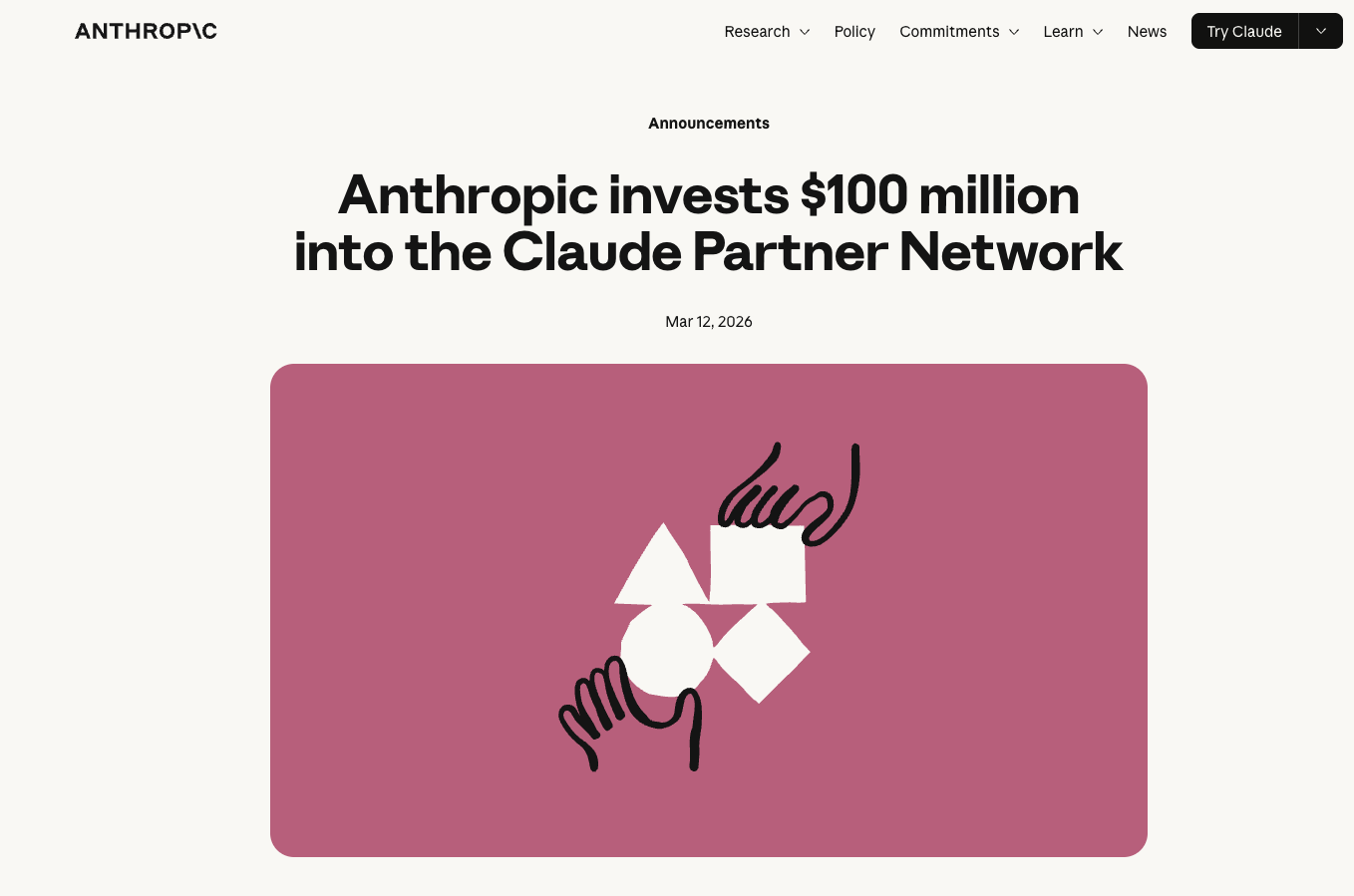
Anthropic committed $100 million to its Claude Partner Network and has stated it will expand its partner-facing Applied AI team fivefold. The hiring is real and accelerating. The compensation reflects the company's view that the Applied AI Engineer is among the most important hires it can make — not a support function but a strategic capability.
https://www.anthropic.com/news/claude-partner-network
Why This Is the Most Important Emerging FDE Credential in the Market
Here is the argument for why an Anthropic Applied AI role is worth targeting even beyond the extraordinary compensation.
The entire enterprise AI deployment ecosystem is converging on Claude. Salesforce Agentforce, which committed to nearly 1,000 FDEs, is deploying Claude as a core agent model. Rippling's App Studio builds on Claude integrations. Decagon's AOP system uses foundation models from Anthropic among others. The companies in the Palantir FDE alumni network are building their agent systems on Claude alongside OpenAI's APIs.
The Applied AI Engineer who has deployed Claude at production scale inside Fortune 500 environments — who understands how Claude behaves at the edges, how to design evaluation frameworks that catch reliability issues before clients do, and how to build MCP server infrastructure that connects Claude to enterprise systems — is the professional that every company in the AI deployment ecosystem wants to hire.
Kevin Bai's path from Palantir to Rippling to Anthropic Applied AI is the template. But for candidates who are targeting Anthropic directly — rather than building up to it through earlier FDE roles — the path is the CCAF certification, the portfolio of Claude implementations, the hands-on MCP server experience, and the customer-facing track record that demonstrates the three-hat capability in a Claude-specific context.
Schedule Your Forward Deployed Engineering Strategy Session
If you want to understand what the realistic path looks like from where you are to a competitive Anthropic Applied AI candidacy — and how the CCAF certification, the portfolio work, and the customer-facing experience combine into a preparation plan for your specific background — book a strategy session with our team.
We are part of the Anthropic partner ecosystem. We run CCAF preparation twice weekly. We have prepared candidates for the most demanding FDE interviews in the market and we have the preparation infrastructure to help you build toward the Anthropic Applied AI role specifically.
Book your session here: https://consultation.techcareers.io/o-discover-fde/about
Submit your profile here: https://www.paraform.com/forms/cms9ccu9n00070bjur3ljopm2
Frequently Asked Questions
What is the Anthropic Applied AI Engineer role and how does it relate to forward deployed engineering?
The Anthropic Applied AI Engineer is their version of Palantir's Forward Deployed Engineer: a hybrid of solutions engineering, ML engineering, and embedded product management for enterprise Claude deployments. The role embeds directly with strategic customers to drive AI adoption, ships advanced AI applications including MCP servers, sub-agents, and agent skills, and feeds repeatable deployment patterns back to Anthropic's product and research organizations. The day-to-day is approximately 40 percent prototyping with the Claude API at customer offices, 30 percent architecture design with customer engineering teams, and 30 percent feeding signal back to internal teams.
What is the Anthropic Applied AI Engineer interview process?
The Anthropic FDE interview pairs practical Claude-deployment rounds with a company values interview that counts as much as the technical stages. The five stages are a recruiter screen covering background, motivation, and early references; a technical use-case screen built around deploying Claude with MCP tooling and long-context reliability; a practical incremental coding round on a platform such as CodeSignal; a hiring manager round covering past projects, scalability, and customer reasoning; and a final panel including solution design, behavioral assessment, and company values evaluation. The customer-conversation simulation in the final panel filters out roughly 60 percent of candidates who pass the coding stages.
Why does the CCAF certification specifically matter for Anthropic Applied AI candidates?
The Claude Certified Architect Foundations certification builds hands-on competency with the Claude API, MCP server implementation, tool use capabilities, and agent architecture patterns — precisely the technical vocabulary the Anthropic technical use-case screen and coding round evaluate. More importantly, it demonstrates to the Anthropic recruiter that the candidate has built with Claude rather than only studied it, which produces the specific and credible answers about Claude behavior that advance candidates past the recruiter screen and into the technical rounds. TechCareers.io runs CCAF exam preparation every week.
What does Anthropic pay Applied AI Engineers?
The role pays north of $300,000 base for senior levels per Levels.fyi public data, with total comp regularly crossing $500,000. Anthropic's equity structure uses Profit Participation Units rather than traditional RSUs — a structure specific to Anthropic's Public Benefit Corporation status. The company's valuation exceeds $61.5 billion and the Applied AI team is expanding aggressively following the commitment of $100 million to the Claude Partner Network and the stated plan to grow the partner-facing team fivefold. Anthropic offers are widely reported to be firm rather than negotiable, so the first offer is typically the real offer.
What is the customer-conversation simulation in the Anthropic final panel and how do you prepare for it?
The customer-conversation simulation presents a realistic enterprise scenario and asks the candidate to conduct a discovery conversation, identify the real problem beneath the stated one, and propose a Claude-based solution while managing customer expectations in real time. The Anthropic version specifically evaluates whether candidates proactively raise safety and reliability considerations that the customer has not asked about — whether they are genuinely safety-aware field ambassadors rather than engineers who check the safety box when prompted. Preparation requires both the standard FDE customer discovery practice — the diagnostic question framework and active listening discipline — and specific familiarity with Anthropic's safety principles, Responsible Scaling Policy, and Core Views on AI Safety.
How is Anthropic different from Palantir and OpenAI as an FDE destination?
Anthropic is more specifically focused on Claude deployment and AI safety than either Palantir or OpenAI in its FDE function. The Palantir FDE operates across a broad proprietary platform stack in government, defense, and commercial enterprise contexts. The OpenAI FDE deploys GPT-4 and OpenAI's API suite across diverse enterprise customers. The Anthropic Applied AI Engineer builds exclusively on Claude and the Anthropic platform — which means deeper platform-specific expertise is required but the scope is narrower. The safety-aware field ambassador dimension is more explicitly evaluated at Anthropic than at either Palantir or OpenAI. The compensation at Anthropic is the highest of the three programs at equivalent seniority levels.
How does Kevin Bai's career arc relate to the Anthropic Applied AI path?
Kevin Bai's career — Palantir FDE, founding FDE at Rippling building the function from zero to 25 people in one year, then Member of Technical Staff at Anthropic Applied AI — is the most direct public proof that the FDE career path terminates at exactly this role. Anthropic hired Kevin not for the Palantir brand but for the specific combination of enterprise deployment experience, platform-agnostic technical delivery, and client trust-building capability that the Applied AI role requires. For candidates targeting Anthropic Applied AI directly without the full Palantir-to-Rippling arc, the preparation path is the CCAF certification, a portfolio of production Claude implementations, MCP server experience, and customer-facing track record that demonstrates the same three-hat capability through a Claude-specific lens.