Decagon Agent Development Manager and Agent Deployment Engineer: How to Get the Role, What the Interview Looks Like, and Why This Model Is Beating Traditional FDE
The Most Important Thing You Need to Know Before Applying to Decagon
If you are targeting a forward deployed engineering role in 2026 and Decagon is on your list (and it should be), then there is something you need to understand before you apply anywhere or talk to anyone.
Decagon does not have forward deployed engineer roles.
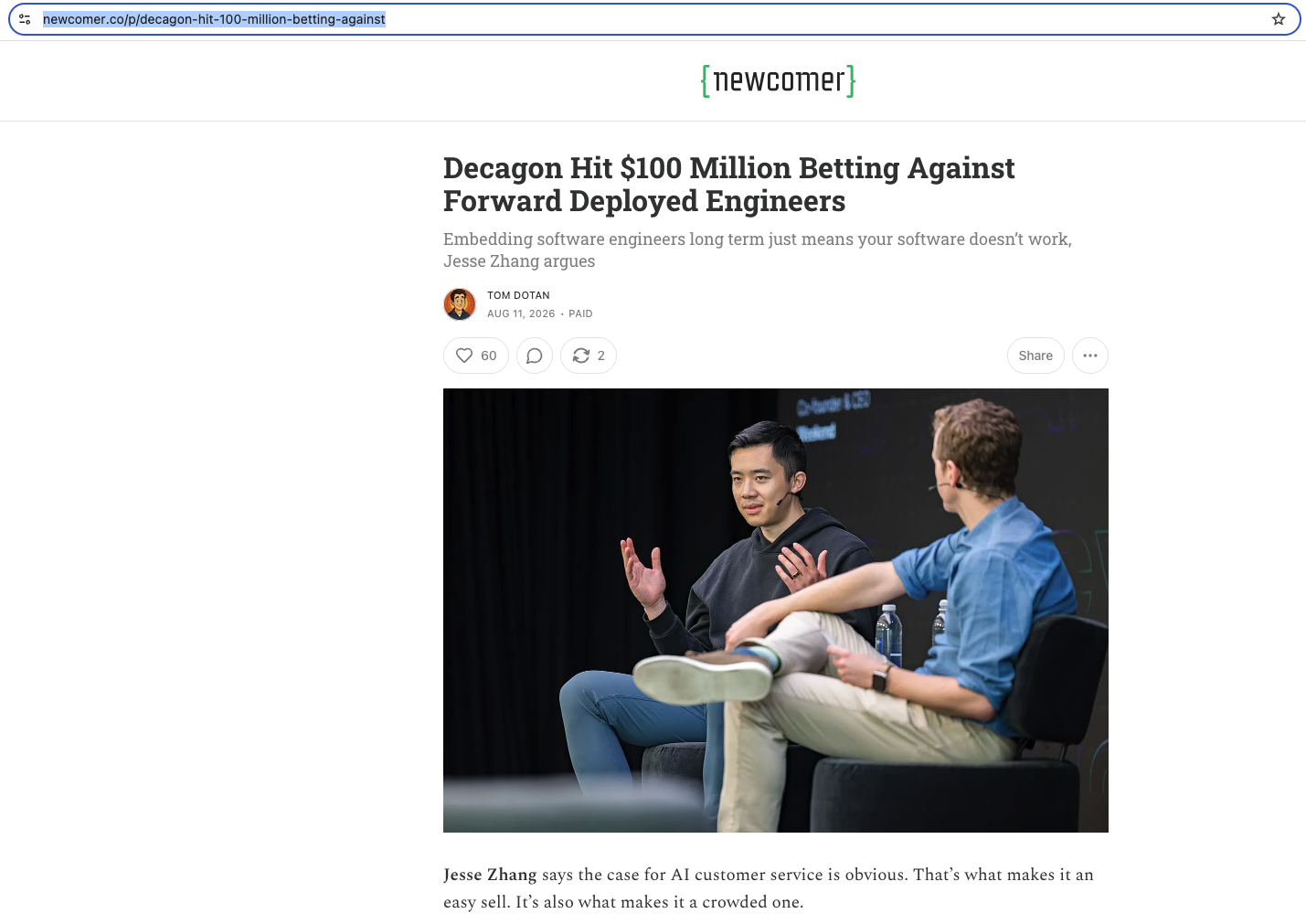
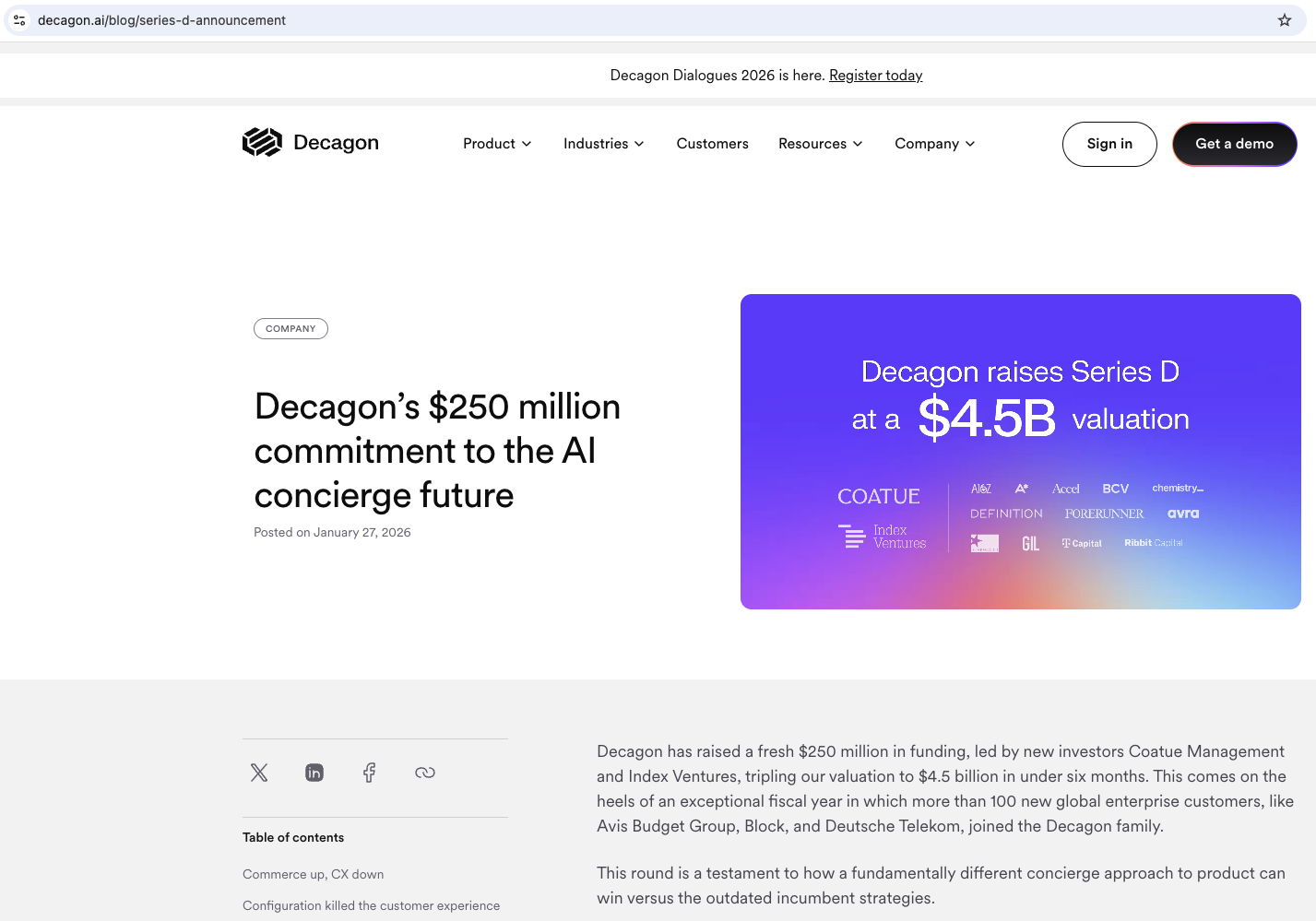
Not because they do not do that work. They do. But Decagon's CEO Jesse Zhang has publicly argued that reliance on embedded forward deployed engineers is a sign of a weak product. He built a company to $100 million in annualized revenue and a $4.5 billion valuation by betting against the traditional FDE model. And in doing so, he created something genuinely new — a reinvention of forward deployment that the rest of the AI industry has not yet caught up to.
Decagon calls it Agent Development. The roles are Agent Development Manager and Agent Deployment Engineer.
The candidate who walks into a Decagon interview talking about wanting to be a "forward deployed engineer" is speaking the wrong language at a company that has explicitly rejected that framing. The candidate who understands what Agent Development actually is, why Decagon built it, and how it differs from traditional FDE work is the candidate who gets the offer.
This blog gives you that understanding. Everything else follows from here.
Why Jesse Zhang Bet Against Forward Deployed Engineers
To understand what Decagon built you need to understand the problem they were solving.
The traditional forward deployed engineering model — pioneered by Palantir — embeds highly skilled engineers directly inside client organizations for weeks or months. These engineers learn the client's environment deeply, build custom solutions, and become the bridge between the product and the client's specific reality.
It works. Palantir's 133 percent US commercial revenue growth in Q1 2026 proves it works. But it does not scale cheaply. Every client generates an endless stream of bespoke requests that route through the FDE. Every deployment requires custom work. The FDE becomes a bottleneck — brilliant, valuable, and irreplaceable in a way that prevents the product from standing on its own.
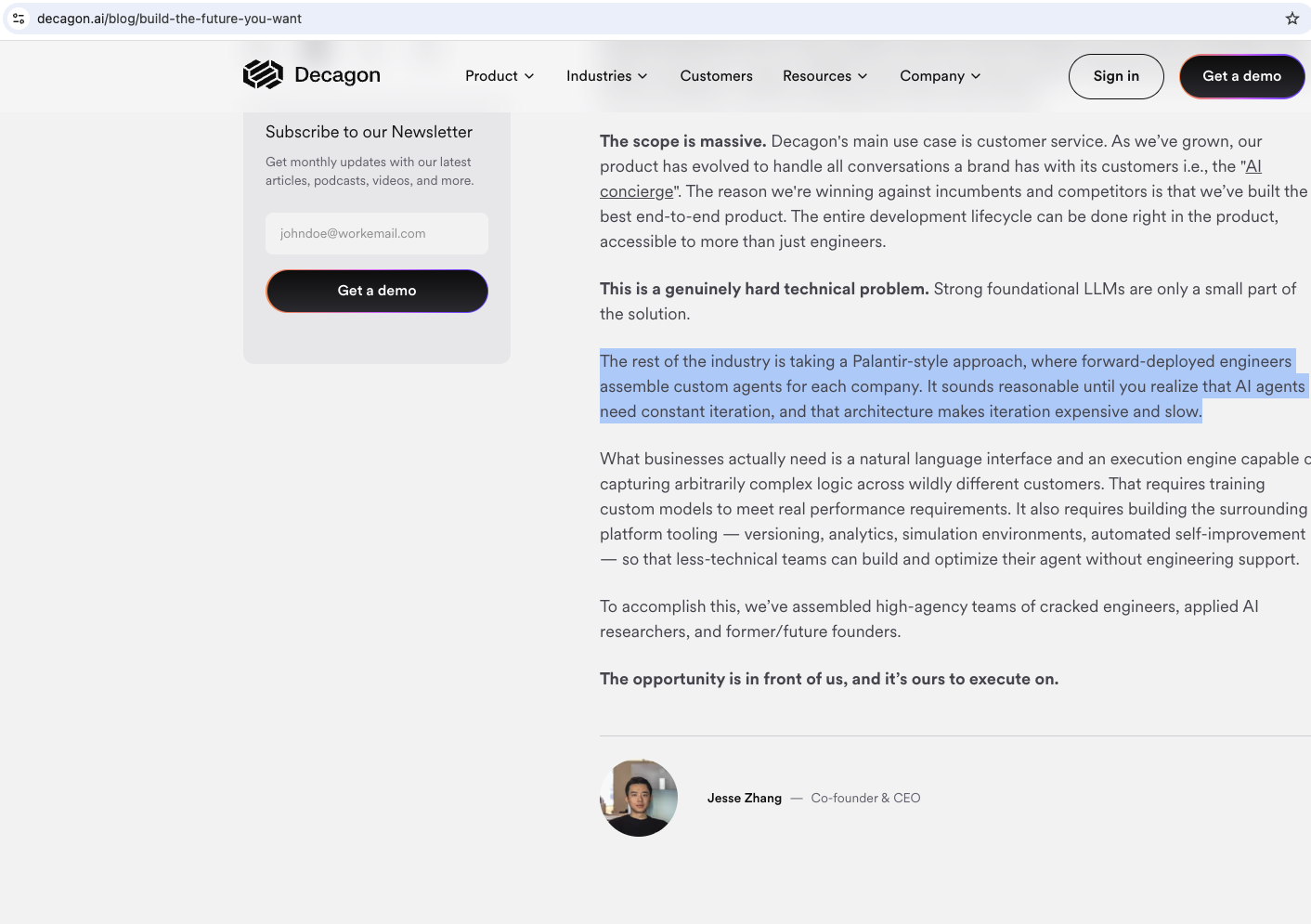
Jesse Zhang saw this pattern across the enterprise AI landscape and made a deliberate bet. He would build a product strong enough that clients could customize their own agents. And he would build a delivery team focused on systems rather than heroism — on frameworks and playbooks that compound with every deployment rather than bespoke work that has to be rebuilt from scratch for every client.
https://decagon.ai/blog/build-the-future-you-want
The results are documented.
- Decagon crossed $100 million in annualized revenue.
- Chime reports 70 percent chat and voice resolution.
- Duolingo reports an 80 percent deflection rate.
- ClassPass reports a 95 percent cost reduction.
- Hunter Douglas credits the platform with $1 million in revenue from fully AI-handled conversations.
https://www.newcomer.co/p/decagon-hit-100-million-betting-against
These outcomes are not the product of heroic FDE embedding. They are the product of a delivery model that treats agent building as a craft that should get better with every deployment — not start over from scratch with every new client.
What Agent Development Actually Is: The Model Decagon Built
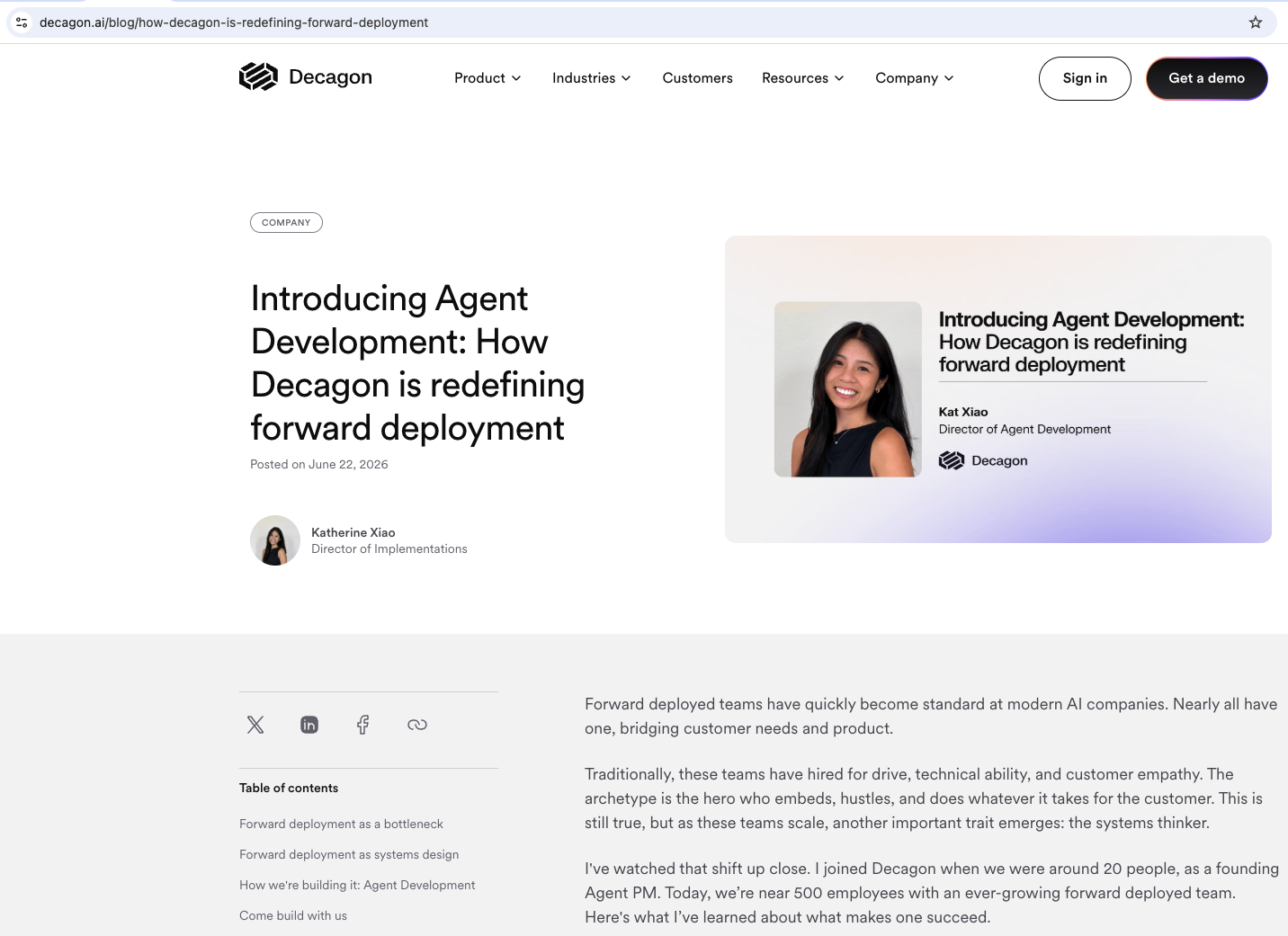
Katherine Xiao, Decagon's Director of Agent Development, published the defining explanation of this model in June 2026. Her framing is the most important thing you can read before interviewing at Decagon.
https://decagon.ai/blog/how-decagon-is-redefining-forward-deployment
The insight starts with a problem every hypergrowth company eventually faces.
Early on, the forward deployed team orchestrates between engineering, product, and customers — translating what a client needs into engineering tasks and explaining product limits back to them.
At ten customers, you can brute-force every launch.
At hypergrowth scale, that model breaks. The wave of demand that every company wants is exactly the wave that breaks a team built on brute force.
Decagon's answer was systems thinking. Not more people doing bespoke work. Better systems that absorb increasingly complex customers and improve with every launch.
https://decagon.ai/blog/how-decagon-is-redefining-forward-deployment
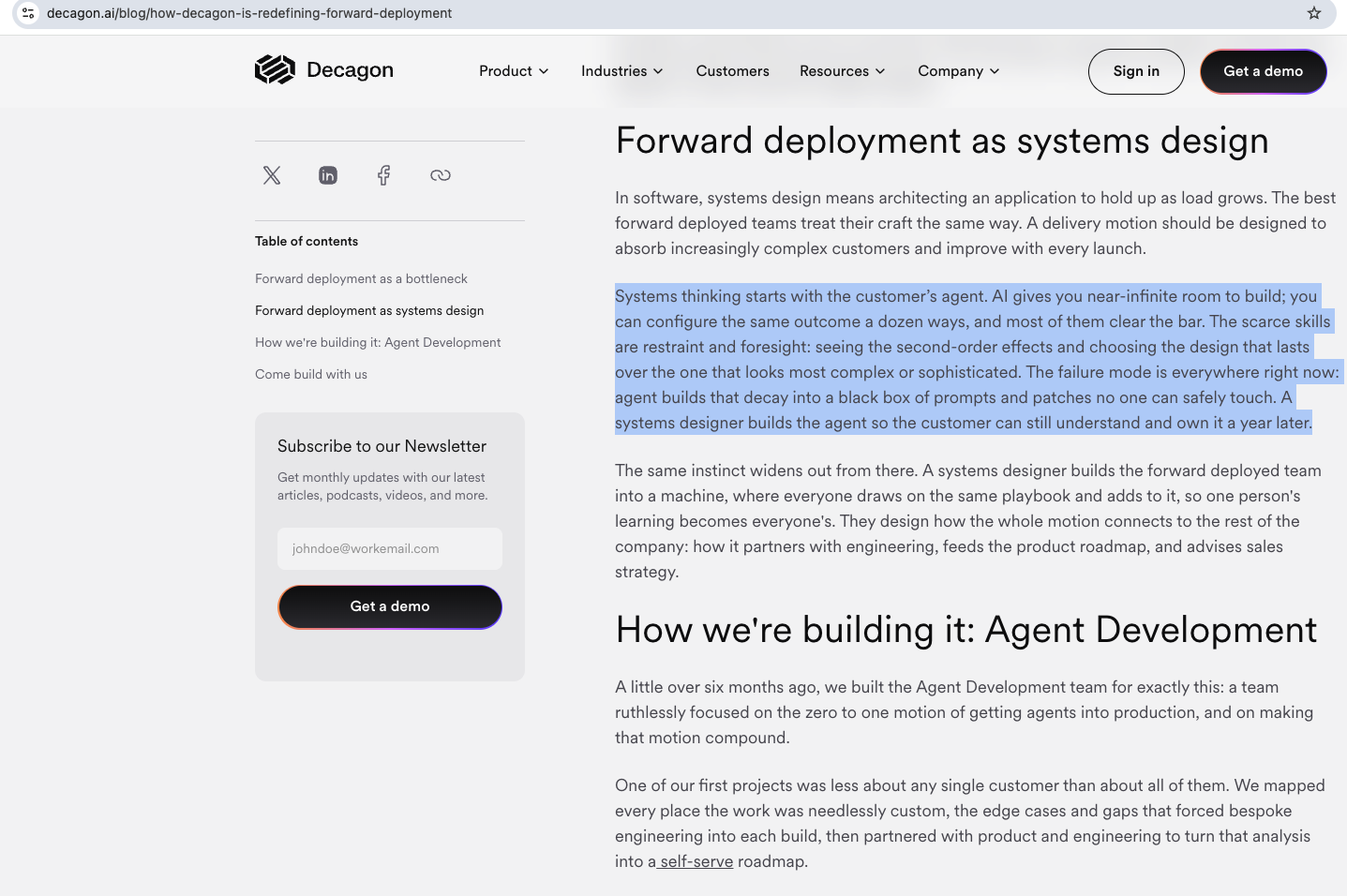
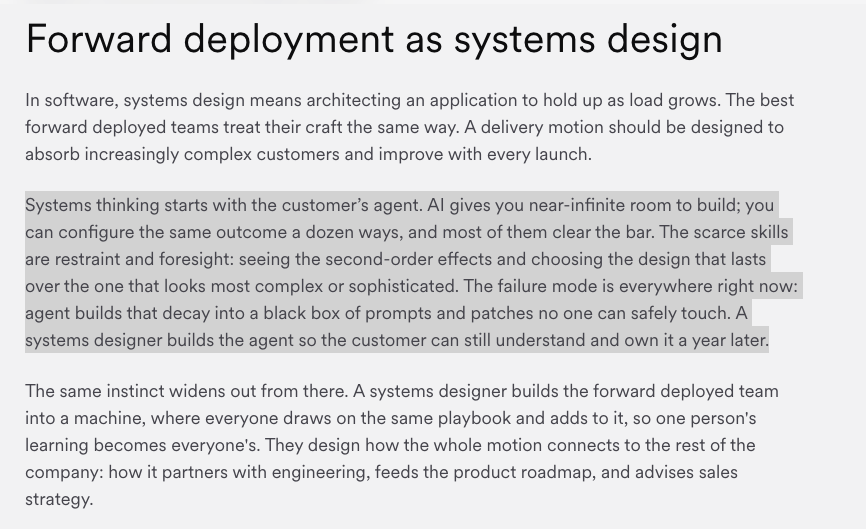
In practice this means two things simultaneously.
- Building agents that clients can understand and own a year later — not a black box of prompts and patches that no one can safely touch. The scarce skills are restraint and foresight — seeing second-order effects and choosing the design that lasts over the one that looks most sophisticated.
- Building the delivery team itself as a machine. Where everyone draws on the same playbook and adds to it. Where one person's learning becomes everyone's. Where the whole motion connects to engineering, feeds the product roadmap, and advises sales strategy.
This is what Decagon means by Agent Development.
It is forward deployment rebuilt as a systems discipline rather than a heroic embedding model.
The Two Roles: ADM and ADE — What Each One Actually Does
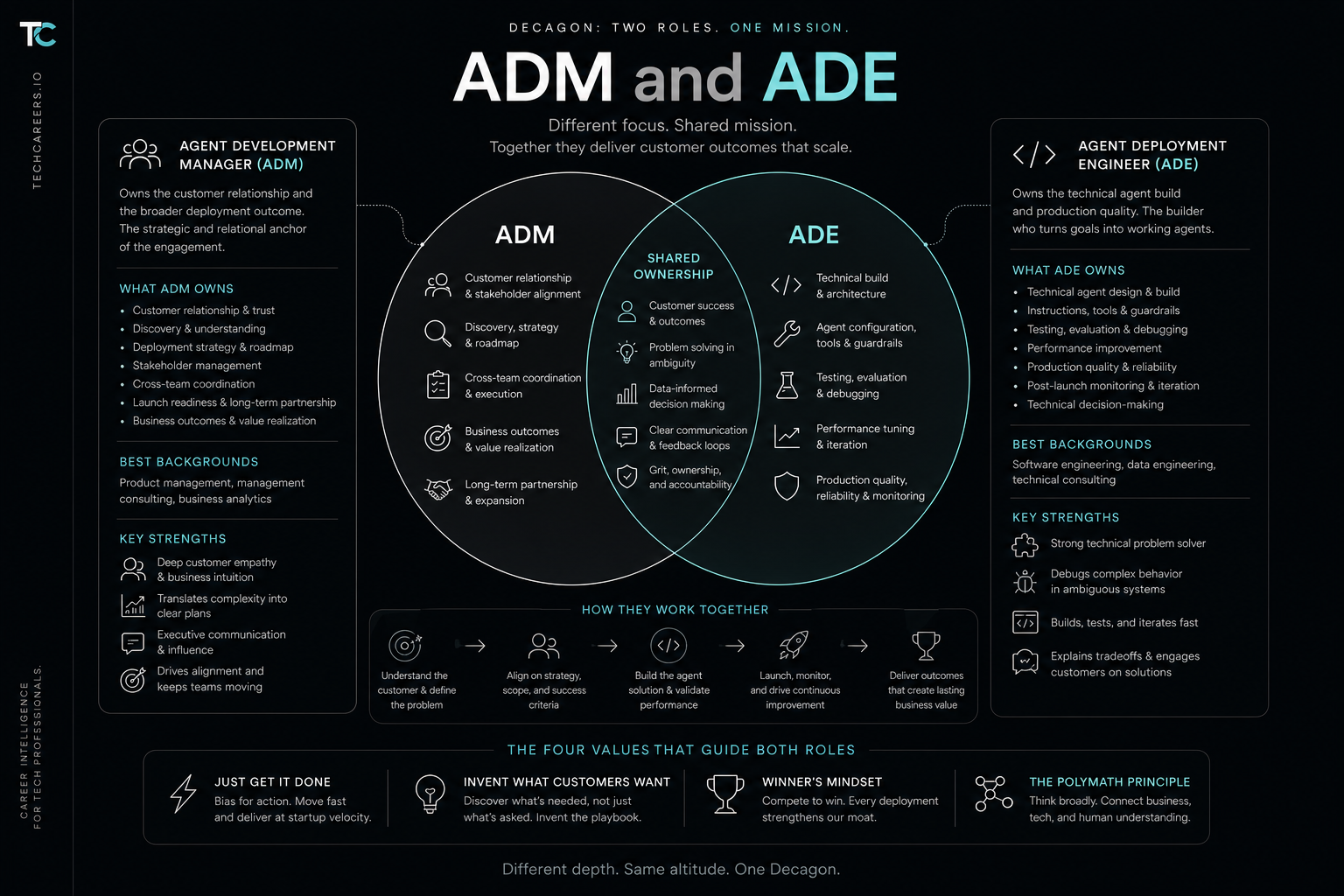
Decagon has separated the Agent Development function into two distinct roles.
Understanding which one fits your background is the most important decision you can make before applying.
The Agent Development Manager (ADM)
- The ADM owns the customer relationship and the broader deployment outcome.
- They sit with clients to understand business goals, coordinate work across teams, keep everything moving toward launch, and own the long-term partnership.
- The ADM is the strategic and relational anchor of the engagement.
The ADM profile:
- strong business intuition, deep customer empathy, the ability to translate messy organizational reality into a clear deployment plan, and the communication skills to manage executive relationships through a complex implementation.
- This is the role that most naturally maps to a product management or management consulting background.
- The ADM is not primarily a builder. They own the outcome. The ADE is the builder.
The Agent Deployment Engineer (ADE)
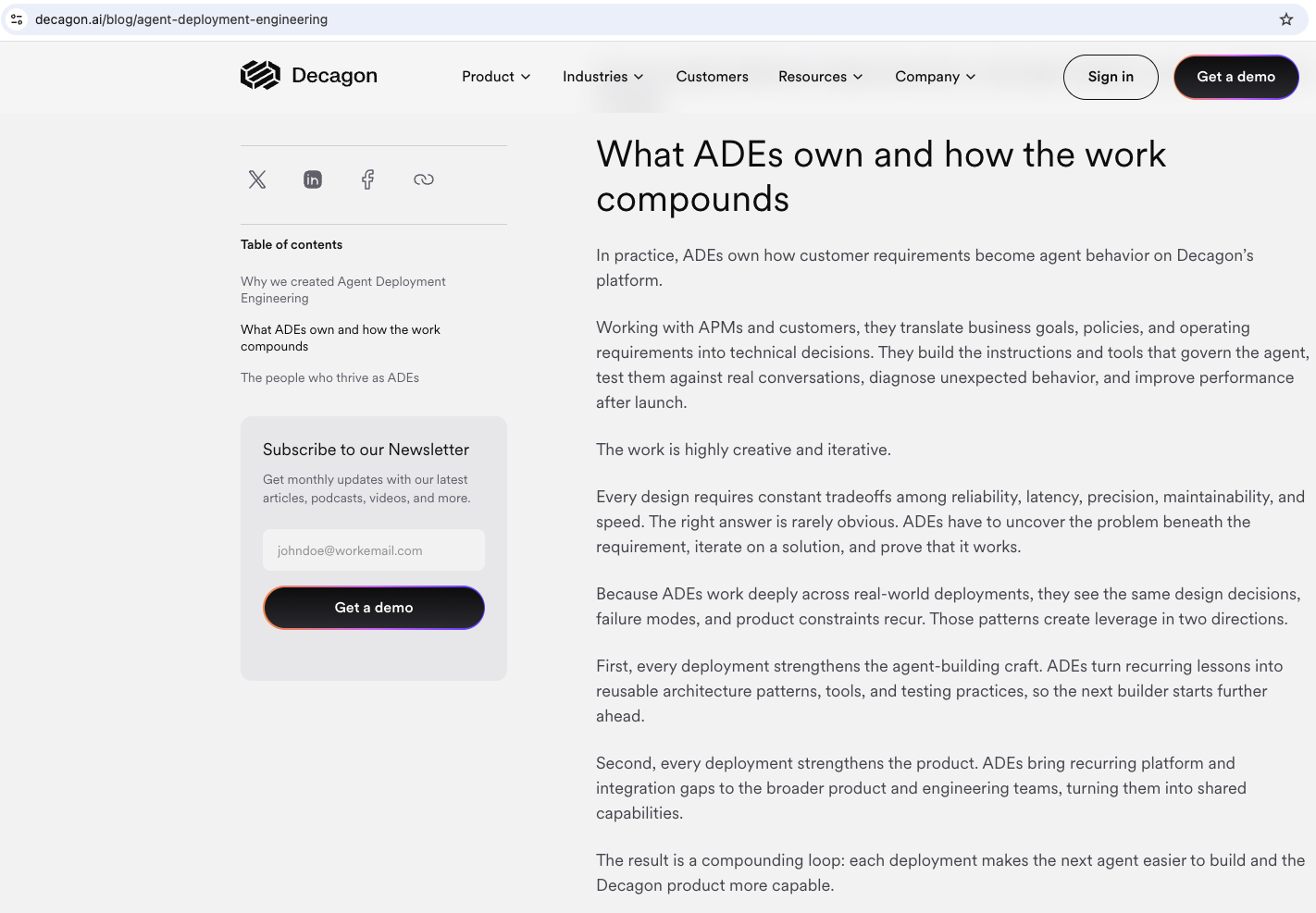
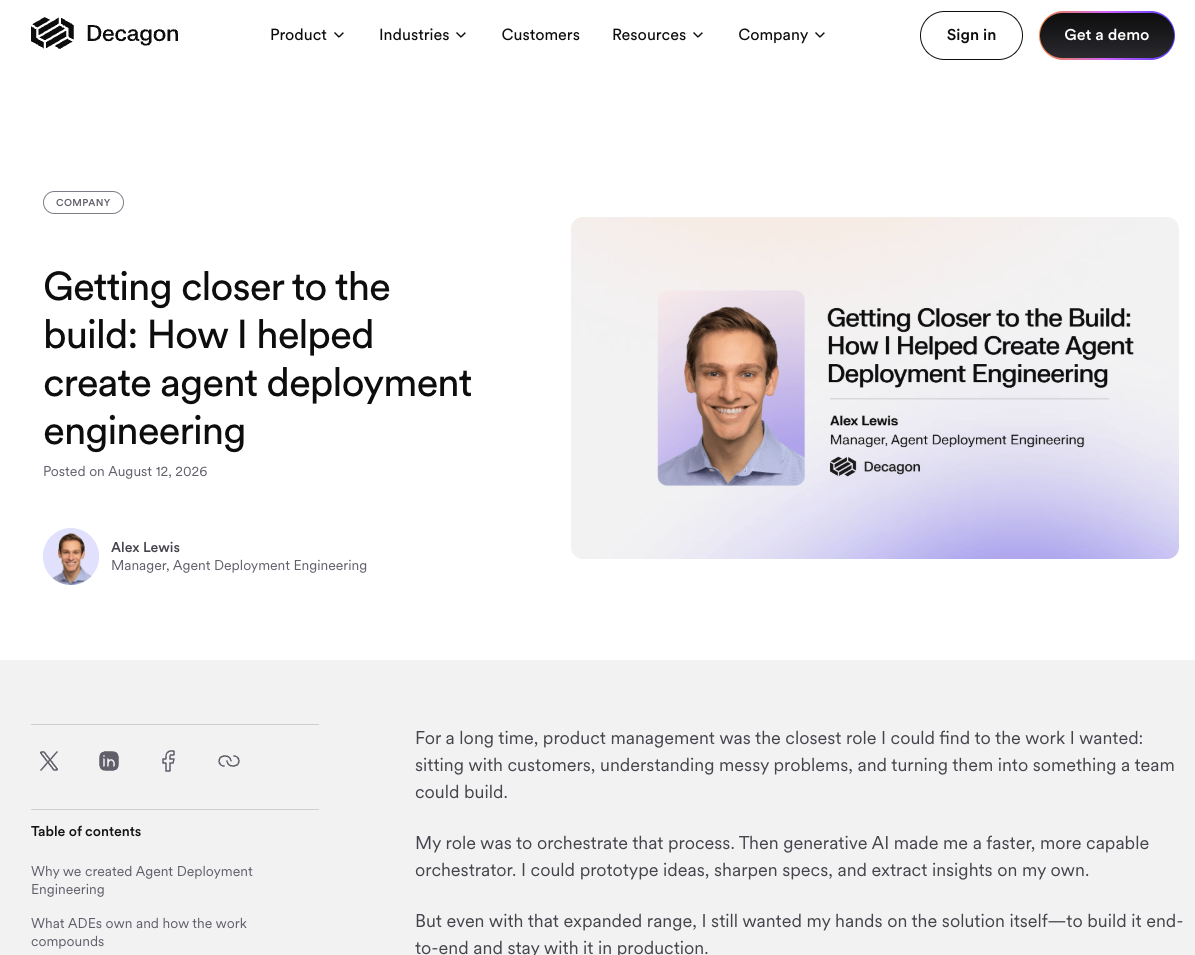
- The ADE owns the technical agent build. Working alongside APMs and customers, they translate business goals, policies, and operating requirements into technical decisions.
- They build the instructions and tools that govern the agent, test them against real conversations, diagnose unexpected behavior, and improve performance after launch.
https://decagon.ai/blog/agent-deployment-engineering
The ADE Profile:
- Comes directly from Alex Lewis, Decagon's Manager of Agent Deployment Engineering, published August 12, 2026 — four days ago at the time this blog was written.
- The people who thrive as ADEs are technical thinkers who are energized by hard customer problems and comfortable navigating ambiguity.
- They are tinkerers who cannot stop building and testing.
- They have strong debugging instincts and enjoy reasoning through unfamiliar systems.
- When something fails in production, they want to trace the behavior to its source and fix it.
- They can move from a technical investigation into a customer conversation, uncover the problem beneath the initial request, and explain the tradeoffs behind their solution.
- Above all, they have the grit to own the outcome.
- The ADE is not a traditional software engineer who also does some client work.
- The ADE is specifically the technical build owner in a two-role pairing where the ADM handles the relationship layer.
- This distinction is what allows each role to go deeper than a single FDE trying to do both simultaneously.
https://decagon.ai/blog/agent-deployment-engineering
The Two Roles Compared: Which One Fits Your Background
| Dimension | Agent Development Manager | Agent Deployment Engineer |
|---|---|---|
| Primary ownership | Customer relationship and deployment outcome | Technical agent build and production quality |
| Day-to-day | Discovery, stakeholder management, roadmap, coordination | Building, testing, debugging, improving agent behavior |
| Technical bar | Strong analytical fluency, SQL, platform familiarity | Production engineering, LLM architecture, agent debugging |
| Best backgrounds | Product management, management consulting, business analytics | Software engineering, data engineering, technical consulting |
| Communication emphasis | Executive and business stakeholder facing | Technical and customer facing — but in a more bounded way |
| Career analogy | Product Manager embedded at a client | FDE who goes deeper on the technical build specifically |
Failure Mode for ADMs versus ADEs
- The failure mode for ADMs is being too process-oriented and not business-intuitive enough.
- The failure mode for ADEs is being technically strong but unwilling or unable to engage directly with customers about what they built and why.
Both roles require what Decagon calls The Polymath Principle — broad thinking across disciplines rather than narrow specialization. If you are the kind of professional who is energized by end-to-end ownership of a complex problem across its full surface area, both roles are worth pursuing. Which one to pursue depends on where your natural depth lies.
What Decagon Is Looking for in Both Roles: The Four Values That Drive Every Interview
Decagon's four core values are not decorative. They shape every hiring decision and every behavioral component of the interview.
Just Get It Done. Decagon operates at startup velocity inside enterprise deployments. The ADM and ADE who is still deciding on the perfect approach while a client's go-live date approaches is not the right person for this environment. Bias for action — the same instinct that Palantir values in FDE candidates — is equally essential at Decagon.
Invent What Customers Want. This is the value that most directly distinguishes the ADM and ADE from a traditional implementation role. Decagon is not asking its delivery team to execute a predefined playbook. They are asking them to invent the playbook — to discover what each client actually needs rather than what they initially asked for, and to build systems that generalize beyond the immediate request.
Winner's Mindset. Decagon is in a competitive market against Sierra, Salesforce Agentforce, and Fin. The delivery team is part of the competitive moat — every deployment that goes live faster and performs better than a competitor's is a competitive win. The ADE and ADM who approach their work with this frame are the ones who compound Decagon's advantage.
The Polymath Principle. The people who thrive at Decagon — whether they come from software engineering, product management, consulting, or operations — share one characteristic. They think broadly. They care about the business logic as much as the technical implementation. They are as comfortable in a customer conversation as they are in a debugging session. This is the hardest instinct to develop and the most valued one at Decagon.
What the Interview Actually Tests
The Decagon interview for ADM and ADE roles tests practical engineering and product judgment over textbook algorithm preparation. Here is what to expect at each stage.
The Recruiter Screen
Thirty minutes covering background, motivation, and role fit. Decagon filters on motivation as aggressively as Palantir does. Coming in with genuine specific knowledge of what Decagon does, why the Agent Development model is different from traditional FDE, and why you specifically want to build in this environment — not at a generic AI company — is the first differentiator.
The Technical or Role-Specific Rounds
For ADE candidates, expect practical coding problems oriented toward real-world agent scenarios rather than abstract algorithms. Designing a chatbot system for a single enterprise customer. Building a multi-tenant AI gateway. Working through a system design problem focused on LLM agent architecture — reliability, latency, failure handling, evaluation frameworks. The technical bar is high. The orientation is toward production systems and real customer constraints rather than competitive programming.
For ADM candidates, the evaluation shifts toward business judgment and structured problem-solving. How do you scope a deployment when the client cannot clearly articulate what they need? How do you prioritize which agent behaviors to build first? How do you communicate a technical constraint to a non-technical executive in a way that maintains the relationship while setting accurate expectations?
The Past Project Deep-Dive
Both roles require a substantive walkthrough of a previous project. Not the summary version. The full technical and relational story. What was the problem? What did you build or design? What decisions did you make and why? What failed and how did you recover? What did you learn that made the next engagement better?
The Decagon interviewer is specifically evaluating whether you have the systems thinking instinct that the Agent Development model requires. Did you design something that could be reused? Did you turn a one-time solution into something that compounded? Did you document what you learned in a way that made it available to the next person?
That compounding instinct is what Decagon is hiring for. The ADE who solves one customer's problem brilliantly and moves on is less valuable than the ADE who solves one customer's problem and turns that solution into a reusable pattern that makes every future customer's agent better.
The Salary Reality: What Decagon ADM and ADE Roles Pay
Decagon's compensation reflects the high technical and strategic bar the roles require.
Based on 125 public Decagon job postings as of June 2026, the median salary at Decagon is $265,000 with a typical range of $209,000 to $300,000 in base salary. Equity is separate and significant given Decagon's $4.5 billion valuation and the trajectory it is on.
For reference, this puts Decagon ADM and ADE compensation meaningfully above traditional FDE compensation at mid-market companies and in the same range as Palantir FDE compensation at the mid-level — with the added upside of pre-IPO equity at a company that tripled its valuation in a single round in January 2026.
The Decagon salary bands reflect several things simultaneously. The technical depth the ADE role requires. The strategic judgment the ADM role demands. The competitive market for people who can do either. And Decagon's explicit positioning as a premium destination for technical professionals who want to build at the frontier of enterprise AI — not manage implementations at a legacy SaaS company that has retrofitted an AI layer onto an existing product.
Why Decagon is One of the Most Strategically Important Companies in Your FDE Job Search Right Now
Most candidates think of the FDE job search as a funnel with Palantir at the top and everything else below it. This framing is outdated.
Decagon has placed the Agent Deployment Engineer and Agent Development Manager roles in the Paraform recruiting ecosystem alongside Palantir FDE roles. Through our recruiter relationship with Paraform, we have direct access to hiring manager intelligence for the specific ADM and ADE roles Decagon is actively filling right now — including the 12 open positions in their agent development function as of this writing.
The candidate who gets an ADE role at Decagon is not taking a consolation prize while they wait for Palantir to call. They are entering a $4.5 billion company at Series D with pre-IPO equity, building the most sophisticated production AI agent systems in the enterprise customer support market, and developing the systems thinking capability that the entire FDE ecosystem is moving toward.
https://decagon.ai/blog/series-d-announcement
The Palantir heroic embedding model and the Decagon systems thinking model are not competing philosophies about which one is right. They are two different expressions of the same fundamental work — getting AI to produce real outcomes inside real enterprise environments — and both require variations of the same core skill set. Understanding both makes you a stronger candidate for either.
Schedule Your Forward Deployed Engineering Strategy Session
If you want to understand which Decagon role — ADM or ADE — fits your specific background, and what the preparation looks like for the active positions they are filling right now, book a strategy session with our team.
Book your session here: https://consultation.techcareers.io/o-discover-fde/about
Submit your profile for Paraform consideration here: https://www.paraform.com/forms/cms9ccu9n00070bjur3ljopm2

Frequently Asked Questions
Does Decagon have forward deployed engineer roles?
No. Decagon does not use the title Forward Deployed Engineer. CEO Jesse Zhang has publicly argued that reliance on embedded FDEs is a sign of a weak product. Decagon's equivalent roles are the Agent Development Manager and the Agent Deployment Engineer — two distinct disciplines within their Agent Development function. Understanding this distinction before applying is essential because using FDE language in a Decagon interview signals that you have not done your research on the company's philosophy.
What is the difference between an Agent Development Manager and an Agent Deployment Engineer at Decagon?
The ADM owns the customer relationship and the broader deployment outcome — discovery, stakeholder management, coordination, and long-term partnership. The ADE owns the technical agent build — translating customer requirements into production-ready agent behavior, building and testing instructions and tools, diagnosing unexpected behavior, and improving performance after launch. The two roles are designed to be paired on complex deployments, allowing each discipline to go deeper than a single FDE trying to do both simultaneously.
What backgrounds does Decagon hire for ADM and ADE roles?
ADM candidates typically come from product management, management consulting, business analytics, or operations backgrounds with strong business intuition and customer empathy. ADE candidates typically come from software engineering, data engineering, or technical consulting backgrounds with strong debugging instincts and enthusiasm for working directly with customers. Both roles require what Decagon calls The Polymath Principle — broad thinking across disciplines rather than narrow specialization.
What is the Decagon ADE interview process?
The Decagon ADE interview includes a recruiter screen covering background, motivation, and role fit, followed by technical rounds that emphasize practical AI agent engineering over abstract algorithms. Expect system design questions focused on LLM agent architecture, reliability, failure handling, and evaluation frameworks. A past project deep-dive evaluates end-to-end ownership and whether you turned individual solutions into reusable systems. The behavioral components of the interview evaluate Decagon's four values: Just Get It Done, Invent What Customers Want, Winner's Mindset, and The Polymath Principle.
What does Decagon pay ADM and ADE roles?
Based on 125 public Decagon job postings as of June 2026, the median salary at Decagon is $265,000 with a typical range of $209,000 to $300,000 in base salary. Equity is separate and significant given Decagon's $4.5 billion valuation. This puts Decagon compensation in the same range as Palantir FDE compensation at the mid-level with the added upside of pre-IPO equity at a company that tripled its valuation in a single January 2026 round.
What is Jesse Zhang's argument against forward deployed engineers?
Jesse Zhang, Decagon's CEO, argues that reliance on embedded FDEs is a sign that the product itself cannot stand on its own — that it requires heroic human effort to compensate for product gaps rather than delivering self-serve value that clients can operate independently. His bet was that building a strong enough product and a systems-thinking delivery team would allow Decagon to scale without the bespoke engineering bottleneck that traditional FDE models create. The result was $100 million in annualized revenue and a $4.5 billion valuation at a company less than three years old.
How does Decagon's Agent Development model differ from Palantir's FDE model?
The Palantir FDE model embeds a single engineer who owns both the customer relationship and the technical build — a heroic model that scales through headcount. Decagon's Agent Development model pairs an ADM who owns the customer relationship with an ADE who owns the technical build — a systems model that scales through better systems and compounding playbooks rather than more people. Both models require the same core combination of technical depth and customer-facing communication. The primary difference is whether that combination lives in one person or is split across two specialists with deeper depth in each dimension.