
Do You Need a Coding Background to Become a Forward-Deployed Engineer? The Answer Will Surprise You
In the past 30 days alone, more than $9 billion has been deployed into onboarding forward-deployed engineers.
- Amazon has committed $1 billion to solving this problem.
- Microsoft is spending $2.5 billion and hiring 6,000 employees for their own forward-deployed engineering army — internally called the Microsoft Frontier Company.
- This is not a trend. This is not a LinkedIn hype cycle. This is a structural, multi-billion-dollar bet made by the largest technology organizations on the planet — and they do not make bets like this on fads.
📅 Schedule Your FDE Career Strategy Session →
The call is 45 minutes. It's free. You will leave with a specific, actionable picture of what your FDE transition looks like — and whether the program is the right vehicle to get you there.
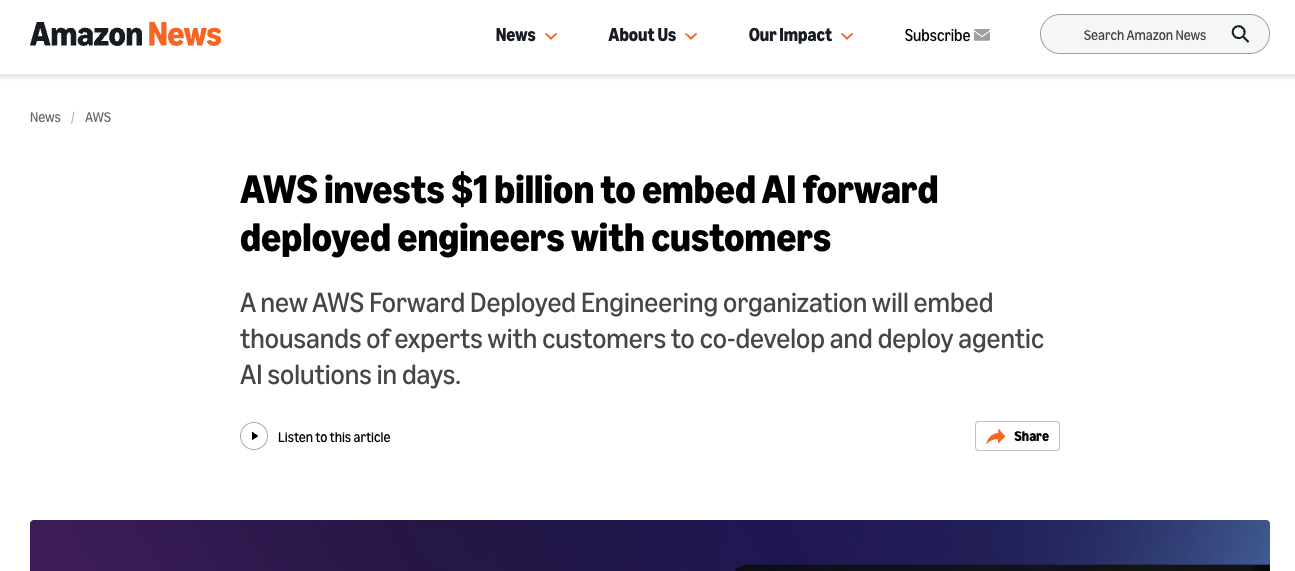
Amazon committed $1 billion.
Amazon Web Services announced a $1 billion investment in a dedicated Forward Deployed Engineering organization on June 30, 2026 — embedding AWS engineers directly inside customer teams like the NFL and Southwest Airlines to compress AI deployment timelines from months to days.
https://www.aboutamazon.com/news/aws/aws-1-billion-forward-deployed-ai-engineers
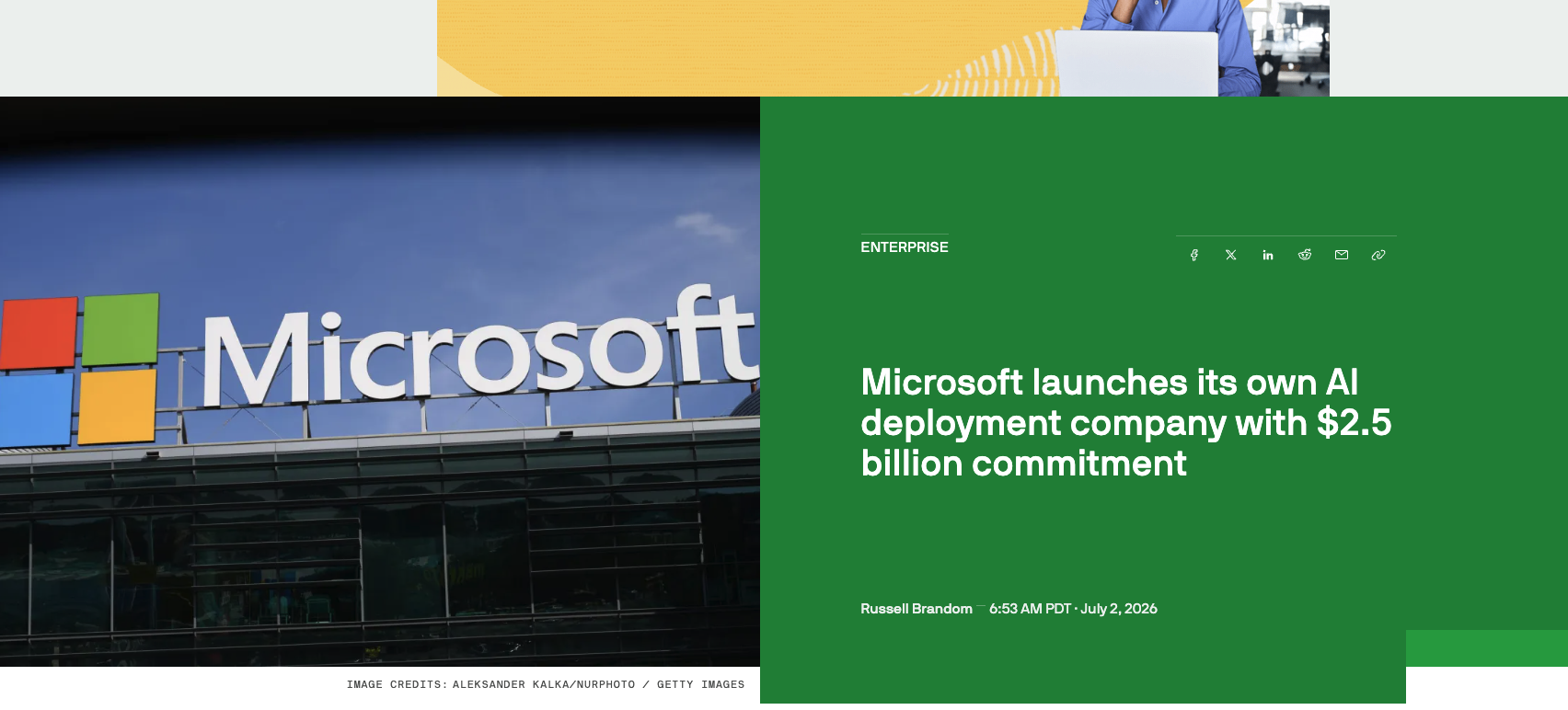
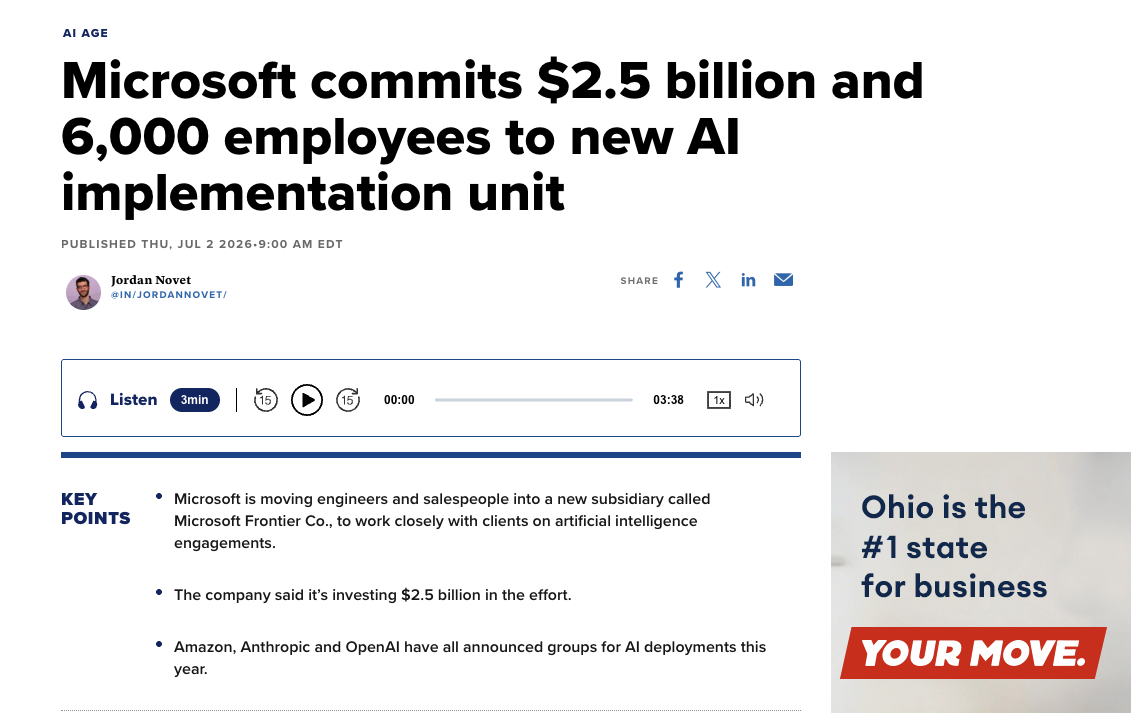
Microsoft committed $2.5 billion and 6,000 people.
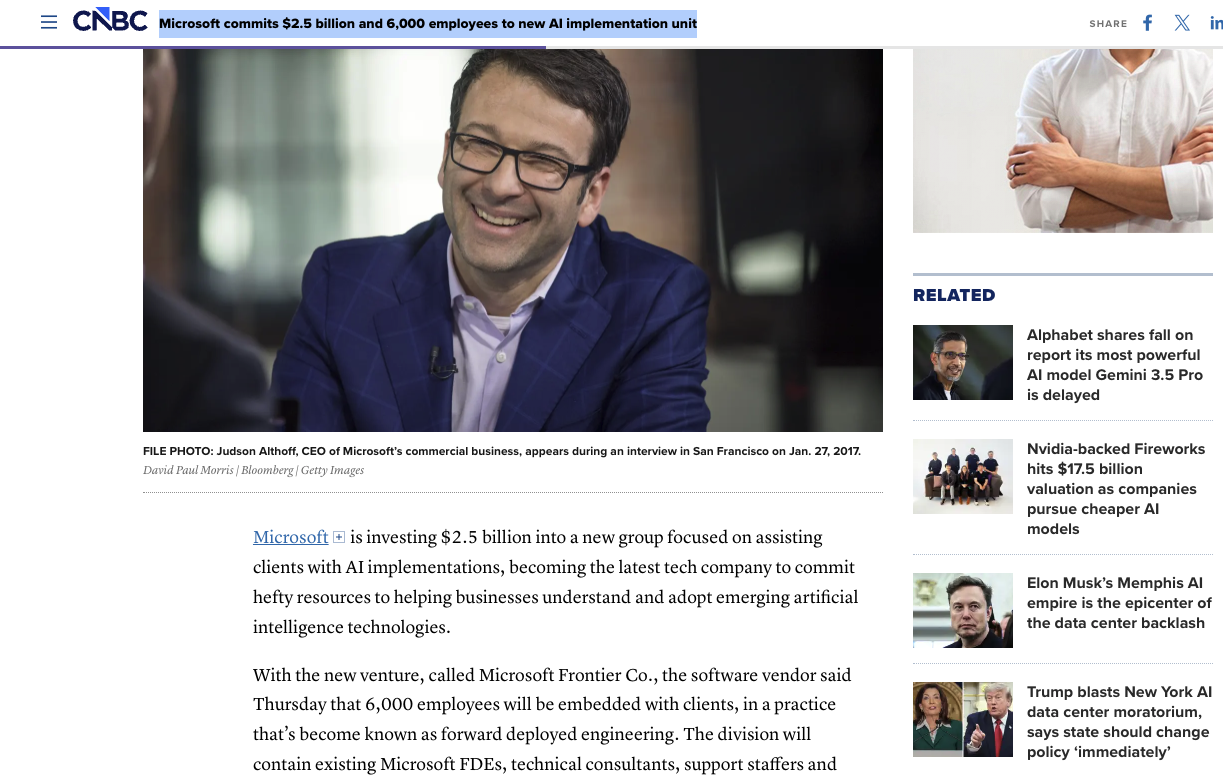
Two days later, Microsoft launched Microsoft Frontier Company: a $2.5 billion commitment and 6,000 engineers and industry specialists, embedded directly with enterprise clients including the London Stock Exchange Group, Unilever, and Accenture.
Microsoft's own Commercial Business CEO didn't shy away from the comparison — he explicitly positioned it against "what has been labeled as Forward-Deployed Engineering," while building essentially the same model at even greater scale.
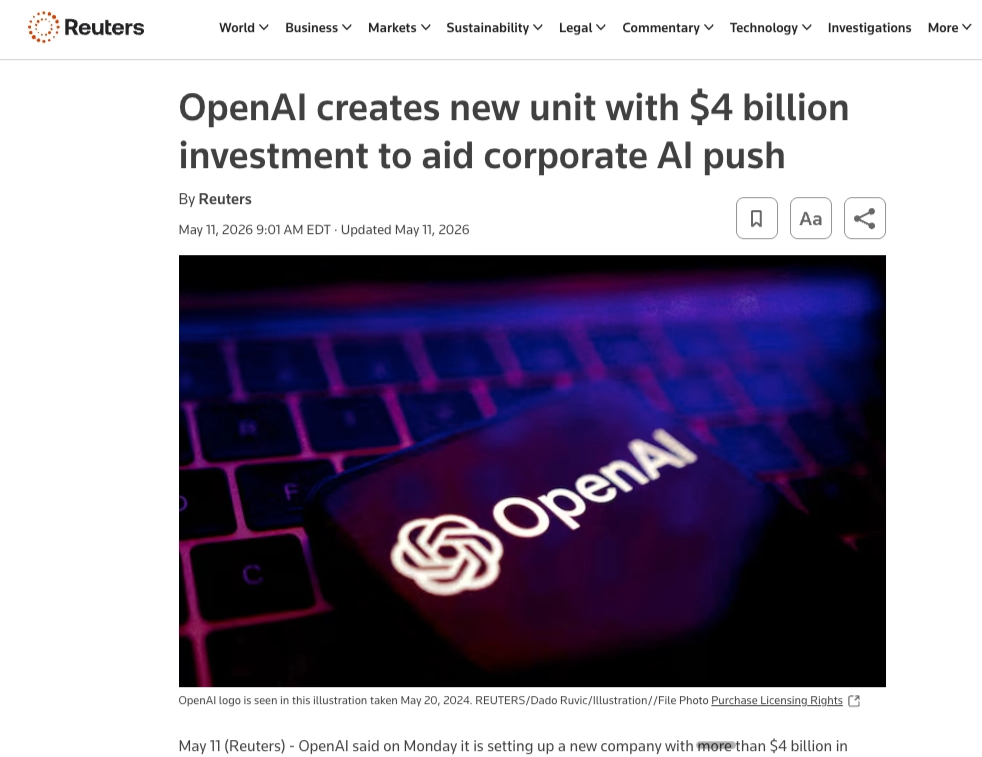
OpenAI stood up a new company backed by more than $4 billion.
OpenAI moved first, in May 2026, launching the OpenAI Deployment Company — backed by more than $4 billion from a 19-firm syndicate led by TPG, with Bain Capital, Brookfield, Goldman Sachs, and McKinsey among the partners.
OpenAI acquired an existing FDE consultancy, Tomoro, to staff it immediately with roughly 150 forward-deployed engineers, with plans to scale into the thousands.
https://openai.com/index/openai-launches-the-deployment-company/
Anthropic partnered with Goldman Sachs and Blackstone on a $1.5B FDE venture of its own.
Anthropic answered with its own venture — a partnership with Goldman Sachs, Blackstone, and Hellman & Friedman — built around embedding engineers inside mid-sized companies that lack in-house AI deployment capability.
https://www.anthropic.com/news/enterprise-ai-services-company
All four moves were aimed at exactly one thing: forward-deployed engineering.
- Four companies.
- Over $9 billion in combined capital commitment.
- Thousands of open roles.
- All in the same 60-day window, all racing toward the same job function.
The question we get on almost every single consultation call right now is this:
"I don't have a coding background. Is it even possible for me to break into forward-deployed engineering and earn $350,000 to $1,000,000 a year?"
The answer may be the most important thing you read about your career this year.
The Honest Answer: Right Now, You Don't Need a Coding Background — But the Window Is Closing
A forward-deployed engineer does not succeed or fail based on their ability to write code. They succeed or fail based on their ability to drive AI adoption inside a client organization — and that requires communication, influence, and business acumen far more than it requires a computer science degree.
Here is what is happening in the market right now, in plain terms.
Companies are pouring billions of dollars into AI products. And they are hitting a wall. The wall isn't technical. The wall is adoption. Enterprises are spending enormous amounts on AI infrastructure and struggling to justify the ROI because their internal teams don't know how to use the tools they've been sold.
Uber COO is saying it's getting harder to justify the money spent on AI token maxing, and he's not alone.
https://www.businessinsider.com/uber-coo-andrew-macdonald-ai-token-spending-harder-justify-2026-5

Forward-deployed engineers exist to solve that problem. They embed at the client site. They train the team. They identify where the AI solution generates revenue and where it saves cost. They translate between the technical world and the business world.
And here is the reality the market has discovered, confirmed by pattern after pattern in active hiring data:
- It is significantly faster and easier to teach a business-savvy professional how to code than it is to teach a software engineer how to communicate, sell, and train people.
That sentence is not a stereotype. It is a hiring conclusion that companies are acting on with billions of dollars.
Why Non-Technical Professionals Are Winning FDE Roles Over Software Engineers Right Now
Go to Reddit today and search "software engineer forward deployed engineering." You will find thread after thread of technically exceptional engineers — people who know six coding languages, who have shipped production systems, who have years of backend experience — asking why they keep losing FDE interviews to management consultants and investment bankers with no formal coding background.
https://getperspective.ai/blog/2026-forward-deployed-engineering-compensation-report-1200-fdes
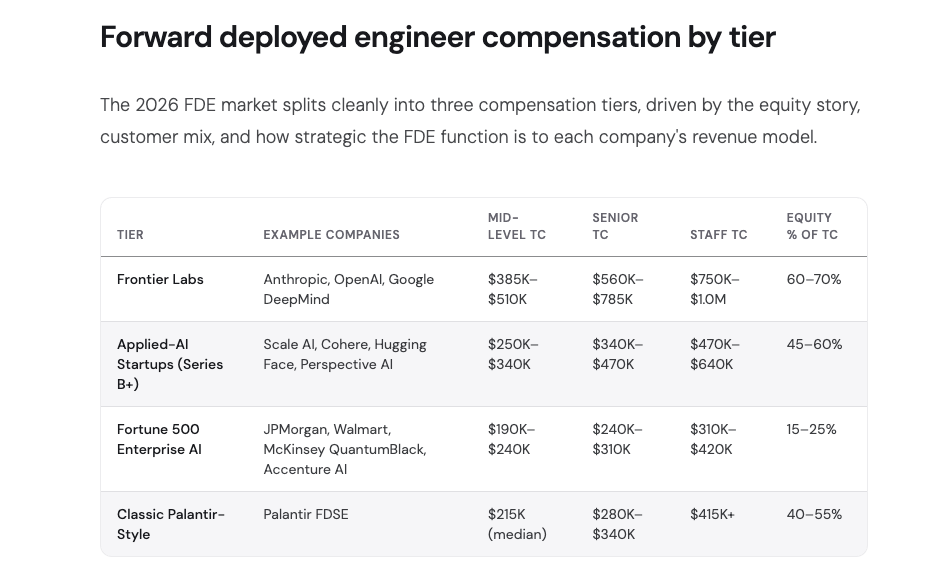
The reason is not unfair. The reason is structural.
A forward-deployed engineer's primary job function is not to build software. It is to:
- Deploy onto a client site and build trust with people who don't share your technical background
- Identify where AI can generate revenue or reduce cost for that client's specific business model
- Train an entire team of non-technical professionals to become power users of a complex AI product
- Surface expansion opportunities that generate new revenue for your employer
Every one of those functions requires you to walk into a room full of skeptical business people and make them feel capable, inspired, and understood — not impressed by your technical credentials.
📅 Schedule Your FDE Career Strategy Session →
The call is 45 minutes. It's free. You will leave with a specific, actionable picture of what your FDE transition looks like — and whether the program is the right vehicle to get you there.
Most software engineers chose their profession, in part, because they preferred systems to people. That is not a character flaw. It is a natural professional gravity — and it is precisely why the role is so difficult for many engineers to transition into, and why it commands the compensation it does.
Meanwhile, product managers, management consultants, investment banking analysts, and customer success managers have been doing client-facing, influence-without-authority work for their entire careers. The communication infrastructure is already built. The remaining gap — technical fluency in AI tools — is a gap the market has determined can be closed in weeks, not years.
That is the window. And it is open right now.
The Real Urgency: This Window Has a Hard Expiration Date
If you're reading this and thinking "I'll get to this eventually" — understand what "eventually" costs you.
The non-technical professionals who recognize this opportunity fastest are entering FDE roles now, while the barrier to entry is at its lowest point. Once they're inside — once they've completed their first client deployments, built their technical proficiency on the job, and established a track record — the barrier rises again.
By the time the market normalizes, the candidates competing for FDE roles will be former management consultants who now also know how to build AI agents. Former investment bankers who can deploy LLM pipelines. Former customer success managers who have three years of FDE deployment experience.
The window right now is: you can enter with the soft skills in place and build the technical layer during the transition. The window later is: you need both fully built before you're considered.
If you are going to make this move, the next 60 to 90 days are not arbitrary. They are the difference between entering a role worth $350,000 to $1,000,000 annually, or watching that door close while you wait for the "right time."
There is no right time. There is only now and later — and later costs more.
You're not too late. But you're not early either.
The professionals booking consultations this week are the ones who will look back in 18 months and say they got in at exactly the right moment.
📅 Schedule Your Free FDE Career Strategy Session →
45 minutes. No obligation. You'll leave with a clear picture of what the realistic path looks like for your specific background.
"But I'm Not Technical Enough" — Let's Talk About That Fear Honestly
We speak with professionals every week who are afraid to even book a call because they assume they'll be told they don't qualify.
Some of those people are 26 years old, three years into a customer success role at a SaaS company, and convinced they're "too junior" to be having this conversation.
Some of those people are 47 years old, 20 years into a management consulting career, and convinced they're "too old" to pivot into anything AI-related.
Both of those people are wrong. And both of those fears are understandable.
If you are earlier in your career: You are entering the market at the most opportune moment in a generation. You have the highest adaptability, the lowest sunk cost in your current trajectory, and the most time to build a compounding advantage in FDE. The professionals who entered Palantir as forward-deployed engineers in their mid-20s went on to become Field CTOs, agency founders, and startup founders by their mid-30s. You are not too early. You are positioned.
If you are later in your career: Your lived experience in client management, business development, stakeholder navigation, or industry-specific domain knowledge is not a liability. It is the exact advantage that entry-level candidates cannot replicate. A 45-year-old former management consultant who speaks the language of a CFO fluently — and who has now built AI agent proficiency — is not a marginal candidate. They are an exceptional one. The FDE role rewards depth of judgment, and judgment compounds with experience.
The fear is real. We hear it on every call. But fear and disqualification are not the same thing.
The Technical Skills You Actually Need — And How Fast You Can Build Them
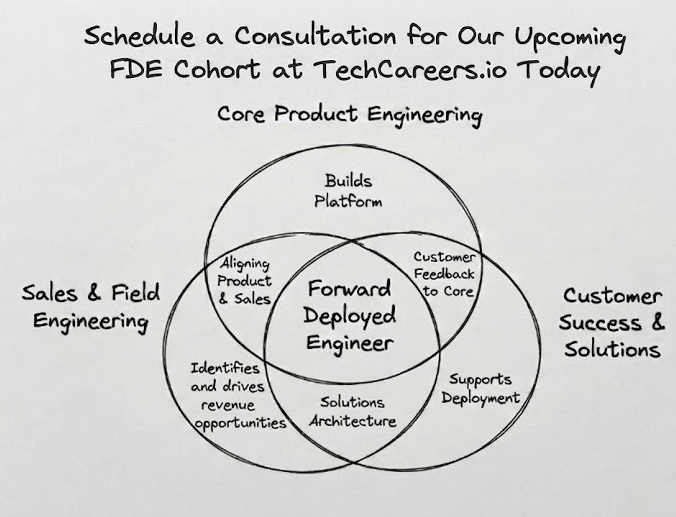
Here is the baseline of what forward-deployed engineering roles expect from non-technical candidates in 2026:
What you need to demonstrate:
- The ability to use AI tools at a power user level — Claude, ChatGPT, Perplexity, and their API layers
- Working familiarity with no-code and low-code AI deployment tools — Claude Code, Cursor, Vercel
- The ability to build and deploy a basic AI agent — not from scratch in raw Python, but using the orchestration tools that exist now specifically to make this accessible
- A framework for learning new AI tools quickly and identifying which ones are substantive versus hype
- The ability to run an AI training session for a non-technical audience and leave them more capable than when you started
What you do not need to demonstrate (yet):
- A computer science degree
- Python proficiency at a production-engineering level
- Experience shipping code in a professional software development environment
- A GitHub profile with years of open-source contributions
The technical bar is rising. It will be higher in 18 months than it is today. But today, the gap between what a motivated non-technical professional can build in 60 to 90 days of focused effort and what the market requires to enter an FDE role is the smallest it has ever been — and the smallest it will ever be again.
This is not a permanent condition. It is a temporary window created by an emergency-level demand for AI adoption talent that the purely technical workforce cannot fill fast enough.
The Skills You Already Have That Are Worth More Than You Think
Let's be direct about something the engineering community rarely acknowledges publicly.
The complaints that come from client organizations about forward-deployed engineers are almost never about technical capability. They are about communication, engagement, and the ability to make a non-technical team feel inspired rather than condescended to.
📅 Schedule Your FDE Career Strategy Session →
The call is 45 minutes. It's free. You will leave with a specific, actionable picture of what your FDE transition looks like — and whether the program is the right vehicle to get you there.
The feedback companies receive from clients who reject forward-deployed engineers is consistent: too boring, too unengaging, too condescending. These are not technical failure modes. They are communication failure modes.
If you have spent years in roles that required you to:
- Present a business case to a skeptical executive team
- Manage a client relationship through a difficult delivery
- Translate complex analysis into language a non-specialist can act on
- Train a team on a new process or tool
- Identify a revenue opportunity and surface it to the right decision-maker
...then you have already been practicing the core competencies of forward-deployed engineering. You have been doing FDE work without the title and without the compensation.
The question is not whether you have the foundation. The question is whether you're going to formalize it, build the AI proficiency layer on top of it, and move before the window narrows.
Every week you wait is a week someone else with your exact background books a consultation, builds the technical layer, and lands the role you're thinking about.
📅 Book Your FDE Career Strategy Session Now →
We work with management consultants, customer success managers, investment banking analysts, sales engineers, and technical PMs making this transition every cohort. Your background is not the obstacle you think it is.
What the Market Is Telling You Right Now
The signal could not be clearer.
Amazon has committed $1 billion to this problem. Microsoft is deploying $2.5 billion and building a 6,000-person forward-deployed engineering function. Every major AI-native company — Palantir, OpenAI, Anthropic, Databricks, ElevenLabs — is actively hiring for this role, and the qualified candidate pipeline is not keeping pace with demand.
Meanwhile, every white-collar professional who does not build AI fluency in the next 12 to 24 months is going to find themselves in an increasingly difficult position. Not because AI will eliminate their role outright — but because the colleague sitting next to them who does have these skills will be 10 to 100 times more productive. They will get more done in less time, navigate faster promotions, and take on more leverage. The professional without these skills will be left managing a heavier workload at the same pace, with the same tools, watching the gap widen.
The question is not whether to build AI proficiency. It is whether you build it on your own timeline and apply it reactively — or whether you build it now, structured around an elite role category, with a program designed to compress that timeline from 18 months to 90 days.
Why This Isn't a Fad — And Why the Window Won't Stay Open
Every one of these signals points the same direction, and they're independently corroborated, not self-reported:
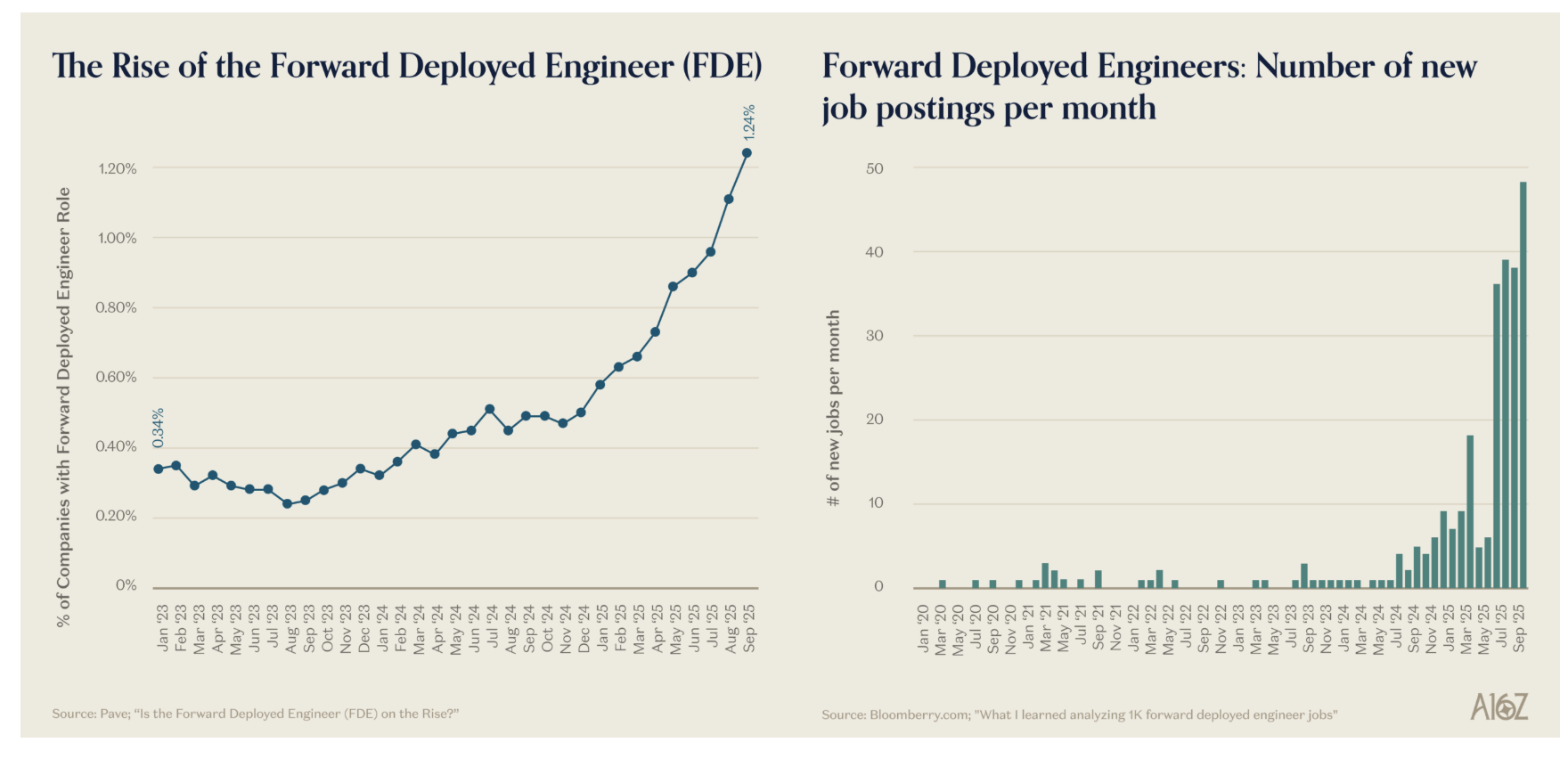
- A16Z's own data shows forward-deployed job postings climbing steadily over 13–18 months — not a spike, a sustained trend.
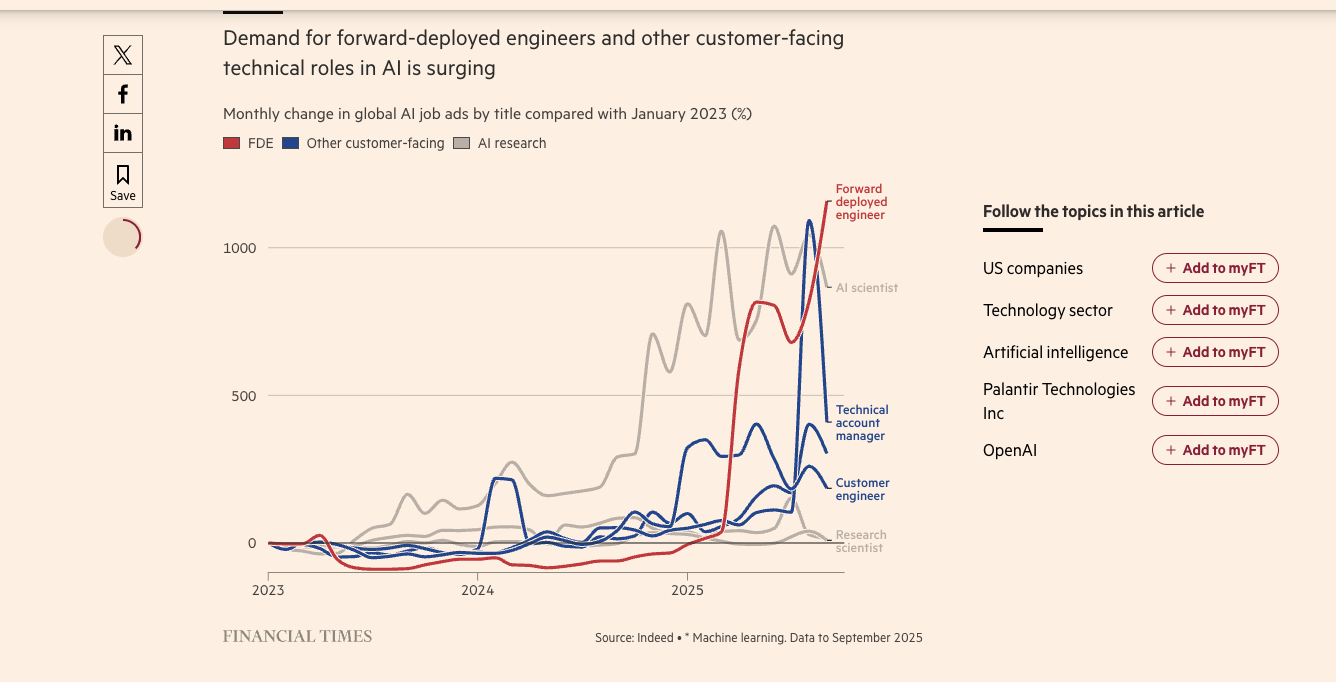
- The Financial Times has separately charted demand for FDEs and adjacent customer-facing AI technical roles surging since 2023, with the steepest acceleration in the past year.
- Business Insider reported FDE job postings up more than 700% year-over-year.
- And now, in the span of five weeks in mid-2026, four of the largest technology companies on earth have backed the model with real capital and real headcount targets.
https://a16z.com/forward-deployed-job-titles/
https://www.ft.com/content/91002071-7874-4cb7-9245-08ca0571c408?syn-25a6b1a6=1
https://www.businessinsider.com/forward-deployed-engineer-jobs-in-demand-2026-5
Here's the part that should create urgency, not panic: demand for this role is currently outpacing the supply of qualified candidates.
What We Help You Build in 90 Days
The Tech Careers FDE Accelerator is not a bootcamp. We do not teach you to code from scratch. We do not exist for professionals who are at the beginning of their technical journey.
We exist for professionals who already have the business acumen, the client-facing experience, or the communication foundation — and who want to build the AI proficiency layer on top of it, position themselves correctly for FDE candidacy, and move faster than the market.
Here is what the 90 days delivers:
Technical Foundation for Non-Technical FDE Candidates:
- AI tool mastery at the power-user and deployment level (Claude, Cursor, Claude Code, agentic AI)
- Portfolio projects built and published — targeted at specific companies you want to work for
- AI workshop hosting experience — using the Tech Careers platform to run real sessions with real audiences
FDE Positioning and Candidacy:
- ATS-optimized resume with FDE-specific bullet frameworks
- LinkedIn profile optimization for a client-facing, senior candidacy
- Direct outreach frameworks for hiring managers at target companies
- Mock FDE interviews — behavioral and technical — against the question formats used by Palantir, OpenAI, and Anthropic
The Intangibles:
- A cohort of peers in parallel transition — accountability, shared intelligence, and the psychological advantage of not doing this alone
- A program that has tracked rejection-to-rebook rates, interview conversion data, and candidate placement patterns across four years of FDE-specific coaching
We do not promise you a job. No ethical program does. What we compress is the timeline and the guesswork — and we do it with people who understand this market at the hiring level, not just the content level.
The Only Question Left Is Whether You Move Now or Move Later
There is no version of this where waiting is the better strategy.
If you are a management consultant, investment banker, customer success manager, sales engineer, or technical PM reading this: the market has already determined that your background is a faster path to FDE than a software engineer who has never faced a client. Act like it.
If you are a software engineer reading this who has struggled to break into FDE despite strong technical credentials: the gap is not your code. It is the communication layer. That gap is closable. But it requires an honest assessment of what you need to build — and a structured environment to build it in.
If you are uncertain whether this role is even realistic for your specific background: that is exactly what the consultation call exists to answer. We have had that conversation with hundreds of professionals. We will tell you the truth — even if the truth is that this is not the right move for you right now.
The market won't wait. Neither should you.
This is the moment. Not next quarter. Not after you finish the online course you've been putting off. Now.
📅 Schedule Your FDE Career Strategy Session →
The call is 45 minutes. It's free. You will leave with a specific, actionable picture of what your FDE transition looks like — and whether the program is the right vehicle to get you there.
Frequently Asked Questions
Do I need a coding background to become a forward-deployed engineer? Not immediately — but the window to enter without one is closing. As of mid-2026, companies are actively hiring non-technical professionals with strong client-facing backgrounds (management consulting, investment banking, customer success, sales engineering) because the demand for FDE talent exceeds the qualified technical supply. However, all candidates — technical and non-technical — must build AI tool proficiency. The technical bar will rise as more professionals enter the space.
Why are non-technical professionals winning FDE roles over software engineers? Because the primary FDE job function is client-side communication, team training, and revenue identification — not software development. Companies have found it faster to teach AI deployment skills to strong communicators than to teach communication and stakeholder management to engineers who entered the field specifically to avoid client-facing work.
What AI skills do I actually need to break into forward-deployed engineering without a coding background? Power-user fluency with AI platforms (Claude, ChatGPT, Perplexity), working familiarity with no-code and low-code deployment tools (Claude Code, Cursor, Vercel), the ability to build and deploy a basic AI agent, and demonstrated ability to train non-technical audiences on AI tools. This is a 60–90 day build for a motivated professional.
Am I too old to break into forward-deployed engineering? No. There is no age at which relevant business experience, client relationship depth, and communication maturity becomes a liability in this role. FDE hiring teams at AI-native firms are not looking for the youngest candidate — they are looking for the candidate most likely to be trusted by a client's executive team. Experienced professionals often have a structural advantage in that assessment.
Am I too early in my career to pursue this? No. Professionals entering FDE in their mid-20s are entering at the most favorable moment in the role's history. The career trajectory for early-career FDEs compounds rapidly — Field CTO, consulting agency founder, startup founder are all documented exit paths for professionals who entered FDE in their 20s.
What does your 90-day program specifically do for non-technical candidates? It builds AI proficiency at the deployment level, builds and publishes a targeted portfolio, develops the FDE positioning and outreach strategy, and prepares you for the behavioral and technical interview formats used by elite AI firms — all within a cohort structure that provides accountability and peer support throughout the transition.
How much do forward-deployed engineers make? Base compensation at elite AI firms ranges from $250,000 to $350,000. Total on-target earnings — including variable tied to expansion revenue — can exceed $1,000,000 annually for top performers.