
The Golden Age of Forward-Deployed Engineering Is Here — And the Window Is Closing Faster Than You Think
Amazon, Microsoft, OpenAI, & Anthropic Just Spent $9 BILLION on Forward Deployed Engineers
In the span of five weeks this summer, four of the most powerful companies in technology all made the same bet, within days of each other.
The Money Is Real — And It's Moving Right Now
Let's start where the evidence is hardest to argue with: capital.
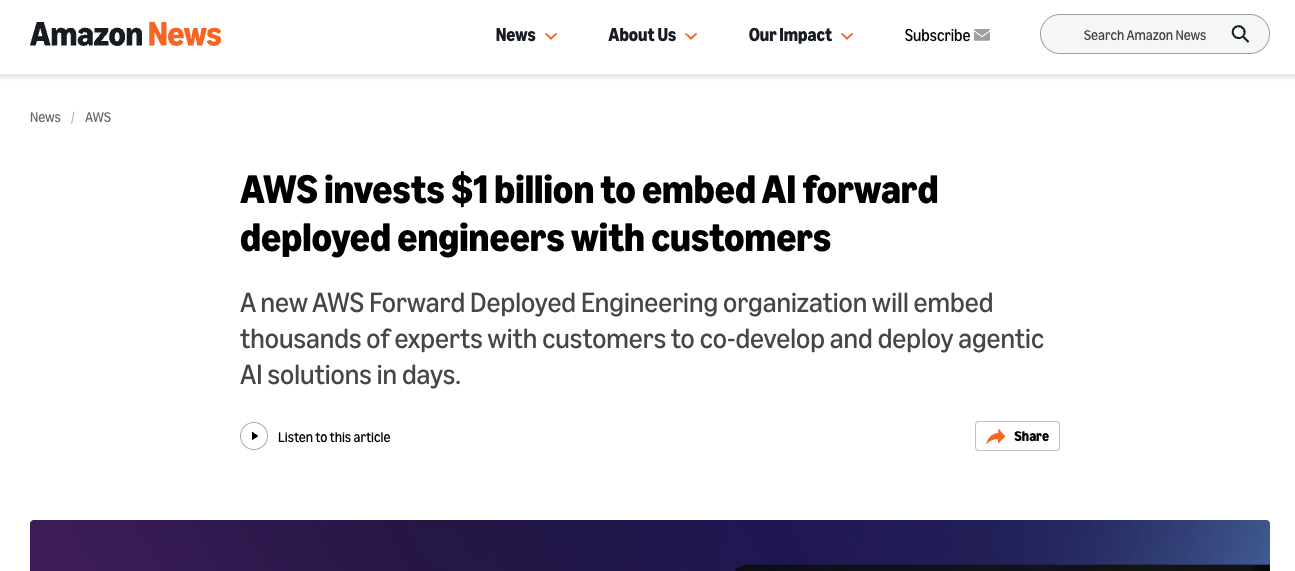
Amazon committed $1 billion.
Amazon Web Services announced a $1 billion investment in a dedicated Forward Deployed Engineering organization on June 30, 2026 — embedding AWS engineers directly inside customer teams like the NFL and Southwest Airlines to compress AI deployment timelines from months to days.
https://www.aboutamazon.com/news/aws/aws-1-billion-forward-deployed-ai-engineers
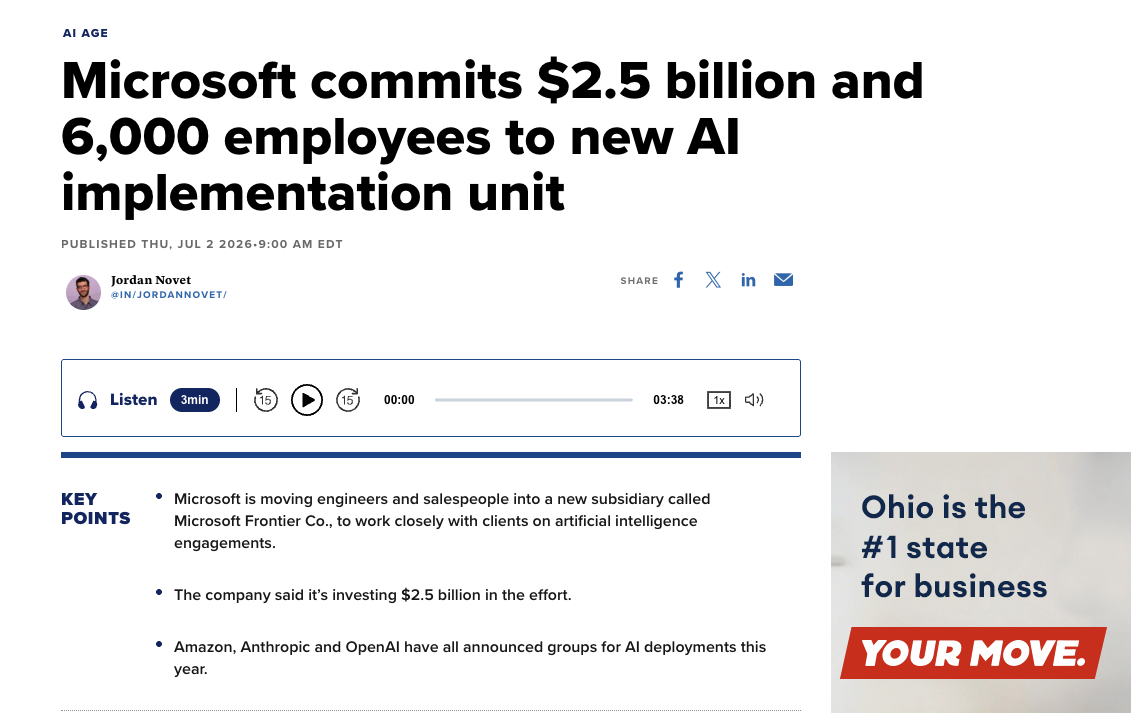
Microsoft committed $2.5 billion and 6,000 people.
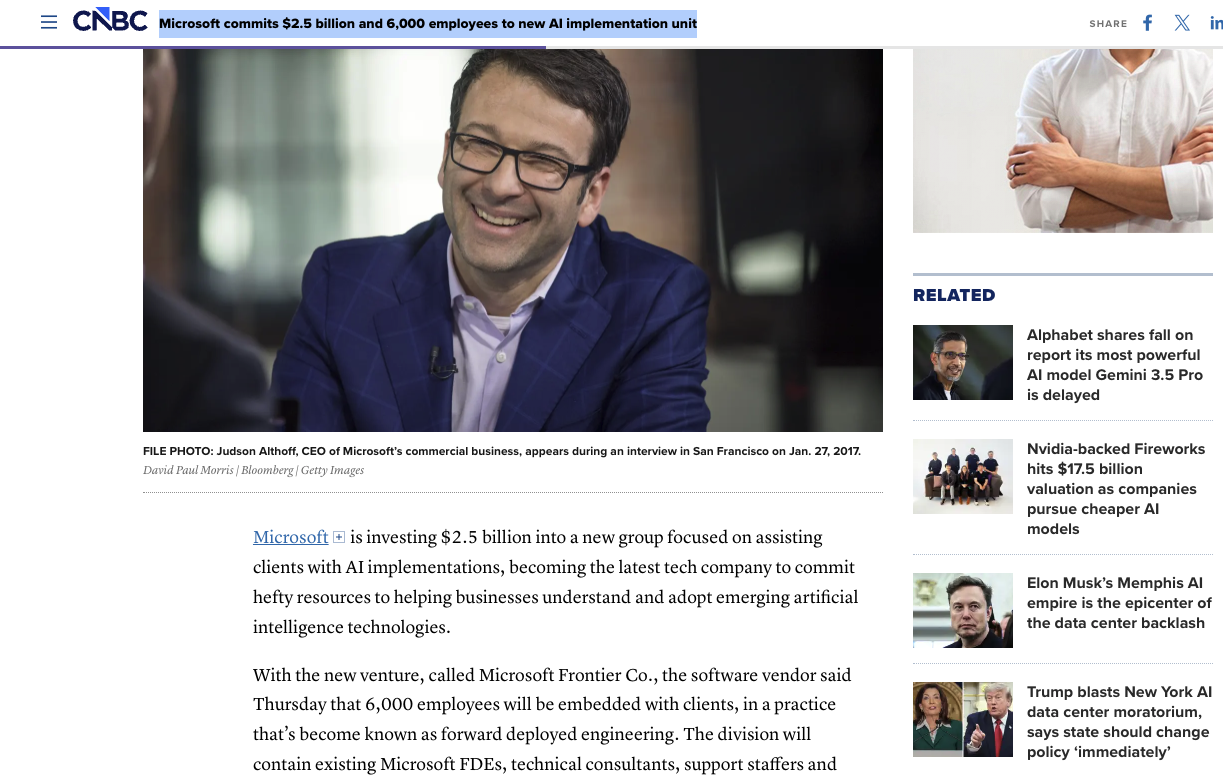
Two days later, Microsoft launched Microsoft Frontier Company: a $2.5 billion commitment and 6,000 engineers and industry specialists, embedded directly with enterprise clients including the London Stock Exchange Group, Unilever, and Accenture.
Microsoft's own Commercial Business CEO didn't shy away from the comparison — he explicitly positioned it against "what has been labeled as Forward-Deployed Engineering," while building essentially the same model at even greater scale.

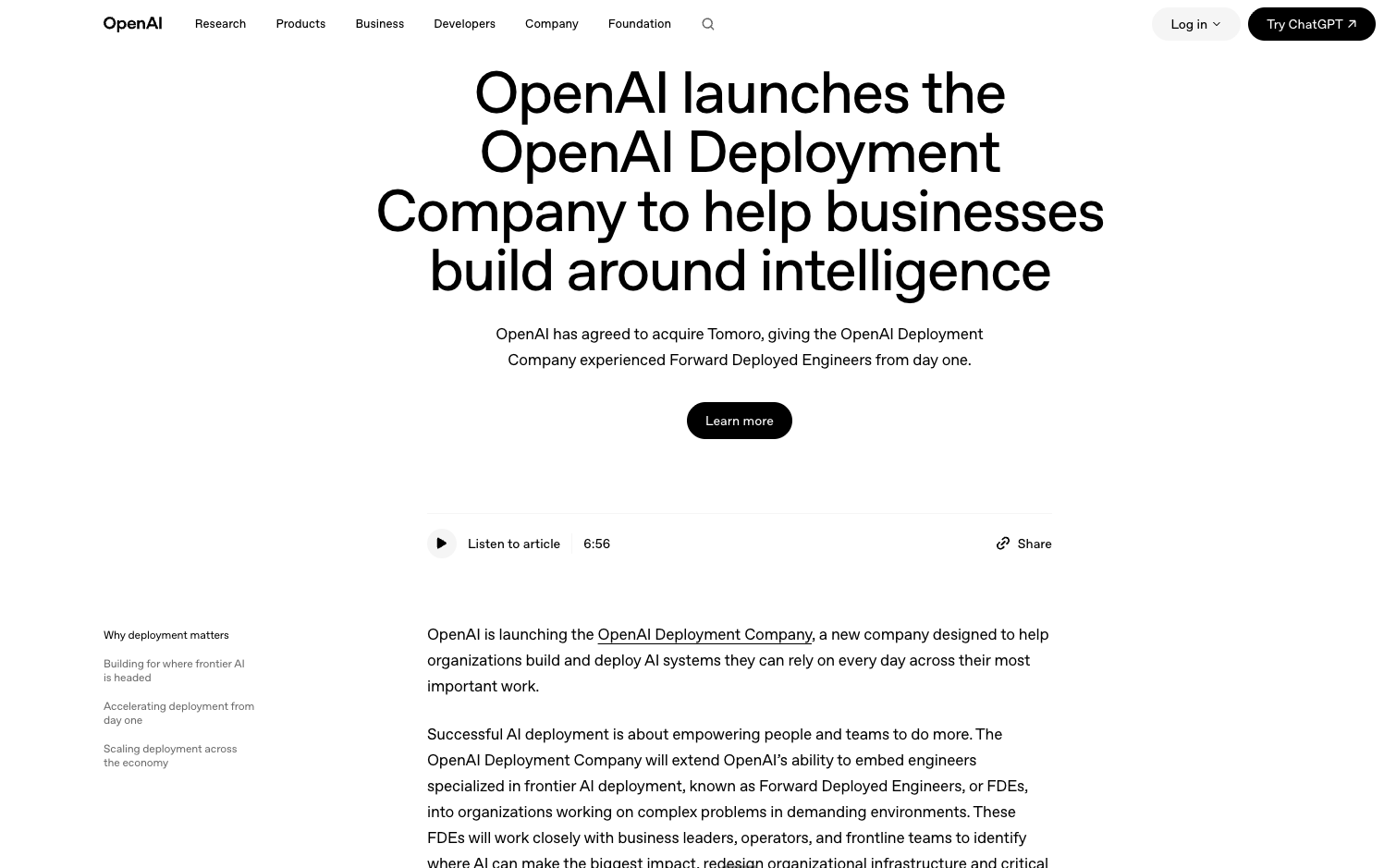
OpenAI stood up a new company backed by more than $4 billion.
OpenAI moved first, in May 2026, launching the OpenAI Deployment Company — backed by more than $4 billion from a 19-firm syndicate led by TPG, with Bain Capital, Brookfield, Goldman Sachs, and McKinsey among the partners.
OpenAI acquired an existing FDE consultancy, Tomoro, to staff it immediately with roughly 150 forward-deployed engineers, with plans to scale into the thousands.
https://openai.com/index/openai-launches-the-deployment-company/
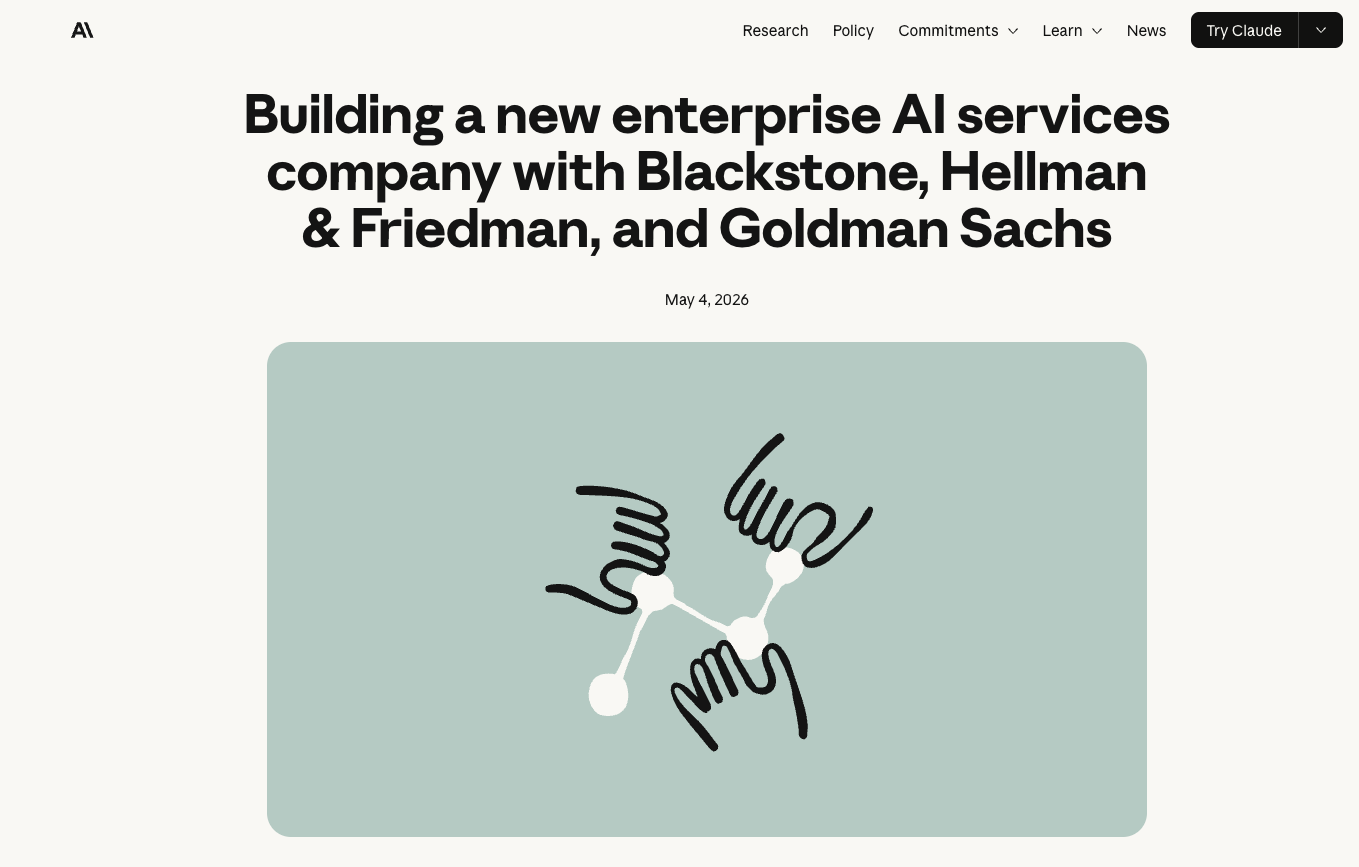
Anthropic partnered with Goldman Sachs and Blackstone on a $1.5B FDE venture of its own.
Anthropic answered with its own venture — a partnership with Goldman Sachs, Blackstone, and Hellman & Friedman — built around embedding engineers inside mid-sized companies that lack in-house AI deployment capability.
https://www.anthropic.com/news/enterprise-ai-services-company
All four moves were aimed at exactly one thing: forward-deployed engineering.
- Four companies.
- Over $9 billion in combined capital commitment.
- Thousands of open roles.
- All in the same 60-day window, all racing toward the same job function.
This is the part most people scroll past without letting it register: this isn't marketing spend. It's headcount and capital, publicly disclosed, from companies that don't make billion-dollar bets on trends or fads.
That's not a coincidence, and it's not a fad cycle. It's four boardrooms independently arriving at the same conclusion at the same time — which is usually the clearest signal you'll ever get that something structural has shifted in a market.
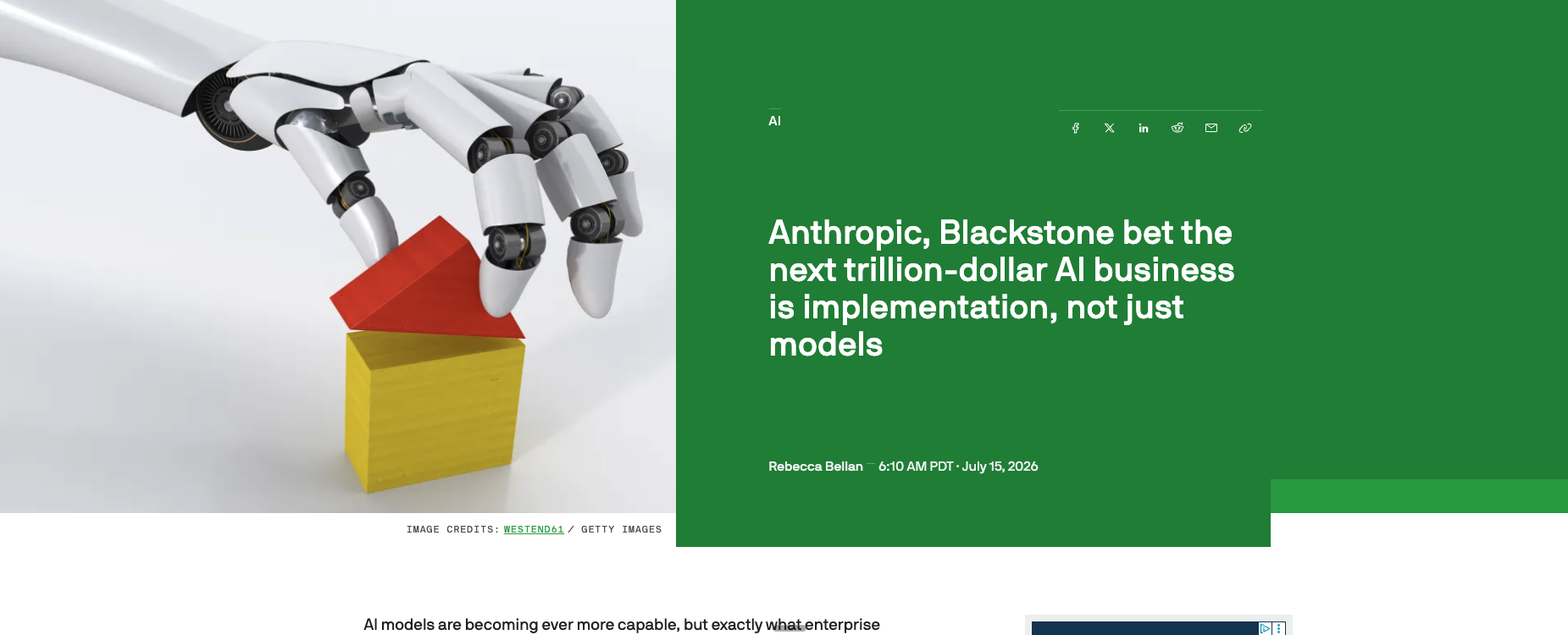
💡 The next trillion-dollar AI business is implementation — integration and adoption, not just models. This is where the cash is going to be printed, and the process starts with better education and storytelling.
If you're a technical professional trying to figure out where the next decade of your career should point, this is worth stopping for.
📅 Schedule your FDE Career Strategy Session →
Why Now? The ROI Problem Nobody Wants to Talk About
Here's the uncomfortable truth sitting underneath all four of these announcements: AI tools are not selling themselves into outcomes.
Uber's COO is saying it's getting harder to justify the money spent on AI token maxing, and he's not alone.
https://www.businessinsider.com/uber-coo-andrew-macdonald-ai-token-spending-harder-justify-2026-5



Companies have spent the last two years buying AI capability — API access, enterprise licenses, model subscriptions — and a huge number of them still can't point to measurable ROI. The tools work. The adoption doesn't. That gap is now the single most expensive unsolved problem in enterprise technology, and it's exactly the gap forward-deployed engineers are hired to close.
https://www.cnbc.com/2026/07/14/chamath-palihapitiya-ai-tokenmaxxing.html

Think about it the way a consumer product works. Getting access to a dating app doesn't get you a date — you still have to figure out your profile, your messaging, your approach. Getting a YouTube channel doesn't get you views — you still have to figure out the content, the hooks, the cadence. Access to a tool was never the same thing as success with a tool.
Enterprise AI has hit that exact wall, at a much larger scale, with much higher stakes. A company can license the best model in the world and still fail to deploy it into a workflow that produces value — because deployment isn't a technical problem alone. It's a technical and organizational problem: understanding the client's actual workflow, decomposing their systems, training their people, and iterating until the tool produces a measurable outcome instead of a demo.
That is the entire forward-deployed engineering function. And it's why Amazon, Microsoft, OpenAI, and Anthropic all decided, independently, that the fastest way to prove AI ROI to their customers was to put their own engineers physically inside those customers' businesses.
Why This Role Commands the Highest Pay in Tech
The comp is not hype — it's one of the best-documented compensation stories in the industry right now. A 2026 industry compensation report synthesizing 1,200 data points across Levels.fyi, Glassdoor, disclosed pay-transparency bands, and direct FDE self-reports lays it out clearly:
https://getperspective.ai/blog/2026-forward-deployed-engineering-compensation-report-1200-fdes
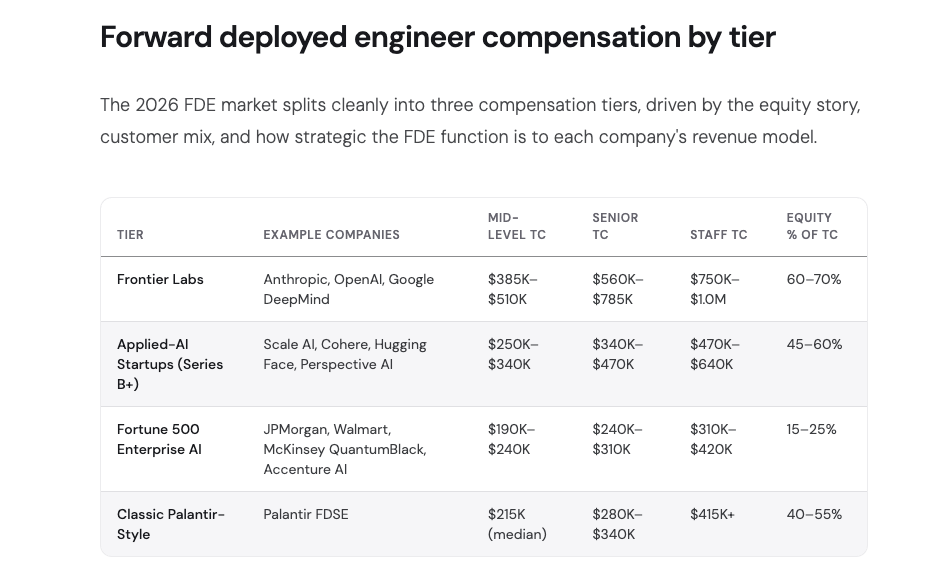
Notice something important in that table: forward-deployed engineers now out-earn ML research engineers at the senior and staff level at multiple frontier labs — a full reversal of the 2020–2023 hierarchy, when research sat at the top of the ladder. The reason is straightforward. Models are increasingly abundant. Engineers who can turn a model into a working, revenue-generating deployment inside a real client's environment are not.
There are four structural reasons this premium exists, and none of them are going away soon:
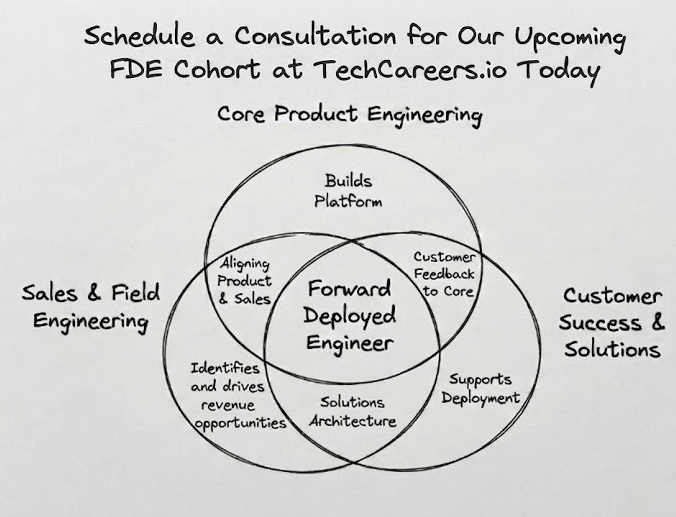
1. Customer-facing technical fluency is genuinely rare. Plenty of engineers are technically strong. Far fewer can walk into a boardroom, decompose a complex architecture in plain language for a non-technical executive, and spot a revenue opportunity in the same conversation. That combination is scarce, and scarcity is priced.
2. Revenue identification is a trained skill, not a personality trait. FDEs are compensated in part as a revenue function — the equity and bonus structure at frontier labs increasingly ties directly to deployments shipped and expansion revenue generated. Most engineers have never been asked to develop this instinct. It's learnable. It's just not taught anywhere else.
3. Deployment willingness is structurally scarce. Most of the workforce opted out of travel and on-site work over the last several years. FDEs opt back in, deliberately, and the market pays a real premium for that willingness because the supply of people willing to do it hasn't kept pace with demand.
4. Deployment-level AI proficiency is a different skill than tool usage. There's a wide gap between an engineer who prompts a model well and one who can deploy an AI system inside a legacy enterprise environment, train a client's team on it, and identify the next integration opportunity in their business. The latter is what these four companies just collectively bet $9 billion on.
The Best Unicorn Startup Founder Training Ground in Tech Has a Name — Forward Deployed Engineer
There's a pattern here that goes beyond compensation, and it's worth understanding if you're thinking long-term about your career, not just your next role.
Palantir — the company that invented the forward-deployed engineer title in 2011 — has produced one of the most well-documented founder pipelines in Silicon Valley. Independent analysis from Fast Company identified 335 documented Palantir alumni who have gone on to found their own companies, spanning household names like Anduril, Hex, and Handshake. Separate research from SignalFire, reported by Forbes, independently ranks Palantir among the top "high-efficiency unicorn pipelines" in tech — alongside OpenAI and DeepMind — when founder production is normalized by company size.
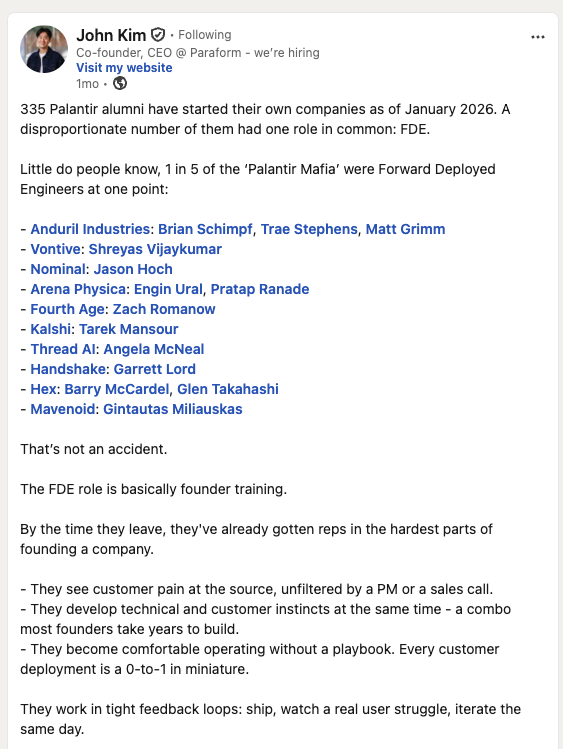
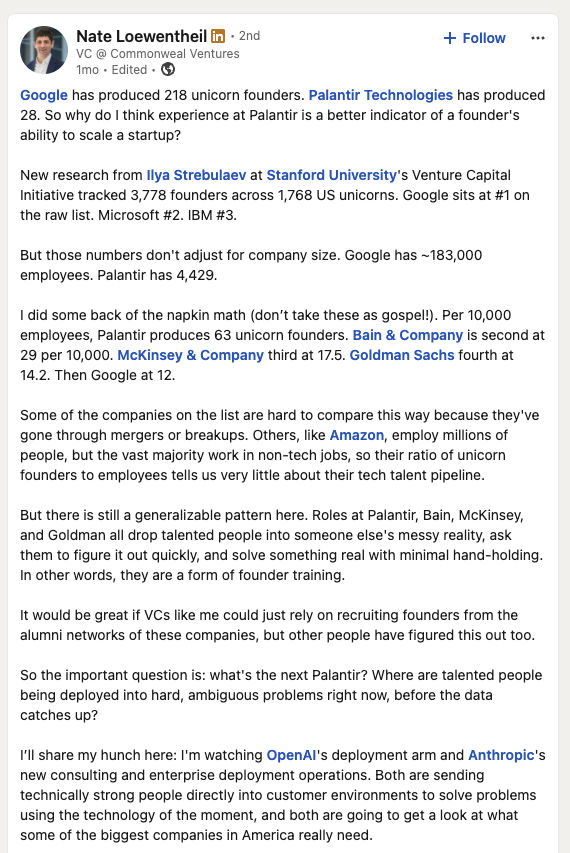
The reason isn't a coincidence. The daily discipline of forward-deployed work — walking into a client's business, diagnosing the real problem underneath the stated request, building a working solution under real constraints, and iterating fast on customer feedback — is functionally identical to the discipline of building a company from zero to one. It's why VCs increasingly treat FDE experience at an elite firm as a credible founder signal, the same way "early Stripe" or "early PayPal" functioned as a signal in prior cycles.
Whether or not founding a company is your endgame, that should tell you something about the caliber of skill this role builds — and the caliber of people the market is now competing to hire.
Why This Isn't a Fad — And Why the Window Won't Stay Open
Every one of these signals points the same direction, and they're independently corroborated, not self-reported:
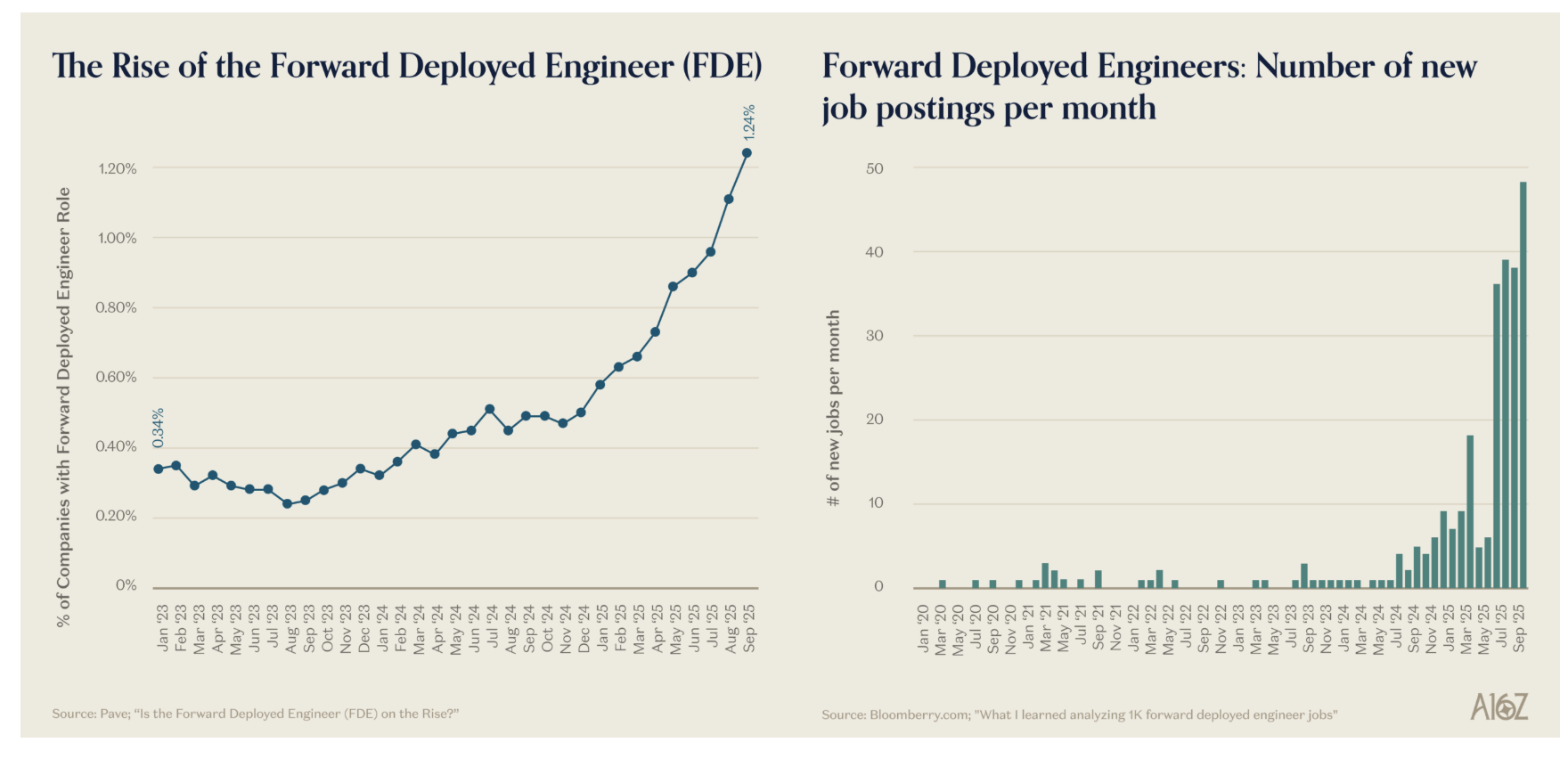
- A16Z's own data shows forward-deployed job postings climbing steadily over 13–18 months — not a spike, a sustained trend.
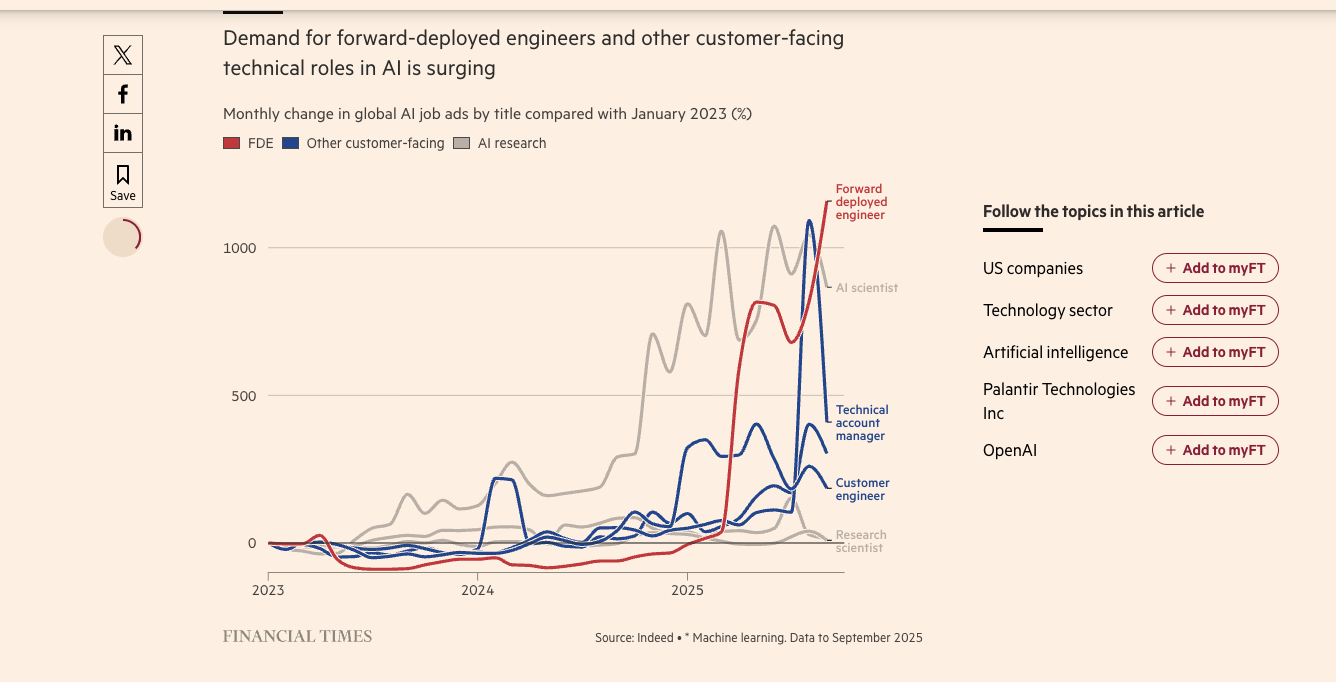
- The Financial Times has separately charted demand for FDEs and adjacent customer-facing AI technical roles surging since 2023, with the steepest acceleration in the past year.
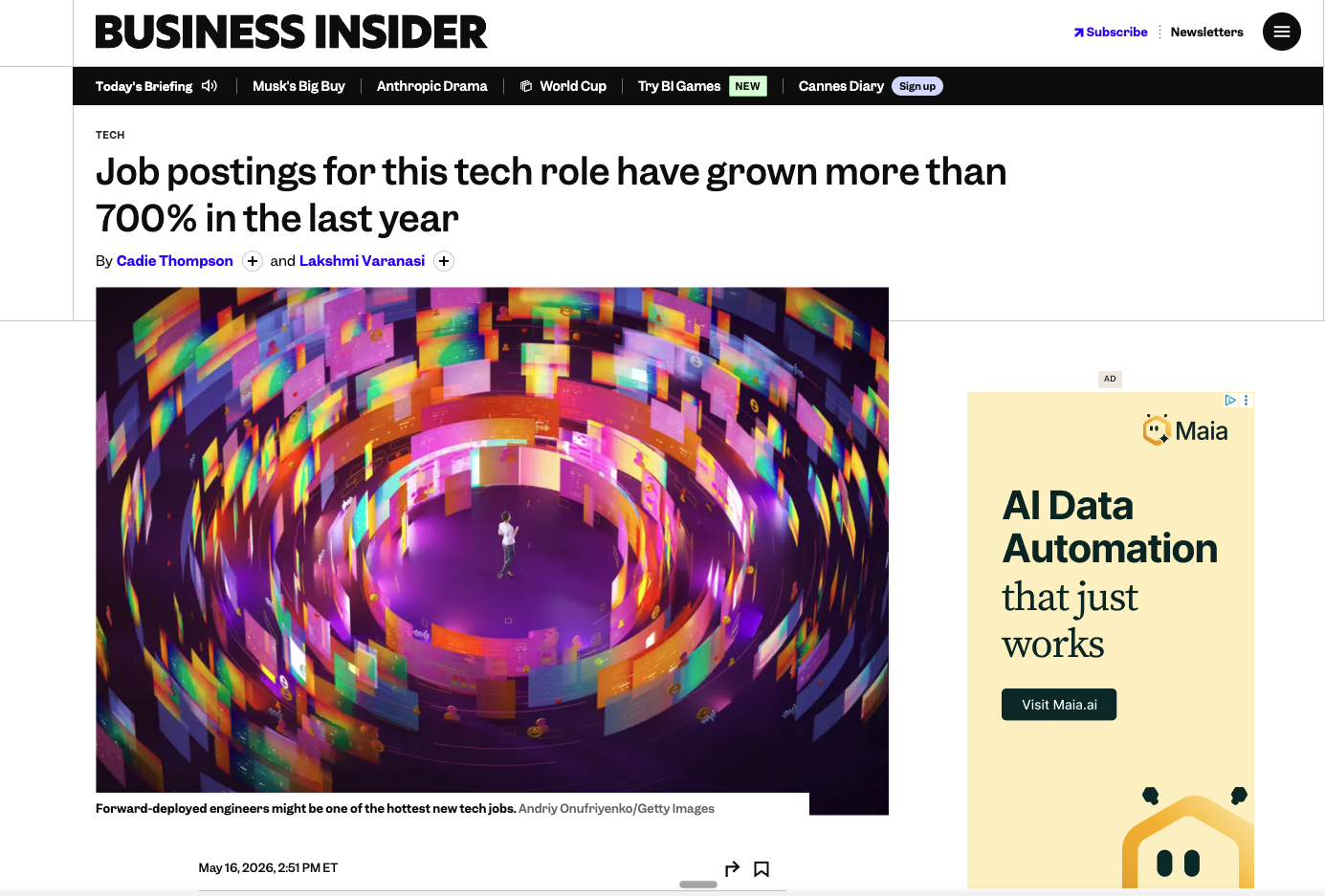
- Business Insider reported FDE job postings up more than 700% year-over-year.
- And now, in the span of five weeks in mid-2026, four of the largest technology companies on earth have backed the model with real capital and real headcount targets.
https://a16z.com/forward-deployed-job-titles/
https://www.ft.com/content/91002071-7874-4cb7-9245-08ca0571c408?syn-25a6b1a6=1
https://www.businessinsider.com/forward-deployed-engineer-jobs-in-demand-2026-5
Here's the part that should create urgency, not panic: demand for this role is currently outpacing the supply of qualified candidates.
That imbalance is exactly what's driving compensation to the levels in the table above. It is also, by definition, temporary. Every hiring cycle that closes this gap even slightly compresses the opportunity for the next wave of candidates.
The professionals who move now — while the supply gap is still wide open — are the ones who capture the premium.
The professionals who wait for the role to become "established" and "safe" are, by definition, choosing to compete in a market with far more qualified candidates and far less leverage.
📅 Book Your FDE Career Strategy Session →
You already have the hardest part. If you're a senior software engineer, a solutions architect, or a technical consultant, you have the technical foundation these companies are fighting over.
What separates a $200K solutions engineer from a $500K+ forward-deployed engineer isn't more code — it's the wrapper: technical discovery, system decomposition for executives, stakeholder management under ambiguity, and revenue identification.
That wrapper is learnable in a focused, structured 90 days. It is not learnable by waiting.
Where You Fit In
This transition tends to work exceptionally well for four specific profiles:
- The Product Manager who has the stakeholder management and business acumen but needs hands-on technical depth in AI deployment scenarios.
- The Senior Software Engineer who has the technical depth but hasn't yet built the customer-facing layer.
- The Solutions Architect who already thinks in systems and trade-offs but hasn't shifted from reactive problem-solver to proactive revenue partner.
- The Technical Consultant who already has the client-facing instincts but needs deployment-level AI fluency.
If you read that list and thought, that's describing where I already am — that recognition is the signal worth acting on, not sitting with.
The Only Variable You Control Is When You Start
Four of the largest technology companies in the world just told you, with $9 billion in combined capital, exactly where the next decade of enterprise technology work is heading. The compensation data confirms what that capital is chasing. The founder-pipeline data confirms what that experience builds toward. None of this is speculative — it's already happened, it's publicly documented, and it's still accelerating.
The gap between the demand these companies just created and the number of people qualified to fill it will not stay this wide forever. Every month that passes, more candidates enter the pipeline, and the premium compresses.
This is a mutual-qualification conversation — we don't accept everyone, and we're not going to waste your time if the fit isn't there. But if you already have the technical foundation and you're serious about closing the wrapper gap before this window narrows, the next step is a 45-minute conversation.
📅 Book Your FDE Career Strategy Session →
No obligation. You'll leave with a clear picture of where you stand, what a realistic timeline looks like, and whether this is the right vehicle for your transition — whether or not you enroll.
Billion-Dollar Forward Deployed Engineering Arms Race Is Here
Champs, the FDE arms race is here, and every company is scrambling to onboard as many forward-deployed engineers as possible. Don't miss out on this opportunity.
As you've already seen from the references above, these are the biggest names in tech and finance — and they do not make bets on fads or one-off trends. This is here, and you need to be "embedded," or get in early, as soon as possible.
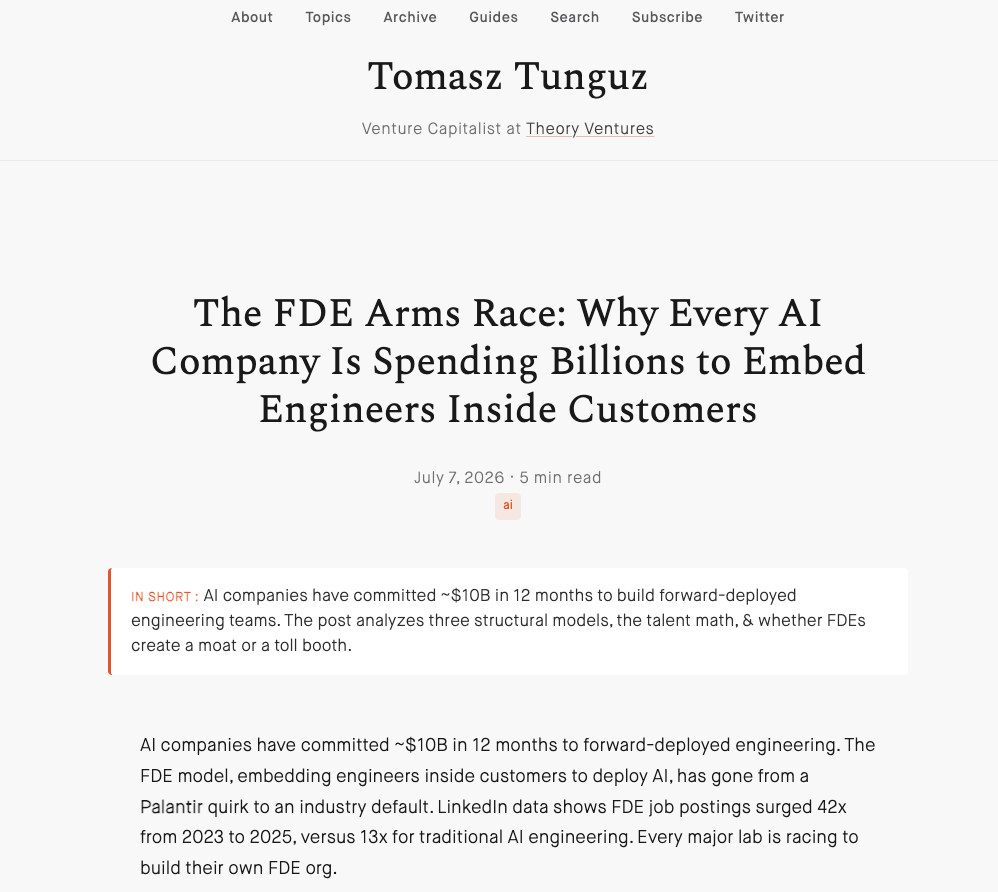
https://tomtunguz.com/fde-arms-race/
Frequently Asked Questions
Do I need prior FDE experience to break in? No. Companies are actively hiring customer success managers, product managers, management consultants, investment banking analysts, and other professionals with "customer-facing" experience — in addition to senior software engineers, solutions architects, technical consultants, and technical product managers who have strong technical fundamentals and are willing to build the customer-facing "wrapper" skills (technical discovery, system decomposition, stakeholder management, and revenue identification) that the role requires.
Here's the reality: the entire industry is moving toward this model. If you're working on the business side with a sales and marketing background, you simply have to learn how to build. But if you're a highly technical, skilled worker such as a software engineer, you now need to also develop the sales and marketing communication skills. All the roles and key functions are essentially merging into one job now.
The longer you procrastinate on turning your weaknesses into actual strengths, the more vulnerable you leave yourself as the market moves faster and faster toward this model.
Why are Amazon, Microsoft, and OpenAI investing billions in forward-deployed engineering? Because enterprises are struggling to convert AI spend into measurable ROI. Amazon, Microsoft, and OpenAI have each launched forward-deployed engineering divisions — backed by a combined $9B+ — because embedding engineers directly inside client organizations is proving to be the most reliable way to close the gap between AI capability and AI adoption.
How much do forward-deployed engineers make in 2026? Total compensation ranges from roughly $215K at Palantir's median to over $1.2M for principal-level forward-deployed engineers at Anthropic and OpenAI, based on a 2026 industry analysis of 1,200 compensation data points. Mid-level frontier-lab FDE compensation averages around $385K.
Is now a good time to become a forward-deployed engineer? 2026 marks the point at which four of the largest technology companies in the world — Amazon, Microsoft, OpenAI, and Anthropic — have simultaneously and publicly committed billions of dollars to scaling forward-deployed engineering teams. Demand for qualified candidates is currently outpacing supply, which is compressing hiring timelines and elevating compensation for technically proficient professionals able to make the transition.
Access the Claude Certified Architect Foundations Study Guide & Forward Deployed Engineering Career Playbook (with Resume Templates + Hiring Referrals)
You can access the Claude Certified Architect Foundations study guide here.
https://whop.com/awaken-ai/forward-deployed-engineers/
We have compiled an entire 15-step Claude Certified Architect Foundations exam study guide, equipped with a voice AI tutor. In addition to hosting mock exam sessions, we also offer tutoring sessions to make sure you're able to pass this exam within the next 30 to 45 days.
Feel free to take all the time you need. Generally speaking, it hasn't taken anybody more than 90 days to pass this exam with us — even those who had zero technical background and had never written a line of code.