How to Prepare for the Cognition Applied AI Engineering Interview
Cognition is one of the most talked-about AI companies in the market right now.
Their product, Devin, an AI software engineering agent, is rewriting what it means to build software at scale. The company is valued at approximately $48 billion. The Applied AI Engineer role pays $325,000 to $400,000.
And most candidates who apply have no idea what they are actually being evaluated on.
This is not a blog about whether you can code.
If you are applying to Cognition, you can code. That is assumed.
What this blog is about is the second barrier to entry, the one that eliminates technically excellent candidates at every stage of the process, and exactly how to clear it.
What the Cognition Job Description Is Actually Telling You
When you open the Applied AI Engineer job description at Cognition, two categories of responsibilities stand out every time, regardless of the specific posting.
https://jobs.ashbyhq.com/cognition/811c3f5a-b26d-4162-b49b-93890a91794d
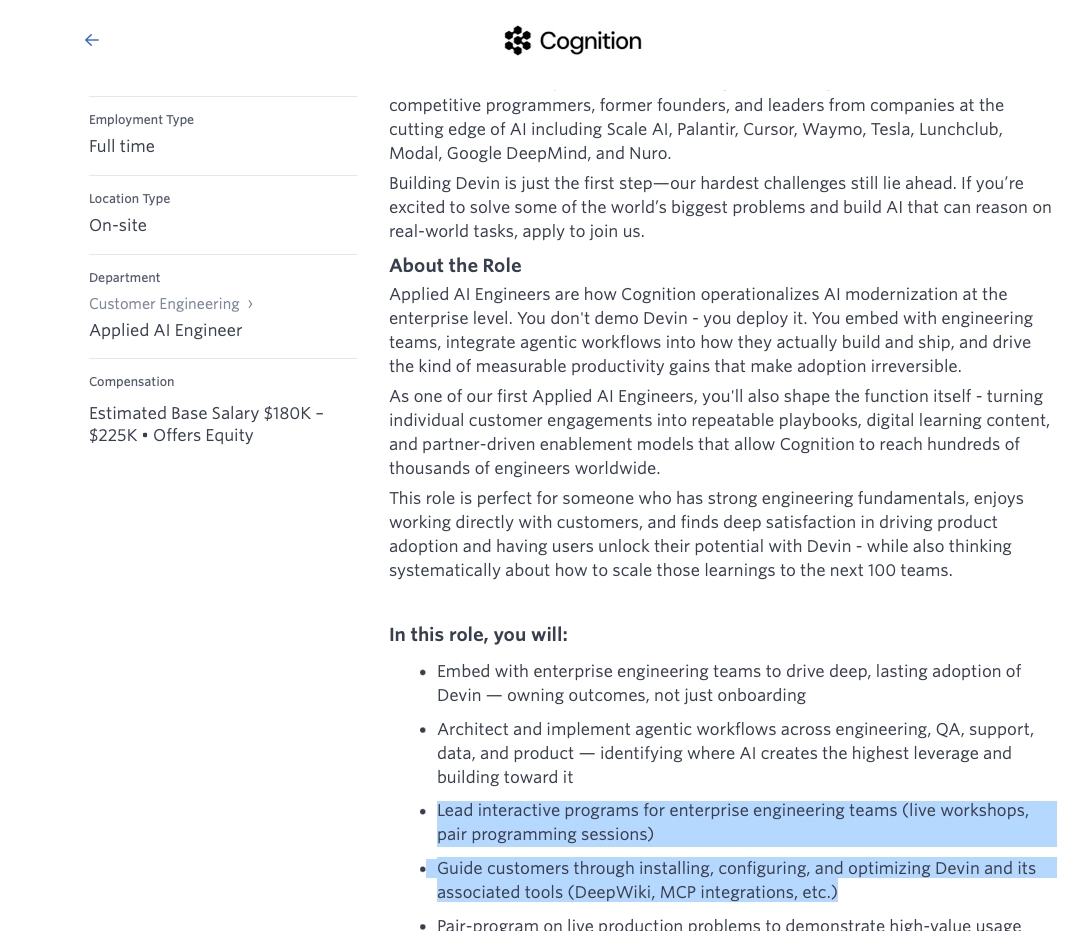
Category one: Lead interactive programs for enterprise engineering teams.
Category two: Guide customers through installing, configuring, and optimizing Devin and its associated tools, including Deep Wiki and MCP integrations, zero to one, end-to-end.
That second category is the one that separates this role from every traditional software engineering role you have held before. "Zero to one, end-to-end" is not just job description language. It is a signal about what Cognition is actually hiring for: someone who can take a customer who has never used Devin and walk them to a working, high-value implementation with the clock running and a room full of enterprise stakeholders watching.
The reason this role exists is precise. When companies buy Devin, they try to use it for an hour or two, and then they realize that what they saw in the demo is not what they are experiencing on day one. The commercial showed Devin shipping features autonomously.
The customer opens the product and thinks: where do I even start?
Cognition hires Applied AI Engineers to close that gap. To be the person in the room who makes the product perform at the level the customer purchased it expecting.
That problem, implementation at scale for enterprise customers who are non-technical or technical but unfamiliar, is what every interview question at Cognition is designed to probe.
The Two Barriers to Entry (Most Candidates Only See One)
There are two distinct things Cognition needs to see before they will make you an offer.
Barrier one is technical proficiency. You need to be able to set up Devin, ship features with it, integrate it with MCP tools, document work in Deep Wiki, and operate in a multi-agent environment. This is the threshold requirement.
Barrier two is distribution and communication. Can you lead a room of non-technical stakeholders? Can you create content that shows other people how to use this product? Can you be a source of education and enablement, not just a practitioner?
The vast majority of candidates with strong technical backgrounds clear barrier one and fail completely at barrier two. They walk into an interview having never led a live workshop, never recorded a piece of content, never demonstrated the ability to make a non-technical audience successful with a complex AI product.
If you can clear both barriers, you are almost guaranteed a job. Not because the technical bar is low, it is not, but because the combination of deep technical competence and public-facing communication ability is genuinely rare.
The strategy in this blog is about clearing both.
The DEI Framework: The Portfolio Architecture That Gets You Hired
The framework for building a Cognition-ready portfolio was developed by Ahdi, a senior technical mentor in the TechCareers.io accelerator program. It applies to every AI-native company hiring for forward-deployed or applied AI engineering roles, but it is especially precise for Cognition.
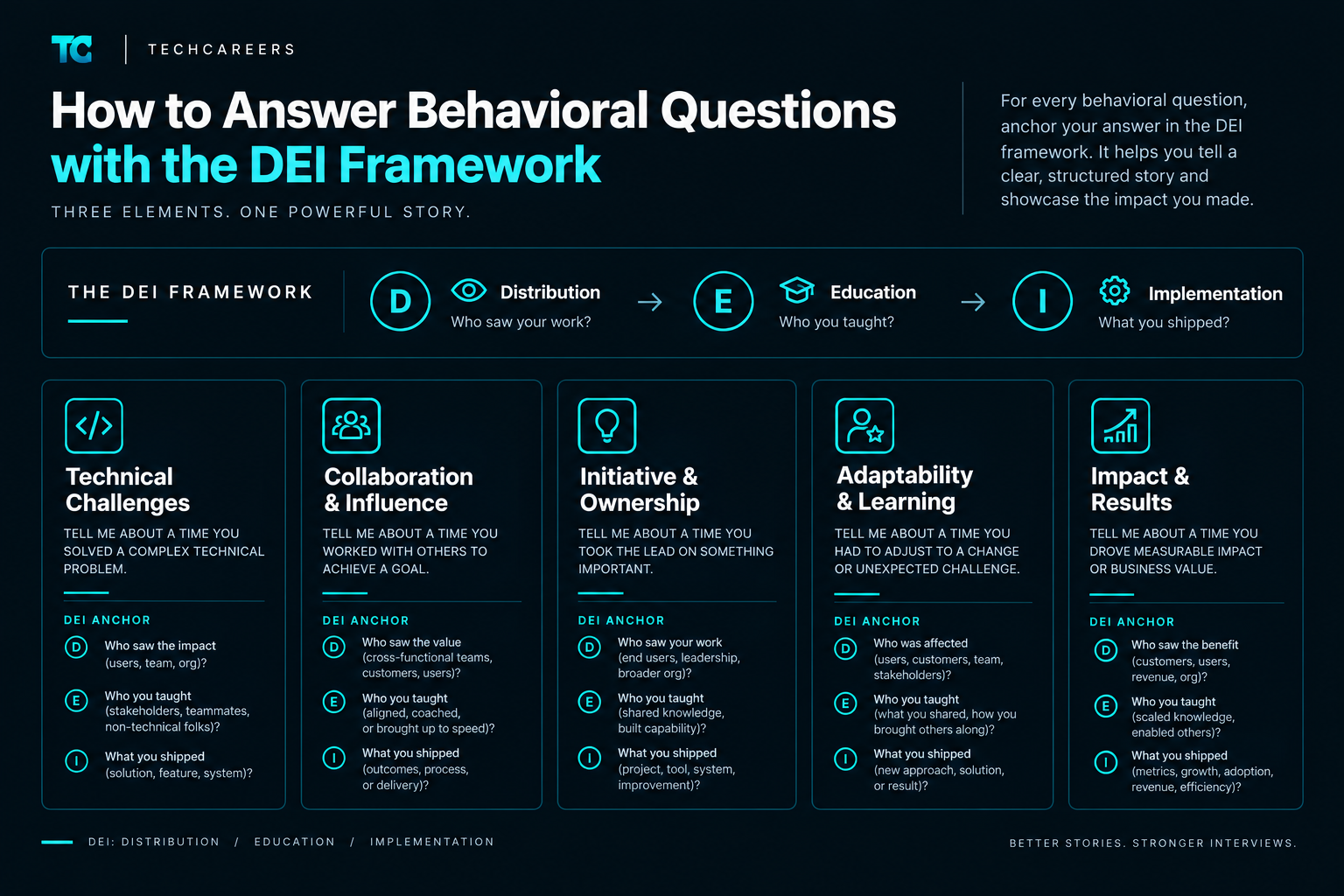
The framework has three components: Distribution, Education, and Implementation.
Distribution means you have an audience, or you are actively building one. You are posting content. You are visible as a technical authority on Devin, on AI agent tooling, on the kind of workflows that enterprise engineering teams actually need. When an interviewer at Cognition searches your name on LinkedIn or YouTube before your call, they see that you are already operating as a practitioner and educator in the space they care about.
This is not a vanity metric. It is a signal that you understand how to bring Devin to market, which is exactly what Cognition's Applied AI Engineer does at every customer account.
Education means you can teach. Not teach engineers. Non-technical people. Older demographics. People who have never heard of an AI agent and need to walk away from your session feeling capable and empowered.
The counterintuitive insight here is that the hardest audience to teach is the most valuable signal to demonstrate. If you can successfully run a live workshop for a room of small business owners or people in their 50s and 60s who have never used an AI agent, and get them to a working implementation in under two hours, Cognition knows you can handle any enterprise customer account they put in front of you.
Implementation means you have proof of zero-to-one builds. Documented. On record. You have deployed Devin to ship real features, integrated it with real tools, and produced work product that can be reviewed. Not theoretical. Not speculative. Actual shipped software and documentation.
The Five Portfolio Projects That Move You to the Front of the Line
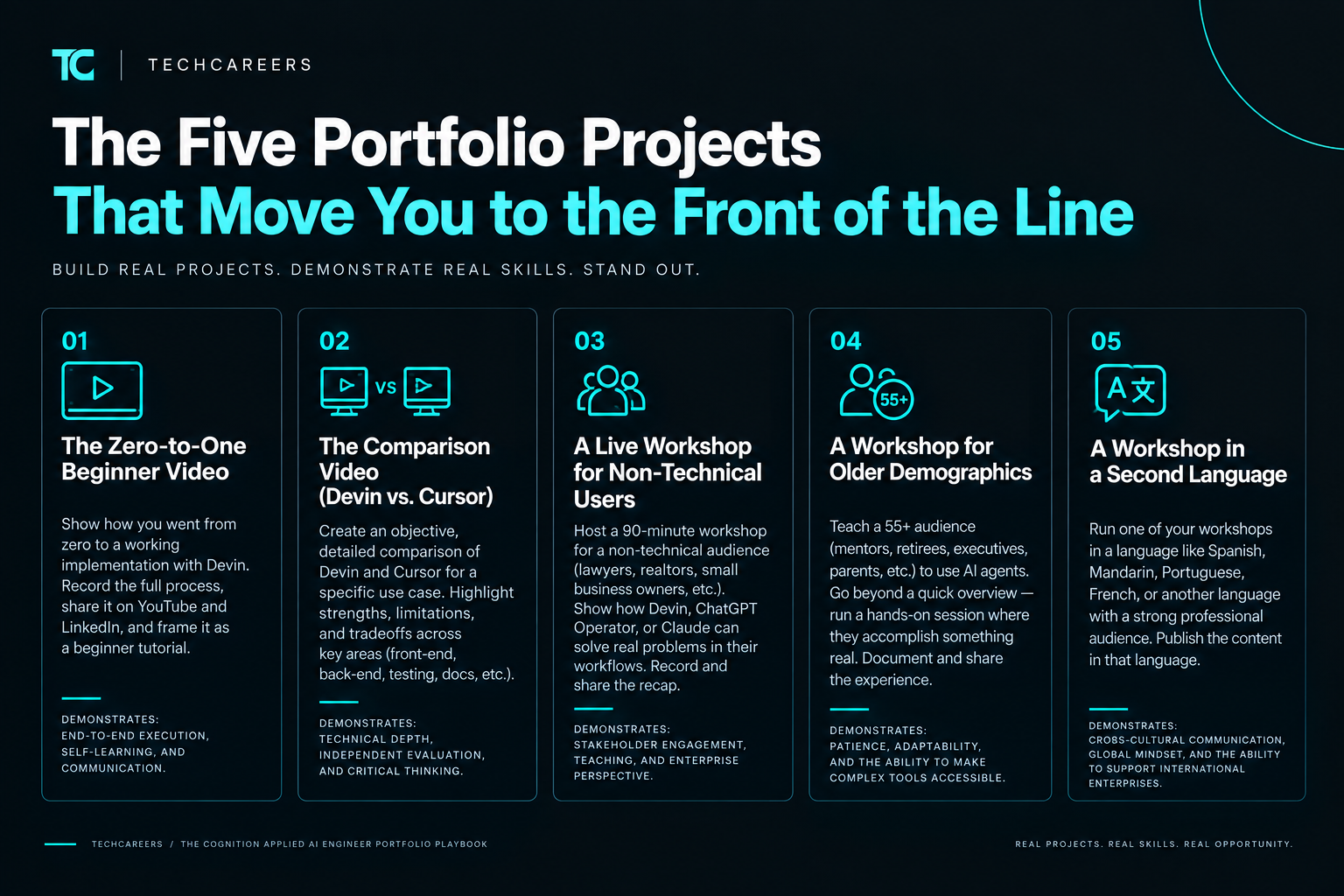
These are not generic portfolio project ideas. Each one is calibrated specifically for the Cognition Applied AI Engineer role and the evaluation criteria embedded in the job description.
Project 1: The Zero-to-One Beginner Video
The concept: I got Devin to build a full-stack app in 4 hours.
This is the single most important portfolio piece you can create. Go to Devin.ai.
Download the Devin desktop. Start from scratch. Walk someone, ideally someone non-technical, through installing it, prompting it, shipping a feature, and documenting the work in Deep Wiki.
Record the entire process. Publish it on YouTube and LinkedIn.
The specific angle that performs: frame it as a beginner tutorial. I just started using Devin and here is exactly what I learned in my first session. Cognition actively monitors content about their product. This video gets seen. And it demonstrates, on video, the exact skill the Applied AI Engineer role requires: taking someone from zero to working implementation, end-to-end.
Candidates on the TechCareers accelerator program who have built this type of content are currently averaging 2 to 3 inbound interview requests per week from LinkedIn alone.
Project 2: The Comparison Video, Devin vs. Cursor
This one builds credibility precisely because it is not promotional.
Record a video comparing Devin and Cursor for a specific use case. Be objective. Show both products. Talk through where each one performs well and where each one has limitations. What Cognition evaluates different AI coding tools for, which tool handles front-end best, which handles back-end, which handles testing and documentation, is actually core to how Devin is deployed in multi-agent enterprise environments.
A candidate who can articulate the tradeoffs between Devin and competitive tools is demonstrating technical depth and independent evaluation skills. That is a rare combination.
Project 3: A Live Workshop for Non-Technical Users
Host a live workshop. Target an audience that has zero technical background. Lawyers. Realtors. Small business owners. Professionals in their field who are not engineers and have never used an AI agent.
Walk them through a 90-minute session on how Devin, or a simpler adjacent tool like ChatGPT Operator or Claude, can save them time in their specific workflow. Document the session. Record it if possible. Post the recap.
This directly addresses the "lead interactive programs for enterprise engineering teams" requirement in the job description, which on closer reading is as much about non-technical enterprise stakeholders as it is about engineers.
Project 4: A Workshop for Older Demographics
This is the highest-signal portfolio piece most candidates will never think to build.
Identify an audience in the 55 and older range. Retired professionals. Senior executives who are technically curious but not practitioners. Parents. Anyone who represents the segment of the population that is most intimidated by AI agents.
Run a workshop for them. Walk them through something substantive, not a two-slide overview, but an actual hands-on session where they leave having accomplished something real.
The reason this is so valuable: if you can make that audience successful, Cognition knows you can make any enterprise customer successful. The challenge of teaching a technically sophisticated product to an audience with low prior exposure is the precise challenge of enterprise AI deployment. You are demonstrating the hardest version of the skill they are hiring for.
Project 5: A Workshop in a Second Language
If you speak Spanish, Mandarin, Portuguese, French, or any other language with a significant professional audience, this is a leverage move that almost no other candidate will execute.
Run one of your workshops in that language. Publish the content in that language. Cognition operates in international enterprise markets. A candidate who can teach, deploy, and support Devin across language barriers is a qualitatively different candidate than one who cannot.
The Leverage Move: Post Your Interview Activity Publicly
This is the strategy that most candidates are afraid to execute, and the reason most candidates never maximize their positioning.
While you are in the interview process at Cognition, post about it on LinkedIn and YouTube.
Not to announce that you have a job offer you do not have. But to document your learning publicly. I spent the last 48 hours going deep on the Devin job description at Cognition, here is what I found. I just ran my first live Devin workshop with 7 non-technical users, here is what I learned. I am documenting everything I am building as I prepare for my Applied AI Engineer interview.
This accomplishes two things simultaneously.
First, it drives inbound. Cognition's team will see this content. Other AI companies hiring for similar roles will see it. Recruiters in your network will see it. You are actively marketing yourself to a highly targeted audience in real time.
Second, it demonstrates the exact behavior the role requires. An Applied AI Engineer at Cognition creates content, builds distribution, educates audiences. Doing it during your interview process is the most credible proof of concept possible.
You are not telling them you can do this role. You are showing them you are already doing it.
How to Navigate Each Stage of the Interview Process
Round 1: The Technical Discovery Call
The first round at Cognition for an Applied AI Engineer role is not a whiteboard coding session. It is more likely to open with a variation of: tell me about your experience with Devin and the tools in this ecosystem.
Your opening should be direct and specific:
"I have been running hands-on sessions with Devin for the past [X weeks]. I have shipped [specific feature or project]. I have also been documenting the experience publicly and I have [content, workshop, video] that I can share after this call if useful. What I want to understand is how your team is currently structuring the first 90 days of a new customer deployment, because that is where I see the most leverage."
Two things this opening does: it demonstrates concrete execution (not just familiarity with the product), and it pivots to a technical discovery question that shows you are already thinking like someone in the role.
Behavioral Questions: The Translation Table
Cognition's behavioral questions are designed to surface the same underlying competency from multiple angles. Here is how to translate the question they ask into the experience they are evaluating:
When they ask: Tell me about a time you had to deliver under ambiguity.
- What they are evaluating:
- Can you operate zero-to-one in a customer environment without a playbook?
When they ask: Describe a situation where you had to explain a technical concept to a non-technical stakeholder.
- What they are evaluating:
- Can you lead enterprise customers through Devin onboarding?
When they ask: Tell me about a time you had to learn a new tool quickly.
- What they are evaluating:
- Will you be current with Devin's capabilities as they evolve?
When they ask: What is a project you are most proud of?
- What they are evaluating:
- Do you have visible evidence of execution?
When they ask: How do you prioritize when multiple customers have competing needs?
- What they are evaluating:
- Can you manage enterprise accounts at scale?
For every behavioral question, anchor your answer in the DEI framework. Distribution (who saw your work), Education (who you taught), Implementation (what you shipped).
Round 2: Interaction with the Sales or Customer Success Team
Many Applied AI Engineer interview processes include a round with someone from sales or customer success. This is not a formality.
It is Cognition testing whether you can cross-function effectively, specifically whether you can support a deal or a customer account without needing a technical translator between you and the commercial side of the business.
Be ready to speak in business value terms, not just technical terms. "I shipped a feature" becomes "I deployed a workflow that eliminated 4 hours of manual work per week for the customer's operations team." Lead with the outcome. Support it with the technical detail.
Final Round: Project Scoping
The final round may include a live or take-home project. The most common format: you are given a customer scenario, an enterprise company considering adopting Devin with a specific workflow pain point, and asked to propose an implementation plan.
Approach it exactly as an Applied AI Engineer would approach a real engagement.
Start by identifying the specific workflow that Devin can address, not all of them, but the one where time-to-value is fastest. Then map the implementation steps zero to one. Identify the stakeholders who need to be in the room for kickoff. Propose a documentation structure in Deep Wiki. Define what "successful deployment" looks like at 30 days.
The candidates who perform best in this format are the ones who have already done this, who have already run a workshop, deployed a zero-to-one build, and documented the process. The interview is not an exercise. It is a portfolio review.
The One Thing That Changes Everything
Every piece of strategy in this blog points toward the same underlying principle: at AI-native companies like Cognition, the interview is not separate from the work. The interview is the work.
Cognition is not asking you to prove that you could become an Applied AI Engineer. They are looking for evidence that you already are one. The candidates who get hired are the ones who have been operating in the role, building workshops, creating content, deploying Devin in real environments, before they ever sent in an application.
The good news: you can start today. You do not need permission to record a video. You do not need a customer account to run a workshop. You need a genuine understanding of Devin, a willingness to teach it, and the discipline to document what you build.
That is the gap between the candidates who are technically qualified and the ones who get the offer.
If you are targeting Applied AI Engineer roles at Cognition, OpenAI, Anthropic, Databricks, or similar companies and you want a structured path to building this portfolio and clearing both barriers to entry, the technical and the communication, that is exactly what our FDE Accelerator program is designed to do.
Schedule a Consultation Call: https://consultation.techcareers.io/fde/booking-calendar
45 minutes. We review your current positioning, map your existing experience to the Applied AI Engineer competencies, and give you a clear action plan, whether you join the program or not.
Frequently Asked Questions
Do I need prior Devin experience to apply for the Applied AI Engineer role at Cognition?
No prior Devin-specific experience is required. What Cognition is evaluating is your ability to learn AI agent tooling quickly and deploy it in customer environments. Demonstrable experience with similar tools like Claude, Cursor, or GitHub Copilot, combined with customer-facing technical delivery work, is a strong foundation. The key is to start building Devin-specific portfolio work now.
What is the salary range for an Applied AI Engineer at Cognition?
Based on available data, the Applied AI Engineer role at Cognition carries a total compensation range of approximately $325,000 to $400,000, inclusive of base salary and equity. Exact figures vary based on experience level and negotiation.
How is an Applied AI Engineer different from a Software Engineer at Cognition?
A Software Engineer at Cognition builds the product. An Applied AI Engineer deploys it for customers. The Applied AI Engineer role is customer-facing, requiring both deep technical proficiency with Devin and the ability to run workshops, lead non-technical stakeholders through onboarding, and deliver zero-to-one implementations in enterprise environments. It is the forward-deployed engineering model applied to AI agent deployment.
What does "zero to one, end-to-end" mean in the Cognition job description?
It means taking a customer who has never used Devin and getting them to a fully functional, value-delivering implementation without gaps, hand-offs, or a separate professional services engagement. The Applied AI Engineer owns the entire journey from initial setup through first successful deployment. This is the core of the role and the primary thing interview questions are designed to probe.
What is Deep Wiki and why does it appear in the Cognition job description?
Deep Wiki is Cognition's documentation tool that integrates with Devin to automatically document codebases, feature changes, and deployment processes. It is mentioned in the job description because part of the Applied AI Engineer's role is teaching enterprise customers how to use Deep Wiki alongside Devin, so the customer's engineering team can maintain context and continuity after the initial deployment.
What portfolio projects are most valuable for a Cognition Applied AI Engineer application?
The highest-value projects are a beginner-focused Devin tutorial video, a live workshop for non-technical users, a Devin-vs-competitor comparison using Cursor or GitHub Copilot, and a zero-to-one build documented end-to-end. Each of these directly demonstrates the skills listed in the job description: leading interactive programs, guiding non-technical users, and shipping implementations from start to finish.
How important is content creation for getting hired as an Applied AI Engineer at Cognition?
More important than most candidates realize. Distribution, having a visible presence as an educator and practitioner in the AI agent space, is the second barrier to entry for this role. Companies like Cognition actively search for candidates who are already creating content about their product, because that behavior directly mirrors what the Applied AI Engineer does: bring Devin to market by educating new audiences. Candidates with active LinkedIn or YouTube content about Devin receive significantly more inbound outreach.
Is the Cognition Applied AI Engineer role a good fit for someone transitioning from traditional software engineering?
Yes, but only if you are willing to develop the customer-facing and communication skills the role requires. The technical foundation of a mid-to-senior software engineer is sufficient for the technical barriers. The gap for most engineers is the Applied AI side: running workshops, teaching non-technical stakeholders, and creating educational content. These are learnable skills, but they require deliberate practice and a portfolio that demonstrates them.
What is the DEI framework for Applied AI Engineer interview preparation?
The DEI framework, which stands for Distribution, Education, and Implementation, is a portfolio architecture developed for candidates targeting forward-deployed and applied AI engineering roles. Distribution means building a visible public presence as a Devin practitioner. Education means demonstrating the ability to teach non-technical audiences. Implementation means proving zero-to-one build capability with documentation. Together, these three areas clear both barriers to entry at companies like Cognition.
How do I prepare for the Cognition Applied AI Engineer final round project?
Approach the final round project as a real deployment scoping exercise. Identify the one workflow where Devin delivers the fastest time-to-value for the given customer scenario. Map the zero-to-one implementation steps. Identify the stakeholders required at kickoff. Propose a Deep Wiki documentation structure. Define a 30-day success metric. Candidates who have run real workshops and completed real Devin implementations before their interview have a significant advantage here because they are drawing on actual experience rather than hypothetical planning.