How to Transition from Product Manager to Forward-Deployed Engineer in 2026
The Number That Puts Everything in Perspective
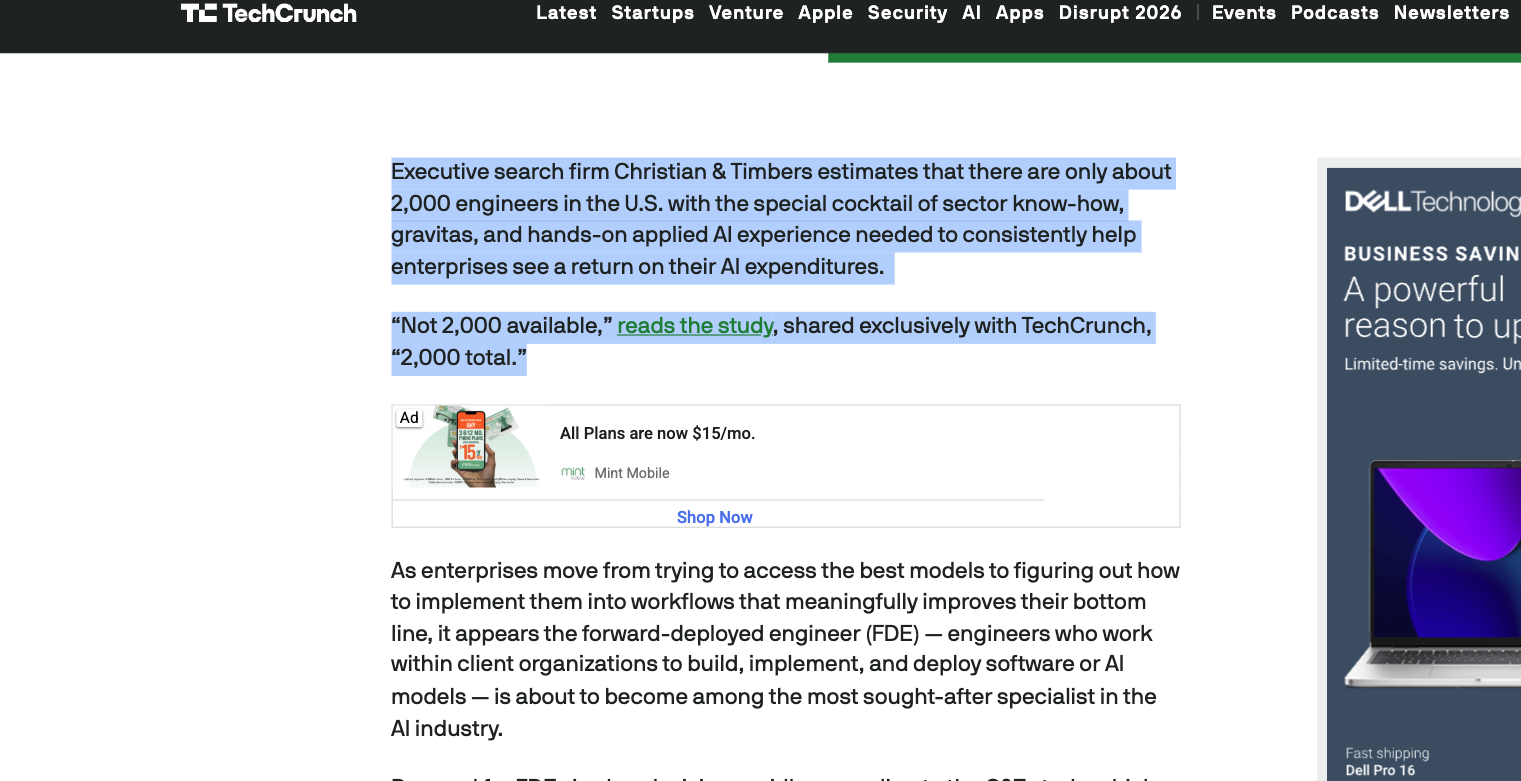
According to executive search firm Christian and Timbers — whose research was recently featured in TechCrunch — there are approximately 2,000 engineers in the entire United States who have the specific combination of skills that forward-deployed engineering actually requires. Not 20,000. Not 10,000. Two thousand.
Andy Leonard is one of them.
He did not get there by waiting until he felt ready. He did not get there by spending months analyzing whether he was qualified enough. He got there by doing what most people in the job market right now are completely unable to do — he took massive action while everyone else was still thinking about it.
This is his story. And if you have a product management background and have been wondering whether the FDE transition is possible for you — Andy's experience is the most honest answer you are going to find.
What the Transition Actually Looked Like
Andy did something that surprises a lot of people when they first hear it. He quit his job before he had an offer in hand.
He explains it this way: he had wrapped up his coursework and was finishing his Harvard capstone. The World Cup was coming. He had a few early signals from companies that felt strong enough. He had a financial cushion. And he made a calculated decision that this was the right moment to move — not because everything was perfectly lined up, but because he had enough signal to be confident and enough runway to land.
That decision is not something we recommend to everyone. Andy is transparent about that. But the underlying mindset — moving on a signal rather than waiting for certainty — is exactly what forward-deployed engineering rewards. As Andy put it himself: "If you are a unicorn, everybody is looking for their unicorn. Just highlight your skills, lean into it, and be passionate about what you are pursuing."
The pay bump came. The title jump came. And he landed at a director level — which puts him in a category that most people trying to break into this space from a PM background assume is years away.
It was not years away. It was a decision away.
What Companies Are Actually Looking for in FDE Candidates
Andy described the conversation in his interviews better than almost any job description manages to capture it.
The expectation in solutions consulting and forward-deployed engineering roles — as companies restructure these departments for the AI era — is that the candidate can do something very specific: speak the business and speak to the technical team simultaneously, in ways that do not get the company in trouble.
That last phrase — "that does not get the company in trouble" — is the one that should stop every PM reading this in their tracks.
Companies are not just looking for people who can demo software or explain technical architecture. They are looking for people who can sit across from a CFO and a machine learning engineer in the same week — and in both conversations earn credibility, communicate clearly, and not create a liability for the business.
That combination — technical depth plus business communication plus customer focus — is what makes the forward-deployed engineering role genuinely difficult to fill. And it is what makes a product management background such a strong foundation for it.
As Andy explained: "You have to be able to whiteboard, go deep into the technical with the client's team, propose architectures, and handle objections. If you have those skills you can make the jump."
Product managers who have been doing stakeholder communication, roadmap strategy, and cross-functional coordination for years already have the foundation. What most of them are missing is the AI implementation layer and the credentials that signal they have it. That is what TechCareers.io builds.
The CCAF Mindset — Why Andy Passed While Others Are Still Preparing
One of the most instructive parts of Andy's story is how he approached the Claude Certified Architect Foundations exam — because it is the opposite of how most people in our community approach it.
Most people treat the CCAF like a mission to Mars. One shot. Cannot fail. Better study for six more weeks just to be safe.
Andy set a date, studied, and took it.
He was motivated in part by watching James — our co-founder — cram for the exam, play a round of golf, and then just take it. That energy was contagious. Andy pulled his own timeline forward and finished it in a week.
His philosophy is one of the clearest articulations of what forward-deployed engineering actually rewards: "Perfection is the enemy of good. If you kind of live in this paralysis world of am I gonna be prepared enough — you know more than you probably give yourself credit for, especially if you're putting the time toward studying. Just give yourself a date and jump in. If it goes well, great. If it doesn't, you can retake it. There's not this huge cliff. Just don't be afraid to take action. You gotta have a bias for action. That's what people are looking for."
He also did something that accelerated his own learning dramatically — he signed up to lead study sessions for other members of the community on sections of the exam he was still learning himself. Teach what you are learning. It forces you to actually know it rather than just recognize it when you see it.
The CCAF is getting more competitive every month. The people who pass it now build a differentiation that will be significantly harder to replicate in twelve months when the candidate pool has grown. Andy recognized that early. It is part of why he is a director right now instead of still preparing to apply.
The Market Reality Andy Is Watching
Andy has a perspective on what is happening in the FDE market that is worth hearing directly.
He watches the same data the rest of us do — Jensen Huang at NVIDIA investing heavily in AI infrastructure, Palantir continuing to scale its forward-deployed engineering teams aggressively, companies across every industry replicating the Palantir model because it is the one that demonstrably works.
His read on it: "You see this opportunity in the market with things shifting — FDE roles opening up, people seeing a model that works, and just wanting to replicate it. What is it about these new roles? What is it about the particular talent they want?"
What companies want, Andy says, is people who are not coding monks. People who cannot be kept away from the customer. People who are curious about problems, motivated to solve them in public, and capable of holding themselves to a higher standard than the market average.
He put it directly: "You can't just be a code monkey — I'm not gonna talk to anybody, I'm just gonna sit here and do my coding. You have to have the perspective of how this fits into a bigger system. Is this gonna work for our customers?"
The engineers who build walls around themselves — who treat communication as an interruption — are on the wrong side of the market shift. The ones who build toward the customer are on the right side of it. And the gap in compensation between those two groups has never been wider.
What Andy Recommends for People Watching This
He was asked directly — what do you tell the people who are watching this video and trying to figure out their next move?
His answer was the most practical thing said in the entire conversation.
Find one actionable step. One. Put it on your calendar. Force yourself to sit in front of the computer and spend one minute on it. Just one minute. Because the hardest part is not the studying, the building, or the interviewing. The hardest part is starting. Once you have momentum — once you can see things coming to life — everything accelerates.
He also said something about the community that is worth quoting directly: "Learn by doing, actually dive into a new subject, and then build out in the open. People aren't looking for private profiles or just you saying on your AI-generated resume that you know Claude or Codex or all these kind of things. It's like — show me that you know this. Show me something you built. Show me that you have passion about what you're jumping into."
That philosophy — building in public, showing rather than claiming, creating proof rather than promises — is the foundation of everything TechCareers.io teaches. Andy is living proof that it works.
Being First Is Worth More Than Being Perfect
There is a moment in the conversation where Andy and Richard reference the movie Margin Call — the line about the three ways to make money. You can be smarter. You can be there first. Or you can cheat.
Of the three, being first is by far the most accessible. And in the forward-deployed engineering market right now, being first means moving before the window narrows. Before the CCAF gets harder. Before the candidate pool grows. Before the companies who are still figuring out what they want have figured it out and raised their requirements accordingly.
Andy got there first. Not because he was the most technically polished candidate in the applicant pool. Because he moved when others were still analyzing. He submitted when others were still preparing. He took the exam when others were still studying for the exam they might take someday.
That is the entire lesson.
What Is Next for Andy
Andy is wrapping up his Harvard Extension capstone in Systems Engineering. He is traveling to build relationships at client sites in his new director role — collecting the airline miles and Marriott points that come with the territory of forward-deployed work. And he is paying it forward — helping other people in the TechCareers.io community make the same transition he just made, because he understands that the people who share what they know are the ones who accelerate the entire ecosystem.
He is the kind of person the AI economy rewards disproportionately. Not because he is uniquely brilliant — though he clearly is. Because he moves. He builds. He ships. He commits. And when the next opportunity appears, he is already positioned to take it rather than still getting ready to get ready.
The Two Mistakes Most Candidates Are Making Right Now
After a decade of coaching technical and product professionals through transitions — Richard and James have watched the same two mistakes repeat themselves across hundreds of conversations.
Mistake one — believing you need the most skills. You do not. The market is moving faster than any candidate can keep up with through preparation alone. The people landing the best roles are not the most technically polished. They are the most credibly positioned. There is a significant difference between the two.
Mistake two — believing you need to be extremely qualified before you apply. You cannot be extremely qualified for roles that barely existed 18 months ago. The qualification standard is being set right now by the people who show up first with the right combination of credentials, portfolio, and energy. Andy set the standard at the director level. That standard will be harder to reach in twelve months than it is today.
The time to move is not when you feel completely ready. It is when you feel ready enough — and then you move anyway.
Who Andy Leonard Is
Andy Leonard is based in Reston, Virginia — about 40 minutes outside of Washington DC. He came through the TechCareers.io AI Product Management program, found success there, and then made the move that a growing number of our PM program alumni are making — transitioning into forward-deployed engineering.
His official title at his new company is Director of Solutions Consulting — a forward-deployed engineering role by every definition that matters. His company is actively transforming its solutions consulting department into a forward-deployed engineering function, which is exactly the pattern we are seeing across every major industry right now. The title is changing. The role is expanding. And the compensation is following.
Andy also recently completed his capstone project in his Master's program in Systems Engineering at Harvard Extension School — while simultaneously starting a new director-level role and going through the TechCareers.io program. That detail matters because it tells you something fundamental about who succeeds in forward-deployed engineering. It is not the person who waits until conditions are perfect. It is the person who moves on multiple fronts simultaneously and figures it out as they go.
Three Ways to Take the Next Step
Andy made it. A growing number of TechCareers.io program members are making it. The question is whether you are going to be in that group or whether you are going to watch from the outside while the window closes.
All three of our programs — Forward-Deployed Engineering, AI Product Management, and Marketing Engineering — include full access to all three curricula plus induction into both the Claude Partner Network and the OpenAI Partner Network for a limited time.
If Andy's story resonated with you and you have a product management or technical background — book a forward-deployed engineering strategy session.
We will look at your specific background and tell you honestly whether you are positioned for this transition and what the fastest path forward looks like.
📅 Book your FDE strategy session:
https://consultation.techcareers.io/o-discover-fde/about
If you are a product manager targeting AI PM roles — book an AI PM strategy session.
The roles paying $230,000 to $400,000 at frontier AI companies are being filled right now. The session is 30 minutes. We will tell you honestly what is between you and those roles.
📅 Book your AI PM strategy session:
https://consultation.techcareers.io/o-ai-pm/about?consultation_utm_source=linkedin
If you are a marketer who needs to learn how to build — or an engineer who needs to learn how to market — our Marketing Engineering cohort starts September 7.
Led by a former Data and GTM Engineer from FanDuel. Built around real projects on a real business. Limited seats. This cohort will not repeat itself on the same timeline.
📅 Apply for the September 7 Marketing Engineering cohort:
https://consultation.techcareers.io/marketing-engineer-o/survey
The 2,000 engineers Christian and Timbers identified did not get there by waiting. Andy did not get there by waiting. Neither will you.
By Richard Chen | TechCareers.io | © 2026 TechCareers.io