
Why Most FDE Candidates Fail the Palantir Decomposition Case Study — And How to Pass It in 2026
The Round That Ends More Palantir FDE Interviews Than Any Other
Last week on a developer community forum, a software engineer with two-plus years of system design experience shared what happened at their Palantir onsite.
They had prepared thoroughly. Distributed systems. Rate limiters. Pub-sub architecture. Two years of technical interview preparation. They felt ready.
Then they got the decomposition round.
The prompt was something like this: "A major city wants to reduce 911 emergency response times. They have call data, traffic data, and ambulance GPS data. Design a system for this."
No further constraints. No scale numbers. No SLA targets. No definition of success. Just a vague real-world problem and sixty minutes of silence waiting for them to begin.
They froze for ninety seconds. Then they started designing a database schema.
They did not get the offer.
Here is the thing about that story. This candidate was not technically inadequate. They were unprepared for a round that tests something completely different from what most technical interview preparation develops. And they paid for that gap with a rejection at one of the most prestigious FDE programs in the world.
The decomposition interview is the round that eliminates the most otherwise-qualified candidates at Palantir, and increasingly at OpenAI, Anthropic, and the wave of companies hiring forward deployed engineers.
This blog tells you exactly why candidates fail it, what it is actually testing, and how to prepare for it in a way that produces a genuinely different result.
What the Decomposition Round Actually Is
Most candidates who have never seen this round describe it afterward as the hardest interview they have ever done. Most candidates who have prepared for it specifically describe it as one of the most interesting.
The difference is not intelligence. It is understanding what the round is actually measuring.
It is a test of whether you can take a messy real-world problem, identify what actually matters, break it into buildable parts, reason about users and data, and communicate clearly under ambiguity.
That is not a system design interview. It is not a product management case study. It is not a LeetCode coding problem. It combines elements of all three while being fully equivalent to none of them.
A decomposition interview is an open-ended, collaborative session where you are given a deliberately vague, real-world problem and asked to break it down into solvable parts while explaining your reasoning. Palantir invented and popularized the format and most companies hiring forward deployed engineers have since adopted a version of it. It is like a system design interview with two crucial differences. The problem is intentionally under-specified — you are not told the scope, the constraints, the data, or even precisely what success means. Surfacing those gaps is part of the test. And there is no single correct answer. The interviewer is not holding a model solution and checking your output against it. They are watching how you navigate toward a solution when the path is not defined.
Palantir has published its own guidance on this round, titled "Navigating Open-Ended Questions." Their core message is direct: these problems are incomplete, cross-functional, and resistant to clean decomposition at the outset. The goal is to demonstrate how you move toward a solution, not to present a finished one. Interviewers score how you move toward a solution, not whether you reach a specific one.
The decomposition round typically runs 45 to 60 minutes, often in a collaborative shared editor or whiteboard, sometimes embedded within a longer onsite alongside coding and behavioral rounds. It carries the highest weight and the lowest pass rate of any round — around 40 percent — and most candidates fail by solving before they clarify.
The Seven Things Palantir Is Actually Evaluating
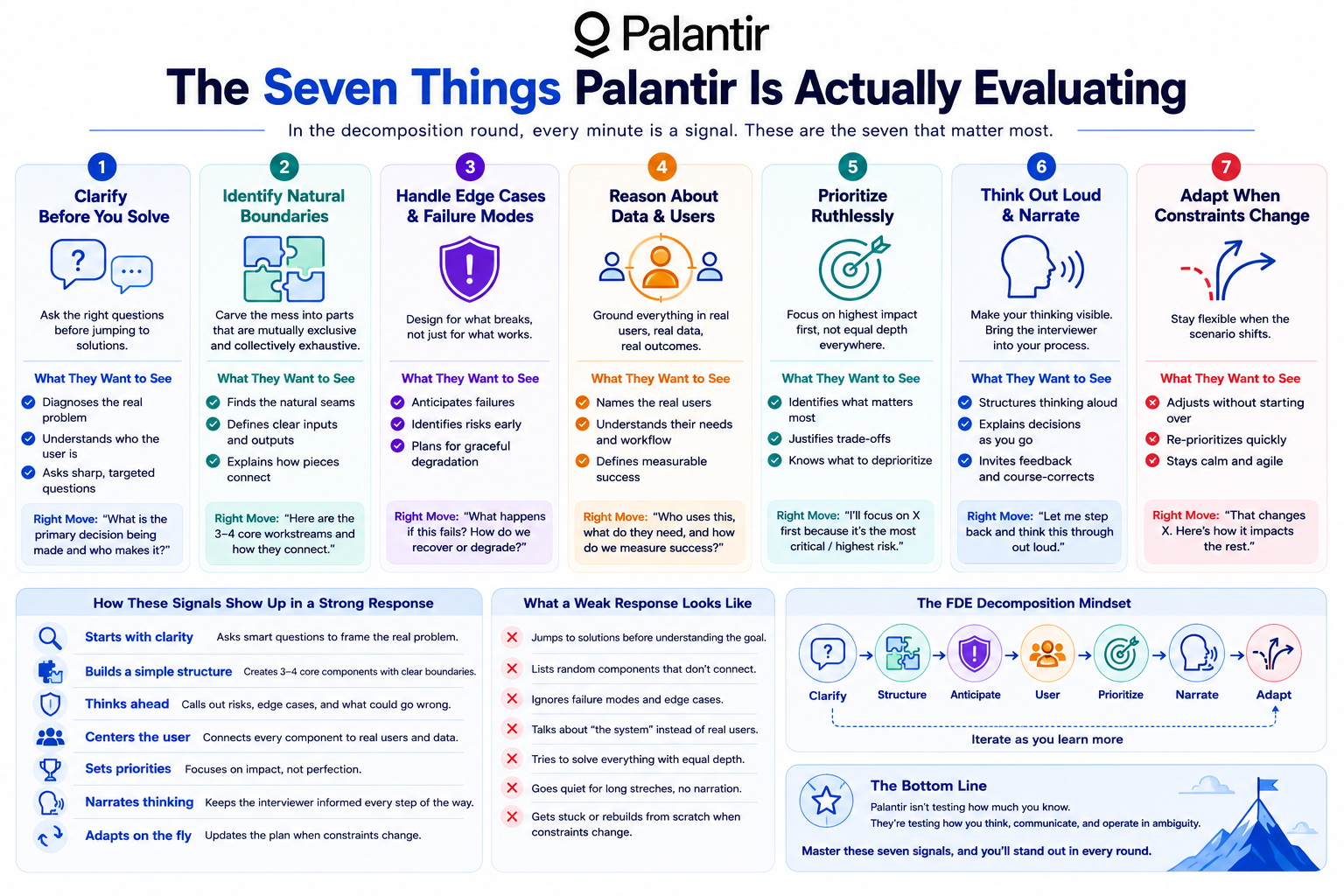
Palantir is looking for seven specific signals in the decomposition round. Understanding each one changes how you approach every minute of the session.
Signal One: Clarify before you solve.
The most common failure pattern in the decomposition round has nothing to do with technical knowledge. The most common failure pattern is jumping to a solution — "I would use a NoSQL database" — before the interviewer has confirmed what the actual goal is.
The 911 emergency response problem described at the beginning of this blog is a perfect example. The candidate who freezes for ninety seconds and then starts designing a database schema has made a critical error. They solved before they understood.
The right opening is not a technical answer. It is a diagnostic question. "What is the primary decision being made and who makes it?" For the 911 problem, the answer could be the dispatcher, the city planner, or the ambulance driver. Each user has a completely different data need and a completely different definition of success. You cannot design anything useful until you know whose problem you are solving.
Start every decomposition round with clarifying questions. Not perfunctory questions you ask out of obligation before starting your real answer. Genuine questions that you need answered before you can make any meaningful progress. The interviewer wants to see that you know what you do not know.
Signal Two: Identify natural boundaries between subproblems.
Once you have enough clarity to begin structuring the problem, your job is to carve the mess into parts that are mutually exclusive and collectively exhaustive. Not arbitrary components. Natural seams in the problem where one responsibility clearly ends and another clearly begins.
For the 911 problem, natural boundaries might be the data ingestion layer that processes incoming call and GPS data, the analysis layer that identifies patterns and predicts response times, the dispatch decision layer that surfaces recommendations to human operators, and the feedback layer that captures outcomes and improves future predictions. Each component has a clear owner, a clear input, and a clear output. They connect to each other without overlapping.
The candidate who lists seven randomly ordered "components" without explaining how they connect, who owns each one, or what problem each one solves is demonstrating surface-level thinking. The candidate who identifies three to four natural seams and explains clearly why each boundary exists where it does is demonstrating the structured thinking that FDE work actually requires.
Signal Three: Handle edge cases and failure modes.
The FDE who builds something in a client's environment and does not think through what happens when the system breaks is the FDE who gets a 3 AM call from a panicked client operations team. Palantir knows this. The decomposition round evaluates whether you think about failure before you have to.
For every component you identify, ask yourself: what happens when this fails? What are the inputs that could break it? What does graceful degradation look like? What is the fallback if the GPS data feed drops?
These questions demonstrate operational maturity — the understanding that production systems fail in ways that the original design did not anticipate and that designing for failure is not pessimism, it is competence.
Signal Four: Reason about data and users explicitly.
The decomposition round is not an abstract engineering exercise. It is a simulation of the discovery work an FDE does at the beginning of a client engagement. The interviewer wants to see that you think about real users with real needs, not generic users with theoretical requirements.
Who uses the system you are designing? What do they actually need it to do for them, in practical terms, in their daily workflow? What data do they have today and what data are they missing? What does success look like in measurable terms that matter to them — not to you as the engineer?
Bringing the user into your decomposition is what separates candidates who think like engineers from candidates who think like FDEs. The engineer optimizes the system. The FDE optimizes the outcome for the person using the system. Palantir is hiring the latter.
Signal Five: Prioritize ruthlessly.
The decomposition problem is always larger than 60 minutes of conversation can fully address. The interviewer knows this. They are evaluating whether you know it too — and whether you can make principled decisions about what to tackle first versus what to defer.
The candidate who tries to address every component with equal depth is demonstrating that they cannot prioritize under pressure. The candidate who explicitly says "I am going to focus on X first because it is the highest-risk component and the others depend on it" is demonstrating the judgment that a Palantir FDE needs when a client engagement has three weeks left and four things left to build.
Prioritization is not admitting defeat. It is demonstrating that you understand what matters most.
Signal Six: Think out loud and narrate your structure.
The decomposition round is collaborative. The interviewer is not watching your final answer — they are watching your thinking process in real time. If you go quiet for two minutes while you think, the interviewer loses visibility into what you are doing. Silence reads as being stuck, even when you are not.
Narrate your structure as you develop it. "I am going to map the inputs first, then decompose into workstreams." "Let me take a second to organize this before I go deeper." "I want to think through the failure modes on this component before I move on."
These narrations do two things simultaneously. They give the interviewer the visibility they need to score your thinking. And they invite the interviewer to redirect you if you are going in a direction that will not serve the conversation — which is information you want to have before you spend ten minutes developing an approach that misses the point.
Signal Seven: Adapt when the constraints change.
Almost every decomposition round includes a moment where the interviewer shifts a constraint. "What if the data feed is delayed by two hours instead of real-time?" "What if the city wants this to run on their existing infrastructure instead of in the cloud?" "What if the budget only allows for one additional analyst?"
This constraint shift is not an attack on your design. It is an evaluation of whether your thinking is brittle or flexible. The candidate who has to rebuild their entire answer from scratch when a constraint shifts is demonstrating the same fragility that would cause problems in a client engagement where requirements change weekly.
The candidate who says "that changes the prioritization of the real-time component — let me think through what that means for the rest of the architecture" is demonstrating the adaptive thinking that defines exceptional FDE work.
The Seven Most Common Failure Patterns — And What Each One Signals to the Interviewer
Most decomposition round rejections follow one of these seven patterns. Recognizing your own tendencies before you walk into the room is the most valuable preparation you can do.
Failure Pattern One: Jumping to solutions before clarifying the problem.
What it looks like: The candidate hears the prompt and immediately starts designing components, suggesting technologies, or proposing a data schema without asking a single clarifying question.
What the interviewer sees: A candidate who does not know what they do not know. An FDE who arrives at a client site and starts building before understanding the problem is one of the most expensive mistakes a deployment team can make.
The fix: The first two to three minutes of a decomposition round should contain zero solutions and multiple clarifying questions. Write down the questions before you ask them if that helps you organize your thinking.
Failure Pattern Two: Treating it like a system design interview.
What it looks like: The candidate maps out a standard distributed systems architecture — load balancers, message queues, microservices — with the same approach they would use for a "design Twitter" or "design a URL shortener" prompt.
What the interviewer sees: A candidate who prepared for the wrong interview. The decomposition round is not asking you to design a scalable distributed system. It is asking you to understand a messy business problem and structure it into buildable parts. The technology choices are secondary to the problem understanding.
The fix: Before you mention any specific technology, make sure you have answered: who uses this, what decision does it support, what data exists, and what does success look like in business terms.
Failure Pattern Three: Over-structuring with a memorized framework.
What it looks like: The candidate applies a rigid consulting or product management framework — MECE, STAR, Jobs-to-Be-Done — mechanically to a problem that does not fit the framework cleanly, producing an answer that feels formulaic rather than genuine.
What the interviewer sees: A candidate who is performing structured thinking rather than actually thinking structurally. Over-structuring a messy problem with a memorized framework is the fastest way to fail. Palantir does not want to see a framework applied. They want to see natural structure emerge from genuine engagement with the problem.
The fix: Use frameworks as checklists to ensure you have not missed major categories — but adapt them to the specific problem in front of you rather than forcing the problem into the framework's shape.
Failure Pattern Four: Failing to break the problem down sufficiently.
What it looks like: The candidate identifies two or three high-level components — "a data layer, a processing layer, and a presentation layer" — without going deep enough into what each component actually does, what it needs, and how it connects to the others.
What the interviewer sees: Surface-level thinking that would not produce anything buildable in a real engagement. An FDE who delivers "a processing layer" to a client team and considers their job done has not done anything useful.
The fix: For each component you identify, push one level deeper. What specifically does this component do? What are its inputs and outputs? Who owns it? What does failure look like? If you cannot answer these questions, you have not decomposed the problem sufficiently.
Failure Pattern Five: Going silent under pressure.
What it looks like: The candidate pauses for extended periods without narrating their thinking, especially after a constraint change or a question from the interviewer that they did not expect.
What the interviewer sees: A candidate who may be stuck, even if they are not. In a client environment, silence in a high-stakes conversation reads as uncertainty. The FDE who goes quiet when an executive asks a hard question loses the room.
The fix: Develop the habit of thinking out loud during practice. Record yourself working through decomposition problems and listen back to identify the moments where you go silent. Those are the moments to develop narration habits.
Failure Pattern Six: Ignoring users and business context.
What it looks like: The candidate designs a technically elegant system without ever anchoring it to who uses it, what decision it supports, or what business outcome it produces.
What the interviewer sees: An engineer, not an FDE. The FDE role exists because technical capability alone is insufficient — someone needs to connect the technical work to the business reality. A candidate who cannot demonstrate this connection in a 60-minute round is unlikely to demonstrate it in a six-month client engagement.
The fix: Return to the user and the business outcome at every transition point in your answer. "This component exists because the dispatcher needs to see X in order to make decision Y within Z timeframe."
Failure Pattern Seven: Failing to adapt when constraints shift.
What it looks like: When the interviewer changes a constraint, the candidate either restates their original design unchanged or rebuilds from scratch without demonstrating that they understand why the constraint change matters.
What the interviewer sees: Rigid thinking that will struggle in the ambiguous, constantly-shifting environment of an FDE engagement. Client requirements change. Constraints shift. The FDE who can only operate against a fixed specification is the FDE who will struggle when the client changes direction three weeks into an eight-week engagement.
The fix: Practice constraint shifts deliberately in your preparation sessions. After you develop an initial decomposition, deliberately change one constraint and work through what changes and what stays the same. Do this until the adaptive response feels natural rather than effortful.
The Framework That Actually Works: The Five-Step Decomposition Approach
Here is the repeatable framework that produces passing scores in the Palantir decomposition round. It is not a rigid formula — it is a sequence of thinking that keeps you on the right track when the pressure makes it tempting to skip steps.
Step One: Ask the diagnostic question first. Always.
Before anything else: "What is the primary decision being made and who makes it?"
This question forces you to anchor the entire decomposition to a real user making a real decision rather than an abstract system solving an abstract problem. Every subsequent decision flows from the answer.
Step Two: Surface the constraints you were not given.
Follow the diagnostic question with two or three constraint questions. What data exists today? What is the timeline? What does success look like in measurable terms? Are there compliance or regulatory constraints on the data?
You are not asking these questions to delay your answer. You are asking them because you genuinely cannot design anything useful without them. Let the interviewer see that you know this.
Step Three: State your decomposition structure before you develop it.
Before you go deep on any component, sketch the full structure at a high level. "I am going to break this into four components — data ingestion, analysis and modeling, decision support, and feedback loop. Let me walk through each one."
This preview does two things. It gives the interviewer a map of where you are going — which allows them to redirect you if you are heading somewhere unhelpful. And it demonstrates that you have a plan rather than improvising component by component.
Step Four: Develop each component with user and failure mode thinking.
For each component: what does it do, who uses it, what are its inputs and outputs, what does failure look like, and what is the fallback?
Do not go deeper than this level of detail unless the interviewer asks you to. The goal is coverage and connection, not exhaustive technical specification.
Step Five: Prioritize explicitly and invite the constraint shift.
After your initial decomposition, explicitly prioritize. "Of these four components, the analysis and modeling layer carries the most implementation risk and the others depend on it — so I would start there." Then invite the constraint shift: "Does that prioritization change if there are any constraints I have not accounted for?"
This invitation signals that you know your decomposition is provisional and that you are ready to adapt. It also gives the interviewer a natural opening for the constraint change they were going to introduce anyway.
What the 911 Problem Should Have Looked Like
Let us go back to the candidate who froze and started designing a database schema. Here is what a passing approach to the same prompt looks like.
"Before I design anything — who is this system primarily for? The dispatcher who is routing ambulances in real time, the city planner who is evaluating long-term infrastructure decisions, or the ambulance crew who needs turn-by-turn routing? The data requirements and the decision latency are completely different for each of those users."
The interviewer answers: the primary user is the dispatcher.
"Got it. And what is the dispatcher currently doing without this system — are they making routing decisions manually based on phone calls, or do they have some existing tool that we are improving on?"
The interviewer answers: they are doing it manually and the average response time is 11 minutes.
"And is there a target response time the city is trying to achieve? And do we know the primary driver of the current 11-minute average — is it routing decisions, traffic, or dispatch delays?"
The interviewer answers: the target is 8 minutes and the primary driver appears to be routing.
"Okay. So the core problem is helping a dispatcher make a better routing decision faster when a 911 call comes in. Let me decompose this into four components..."
Notice what happened. The candidate spent three to four minutes asking questions before proposing a single component. By the time they started their decomposition they knew who the user was, what decision the user needed to make, what the current baseline looked like, and what the specific bottleneck was. Every component they propose from that point is anchored to a real problem that a real person needs solved.
That is the difference between a "Strong Hire" and a "Strong No Hire" in the decomposition debrief.
How to Practice for This Round Specifically
The decomposition round is the hardest interview round to prepare for alone — because the value of the round comes from the collaborative dynamic and the constraint shifts that require you to adapt in real time. You cannot develop that adaptation by studying notes or reading blogs.
You need reps with real partners.
Here is the specific practice protocol that we use in our program with FDE candidates preparing for Palantir interviews.
Practice one: The opening drill.
Take any vague real-world problem — a hospital wants to reduce wait times, a logistics company wants to reduce delivery failures, a financial services firm wants to detect fraud faster — and practice the opening five minutes exclusively. Not the full decomposition. Just the clarifying questions and the structure preview. Record yourself. Listen back. Identify the first moment where you propose a solution before you have earned the right to propose one. That is your weak point.
Practice two: The full decomposition with a partner.
Give your practice partner four to five decomposition prompts and ask them to play the role of the interviewer. They ask the question and sit mostly quiet while you work through the five-step framework. After 20 minutes they introduce a constraint change. Do this weekly. After three to four sessions the framework starts to feel natural rather than deliberate.
Practice three: The constraint shift drill.
Take a decomposition you have already developed and deliberately shift one constraint. Work through what changes. Then shift a different constraint. The goal is to develop the mental flexibility to update your thinking without rebuilding it from scratch.
Practice four: The narration audit.
Record a full practice decomposition and listen back specifically for silence. Every moment longer than five seconds where you are not narrating your thinking is a moment to develop a narration habit. The goal is not to talk constantly — it is to ensure that your thinking is always visible to the interviewer.
The TechCareers.io Advantage for This Specific Round
Here is what makes our program different from every other FDE interview preparation resource for the decomposition round specifically.
We have access to the actual prompts and scenarios that specific Palantir teams are using in their decomposition rounds right now. Not the sanitized versions that candidates share on Reddit after their interviews. The real scenarios from the hiring manager intelligence available through our Paraform recruiter relationship.
We know which domains the healthcare team is using in their decomposition prompts. We know which constraint shifts the defense team is most likely to introduce. We know what the AIP team's decomposition problems look like and how they differ from the problems used in the Foundry-focused interviews.
This is the intelligence that turns a well-prepared candidate into a specifically prepared candidate. The person who has practiced the right types of problems for the right team in their interview loop walks into that round in a completely different position than the person who has practiced generic system design problems and hoped for the best.
Our mock interview sessions are calibrated to the specific team and role you are interviewing for. The partners you practice with are familiar with the decomposition format from the practitioner side. And the feedback after each session is specific — not "you need to clarify more" but "you jumped to the data model before you asked who the primary decision-maker was, and that is the specific failure pattern we see most often in candidates interviewing with that team."
That specificity is what changes outcomes.
Schedule Your Forward Deployed Engineering Strategy Session
If you have a Palantir FDE interview coming up — or if you are building toward one and want to understand what the preparation actually looks like — book a strategy session with our team.
We will tell you honestly where your decomposition thinking is right now and what the specific preparation looks like for the team you are targeting.
Book your session here: https://consultation.techcareers.io/o-discover-fde/about
Frequently Asked Questions
What is the Palantir decomposition case study?
The decomposition interview is an open-ended, collaborative session where you are given a deliberately vague, real-world problem and asked to break it down into solvable parts while explaining your reasoning. Palantir invented and popularized the format and most companies hiring forward deployed engineers have since adopted a version of it. The round runs 45 to 60 minutes, carries the highest weight of any round in the FDE interview process, and has approximately a 40 percent pass rate. The problem is intentionally under-specified — you are not told the scope, the constraints, or what success means. Surfacing those gaps through clarifying questions is part of the evaluation.
Why do most candidates fail the Palantir decomposition round?
Most candidates fail because they jump to a solution before clarifying the business constraints. The most common failure pattern is proposing a technical architecture — a database schema, a microservices design, a data pipeline — before understanding who the user is, what decision the system needs to support, and what success looks like in measurable business terms. Candidates who have prepared for standard system design interviews are particularly susceptible to this failure because they have been trained to start designing quickly. The decomposition round penalizes exactly that instinct.
How is the Palantir decomposition round different from a system design interview?
A system design interview gives you a well-defined problem — design Twitter, design a URL shortener — and evaluates your technical architecture decisions. The decomposition round gives you a deliberately vague real-world problem where the scope, constraints, and success criteria are intentionally missing. The first job of the candidate is to surface those gaps through clarifying questions before proposing any design. Over-structuring a messy problem with a memorized framework is the fastest way to fail.
What does Palantir actually evaluate in the decomposition round?
Palantir evaluates seven signals: clarifying before solving, identifying natural boundaries between subproblems, handling edge cases and failure modes, reasoning about data and users explicitly, prioritizing ruthlessly across components, thinking out loud to make reasoning visible, and adapting when constraints change. The interviewer is not scoring whether you reach a correct answer — they are scoring how you move toward a solution when the path is not defined.
What kind of prompts appear in the Palantir decomposition round?
Prompts are real-world enterprise or government problems with deliberately missing constraints. Examples include: a city wants to reduce 911 emergency response times and has access to call data, traffic data, and ambulance GPS data — design a system for this. A hospital wants to reduce patient wait times using their existing appointment and staffing data. A logistics company wants to predict package delivery failures before they happen. The specific prompts vary by team — the healthcare team uses different scenarios than the defense team, which uses different scenarios than the AIP commercial team.
How should you open a Palantir decomposition round?
Your first statement should be a diagnostic question, not a solution. The most effective opening question is "What is the primary decision being made and who makes it?" This anchors the entire decomposition to a real user making a real decision. Follow it with two to three constraint questions — what data exists today, what is the timeline, what does success look like in measurable terms — before proposing any component of a design.
How many practice sessions do you need before the decomposition round?
Three to five structured practice sessions with a partner using the five-step framework is the minimum effective preparation. The sessions need to include real-time constraint shifts — not just practice on the initial prompt but practice adapting when a constraint changes mid-decomposition. Solo study of frameworks and examples is insufficient because the value of the round comes from the collaborative dynamic that requires real-time adaptation.