How to Pass the Palantir FDE Interview: Decomp, Delta vs. Echo, and What Actually Gets You the Call
One of our coaches just walked a group of people through the Palantir FDE interview process live — while she’s actively in it.
https://www.linkedin.com/in/catherine-theuer/
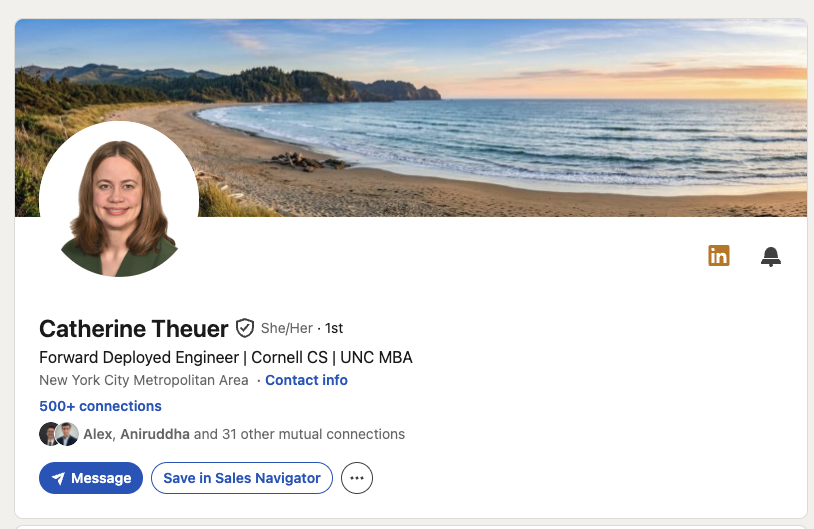
Her name is Catherine. She’s a former software engineer turned product manager turned solutions architect. And a few weeks ago, a Palantir recruiter slid into her DMs — not because she applied, not because we submitted her through a job board — but because her LinkedIn showed up on their radar.
Here’s what she did, what she learned, and what it means for your career.
How the Interview Found Her (Not the Other Way Around)
Catherine wasn’t job hunting in the traditional sense. She made a decision: she wanted to transition into Forward-Deployed Engineering, and she reverse-engineered what that would require her to demonstrate publicly.
She identified a gap — she had the technical and customer-facing skills, but hadn’t showcased her ability to teach. So she started a YouTube channel. She began posting daily LeetCode solutions to GitHub. She showed up consistently on LinkedIn — not posting long original essays every day, but reposting valuable content from others in the space. That consistent activity signaled to the algorithm that she was an engaged, knowledgeable professional in the AI and engineering world.
A Palantir internal recruiter reached out.
No application. No cold outreach. No job board.
One note worth being clear about: TechCareers does recruit on Paraform, and Palantir is one of the companies on that platform.
But this interview was not generated through Paraform. It came through Catherine’s own LinkedIn presence. That distinction matters — building your signal on LinkedIn is the real leverage point, and that’s what we help you develop.
The 5-Stage Palantir FDE Process (What Most Guides Get Wrong)
Most interview guides treat the Palantir process like a standard tech interview. It is not. Here’s what you’re actually walking into:
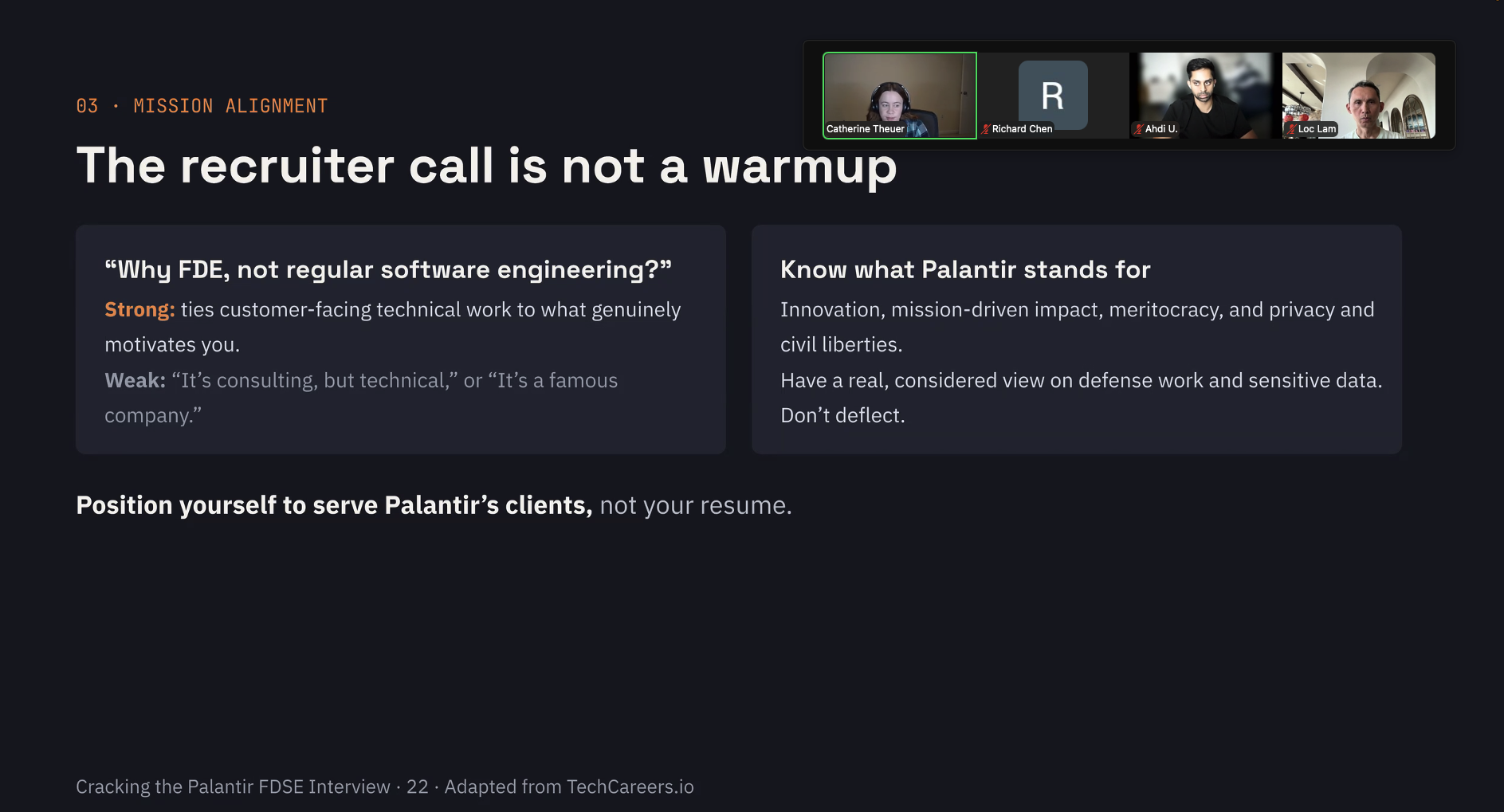
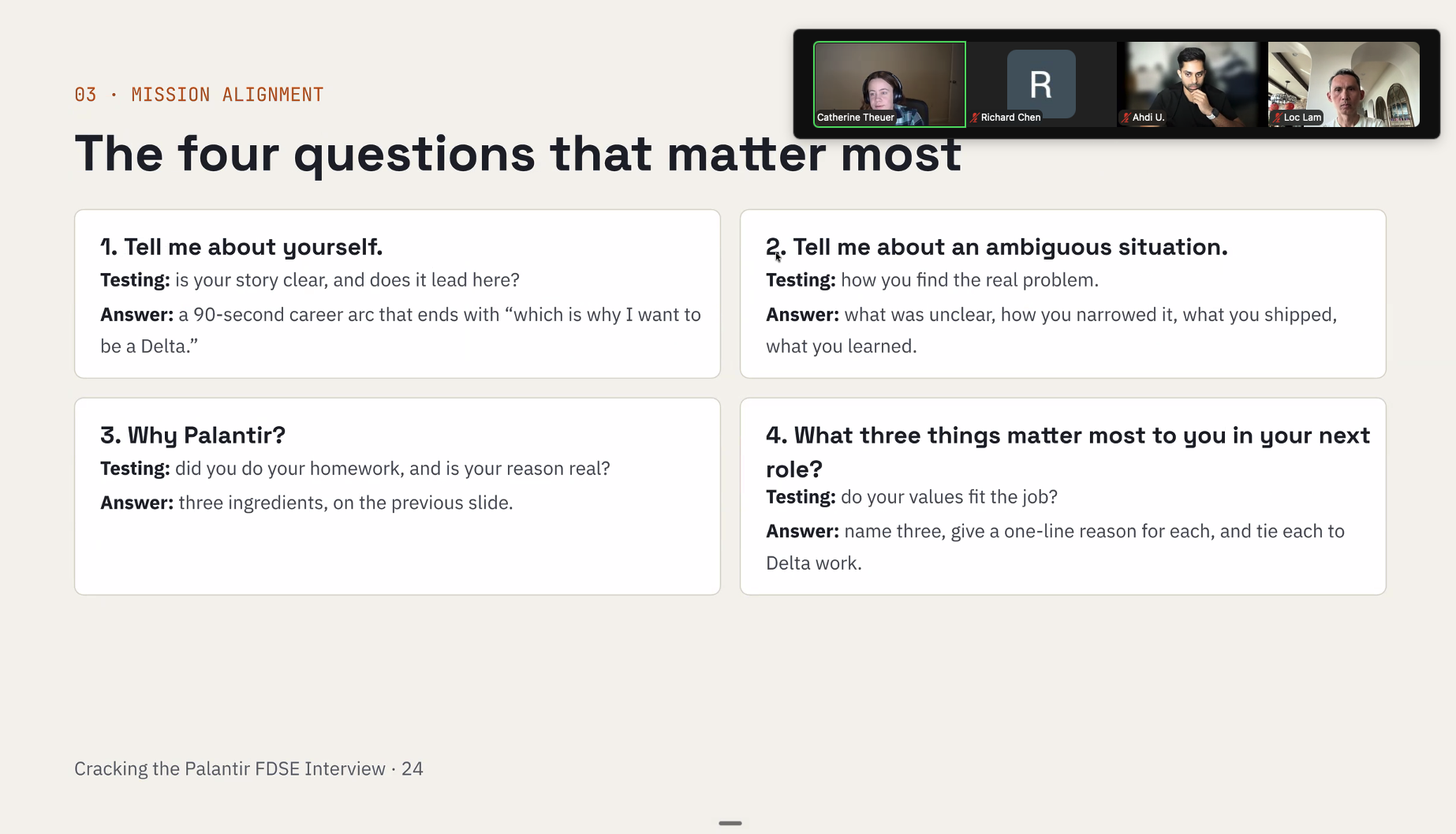
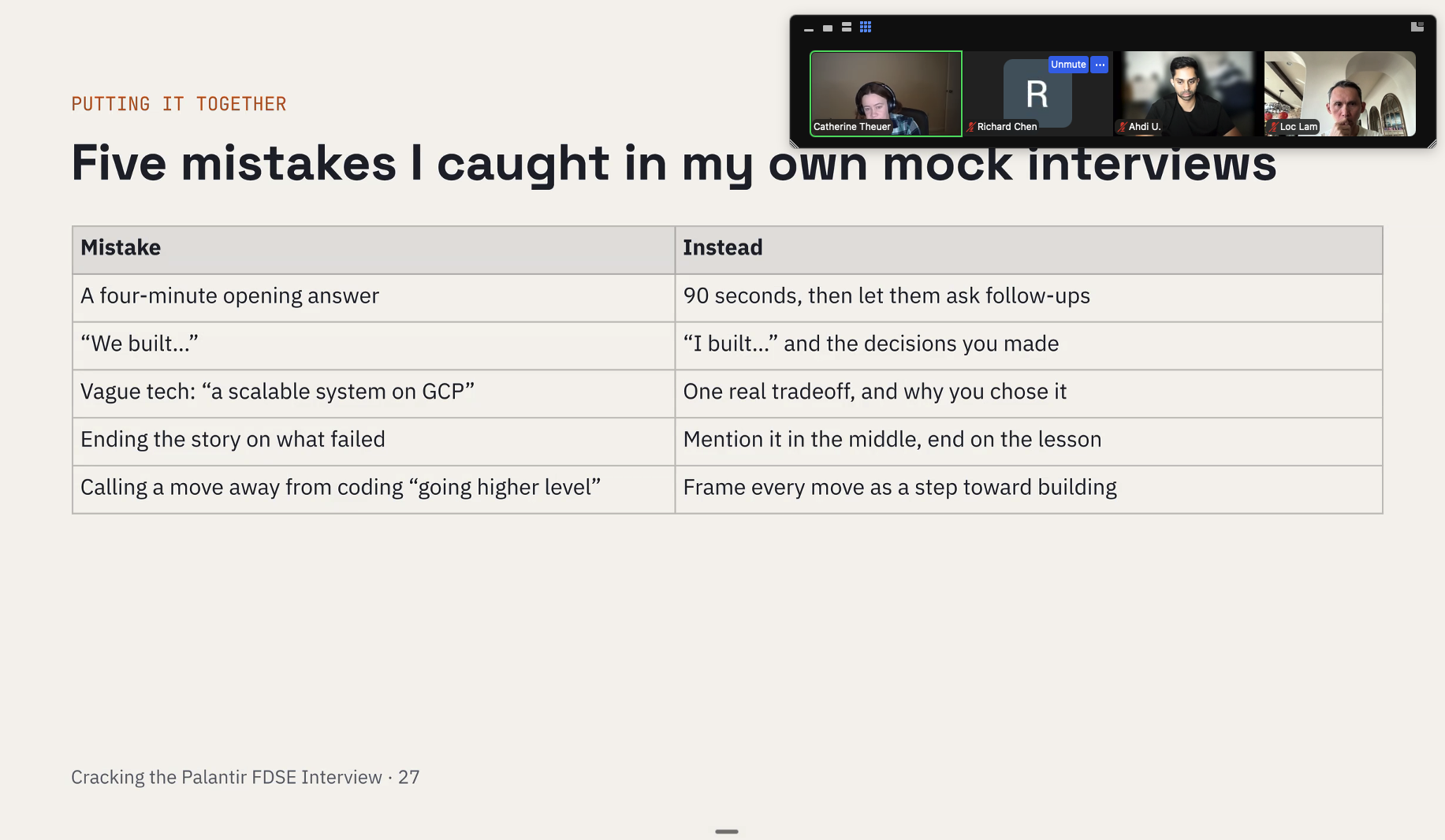
Stage 1 — Recruiter Screen. This is not a warm-up call. Palantir sends you prep documents beforehand and expects you to have done them. Your story needs to be tight — 90 seconds, tied directly to why you specifically want to be a Delta. If you can’t answer “Why Palantir?” with something that’s only true of Palantir, you’re behind.
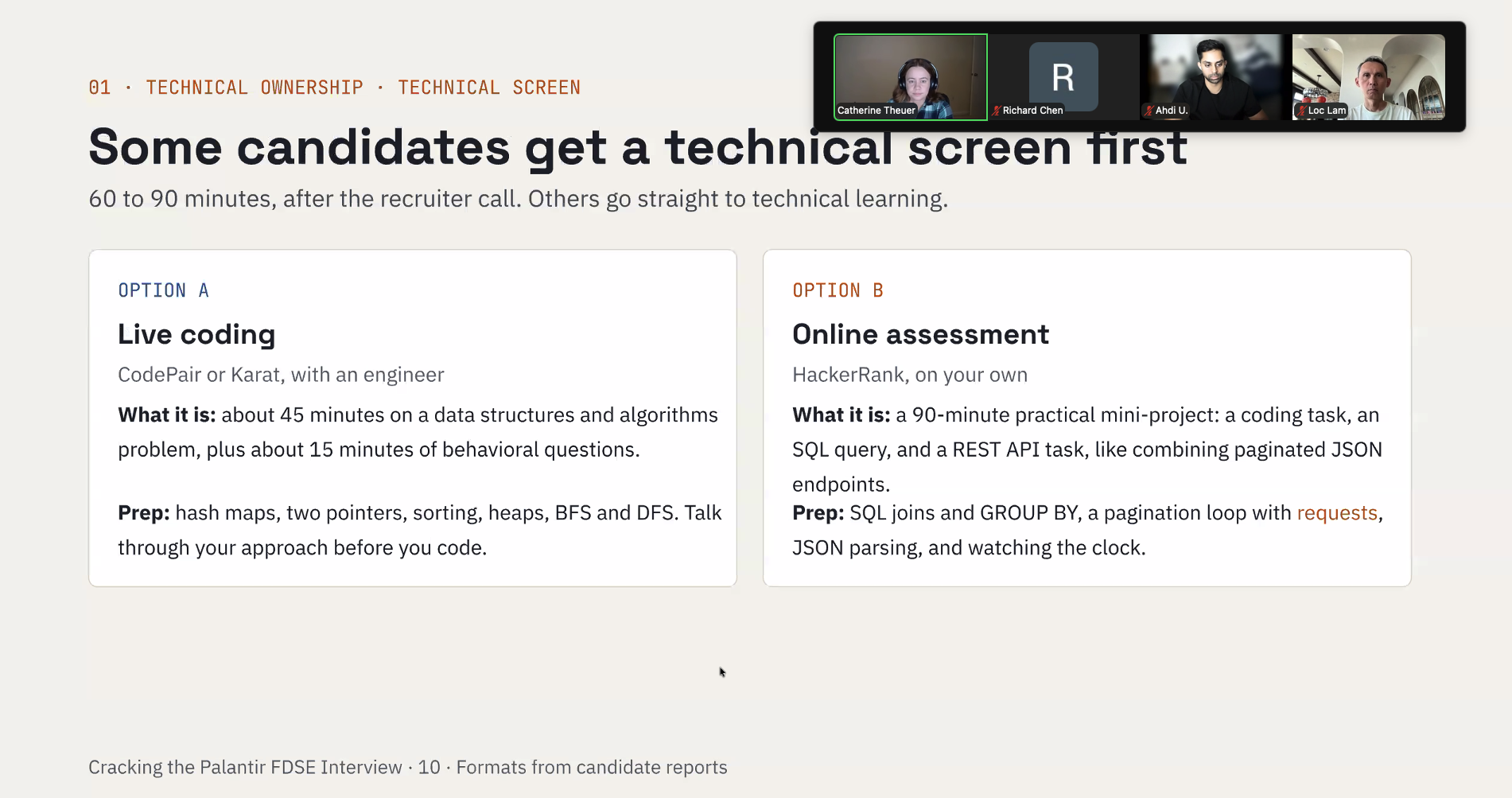
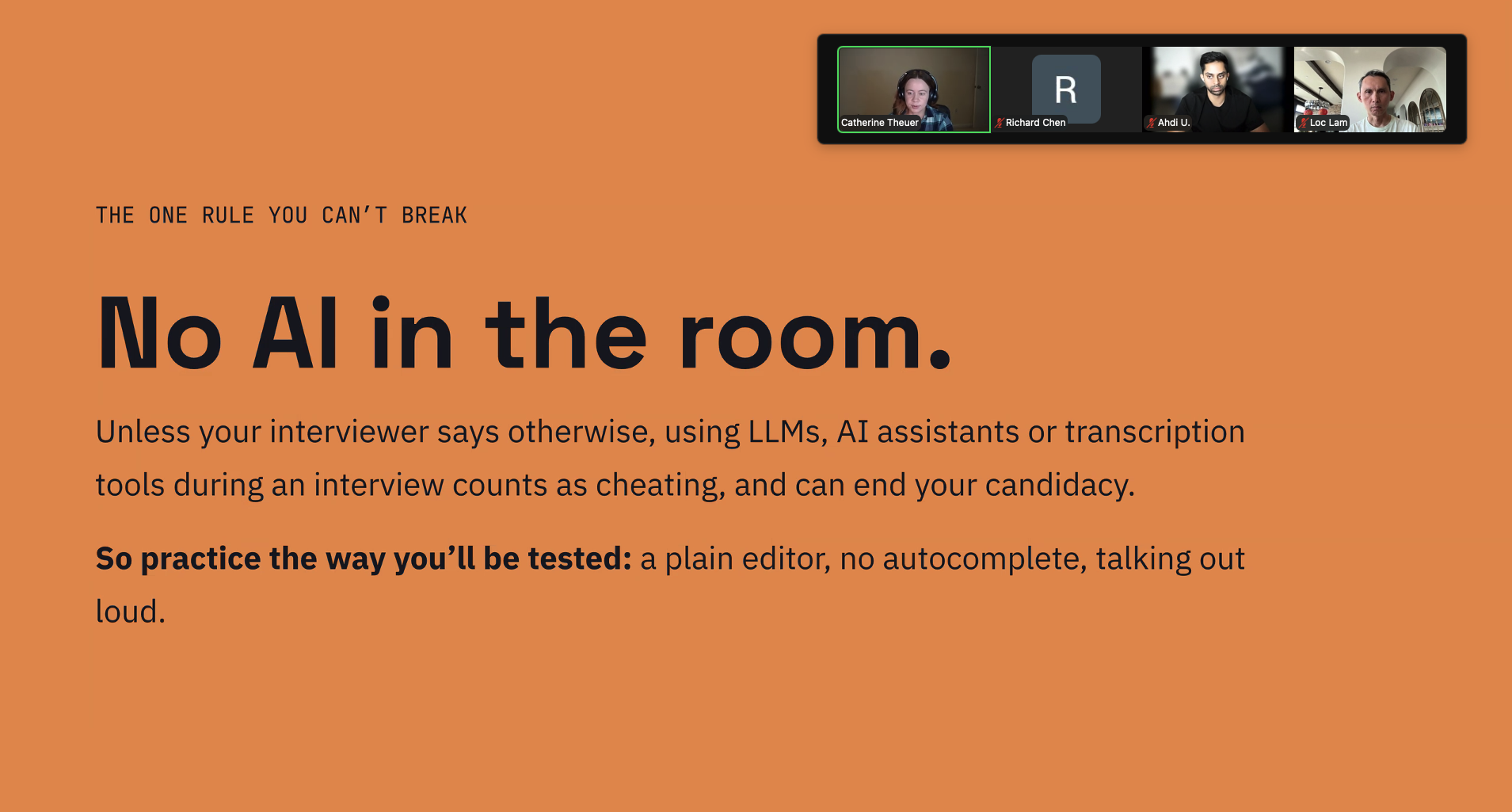
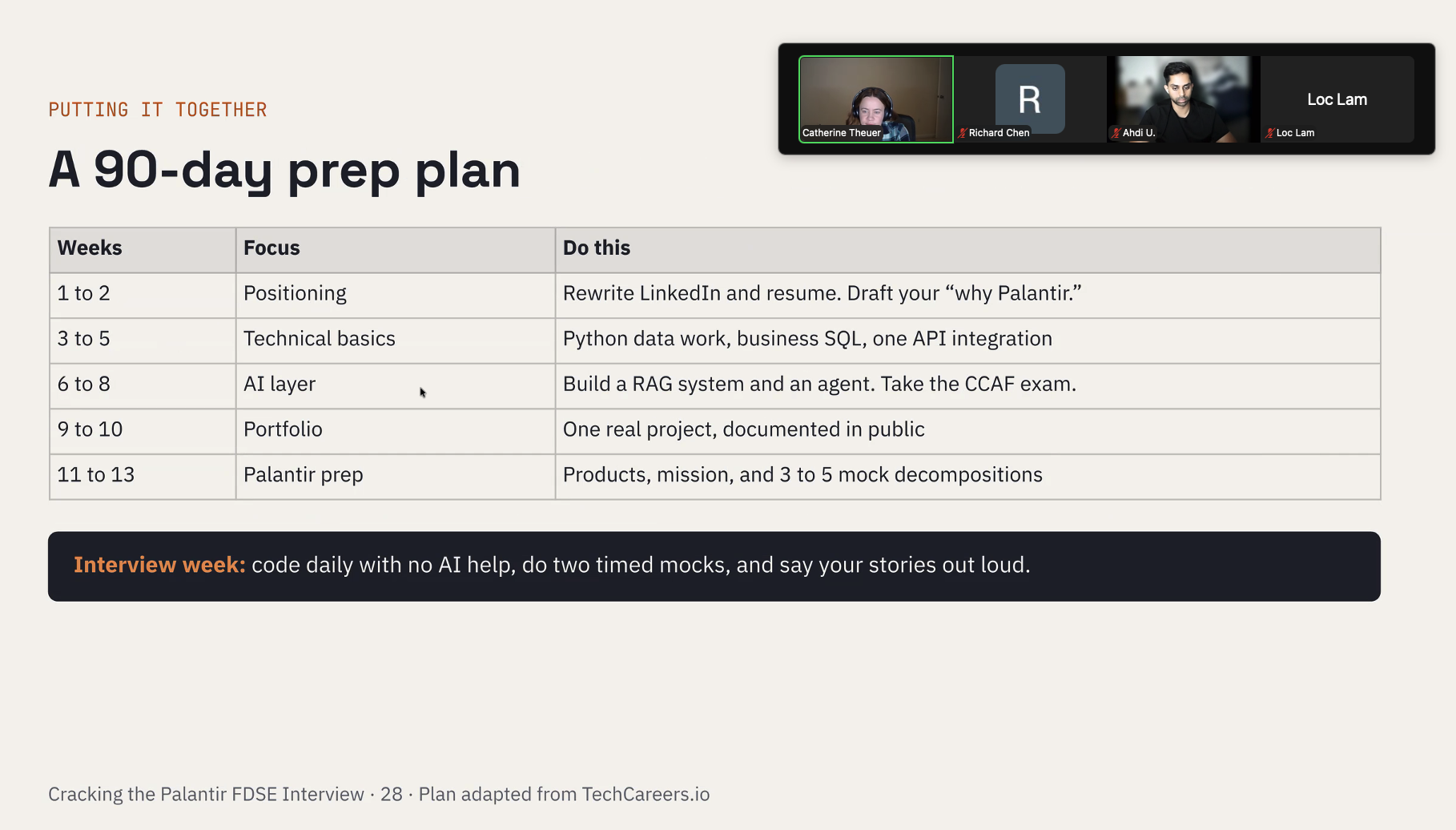
Stage 2 — Technical Learning. You’re dropped into an unfamiliar codebase and asked to do something in it. The interview adapts to you — they find what you’re strong at and where you break down. No AI allowed. This is straight-from-memory code. If you’ve been leaning on Copilot for a year (Catherine admits she has), now is the time to get back to basics in Python and potentially Node.js.
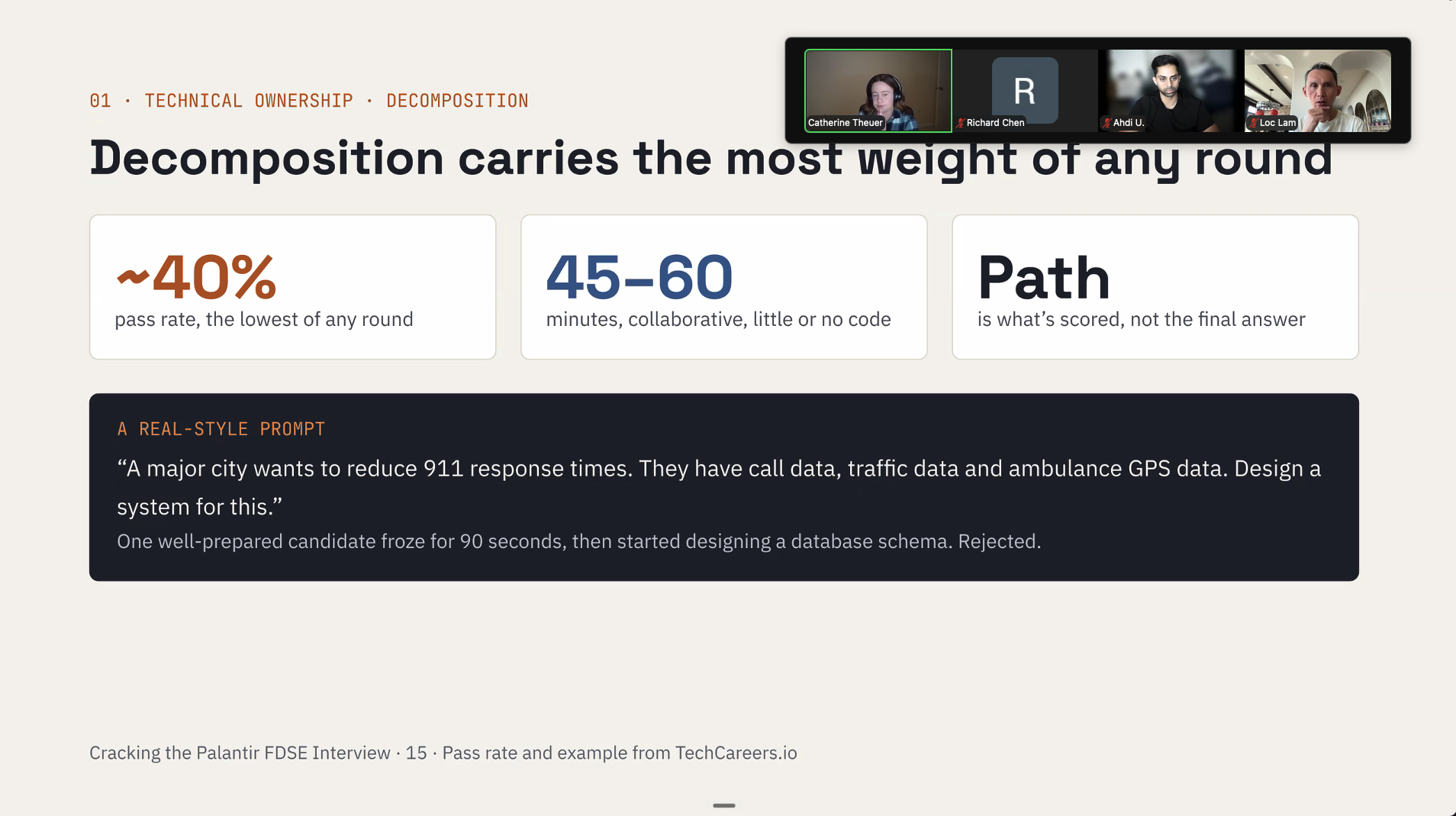
Stage 3 — Decomposition. This is the round where most candidates fail. We’ll go deep on this below.
Stage 4 — Deep Dives. Optional additional interviews. You should be prepared to code in all of stages 2 through 4.
Stage 5 — Hiring Manager Match. The final pairing.
The Decomp Round: Why Engineers Fail It and How to Pass It
Decomposition is not a system design interview. It is not a consulting case interview. It is something in between — and the candidates who treat it like either one tend to fail.
Here’s the example prompt Catherine used in the webinar:
“A major city wants to reduce 911 response times. They have call data, traffic data, and ambulance GPS data. Design a system for this.”
One candidate, upon hearing this, froze for 90 seconds — then started designing a database schema. That is exactly wrong.
What Palantir is actually testing:
They want to see how you operate under ambiguity in the real world. An FDE lands at a hospital, a military base, or a factory floor, and has to figure out what the actual problem is before building anything. The decomp round simulates that.
What the right answer looks like:
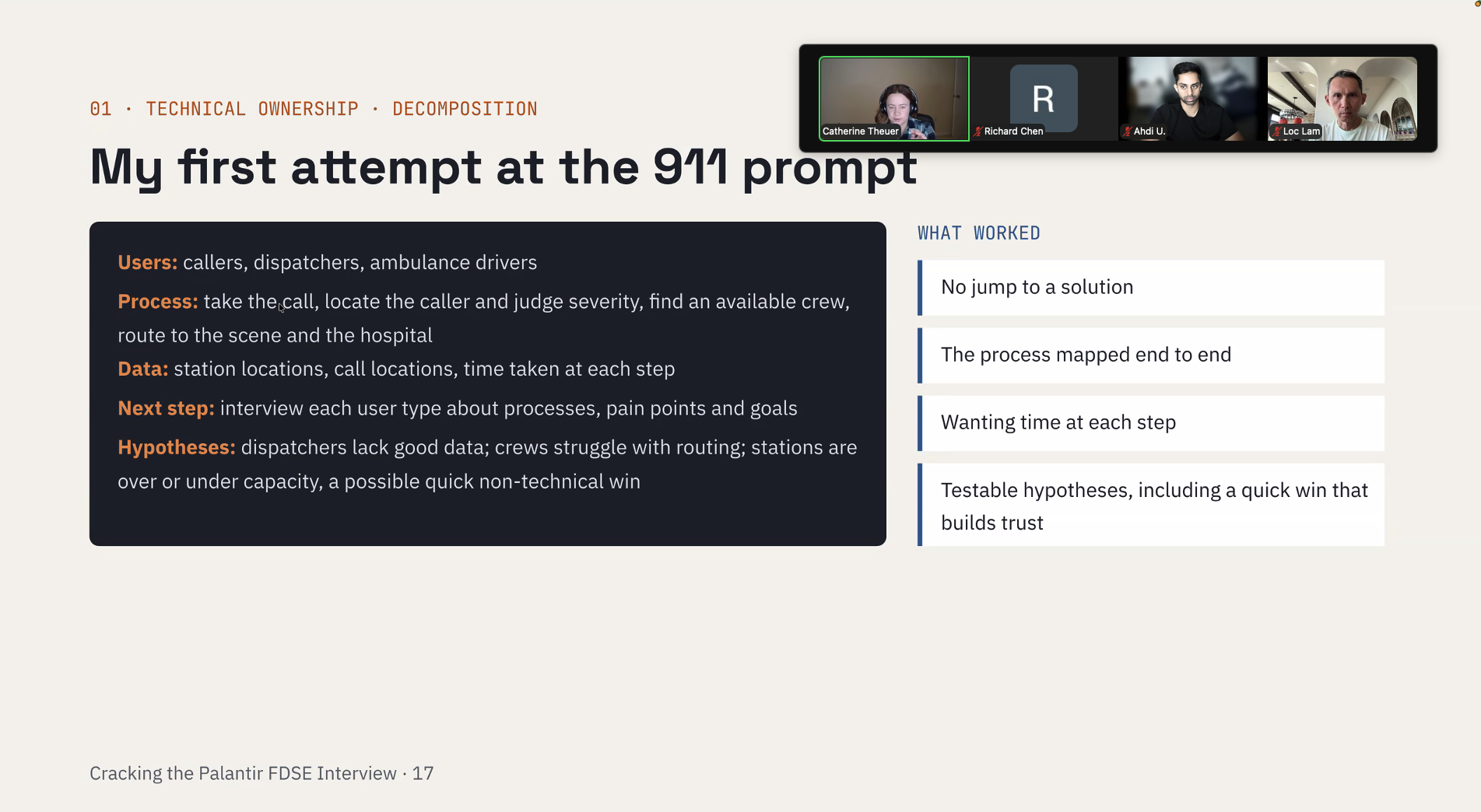
Before you touch code, you ask clarifying questions. Who are the users in this system? What do they currently do? Where is the actual breakdown in the process — is it that dispatchers don’t have good data, or that crews can’t navigate efficiently, or that stations are misallocated? What does success look like in 30 days?
Catherine’s instinct was solid: ask about user segments, map the current process, surface hypotheses, and then — importantly — identify a quick non-technical win that builds trust with the client before you build anything complicated.
The key moves:
- Ask at least 2–3 clarifying questions before you touch a keyboard. If you haven’t done this, it is not time to code.
- Anchor everything in user experience and business metrics — not system elegance.
- Avoid memorized consulting frameworks. They read as canned.
- Stay vocal. Going silent kills you. If you need a moment, say “Can I take 30 seconds to structure this?” and keep the interviewer in the doc with you.
- Expect a curveball. They will throw a new constraint at you mid-exercise to see how you adapt. This is intentional. It’s simulating a client who just told you their legacy system can’t support your architecture. React, don’t freeze.
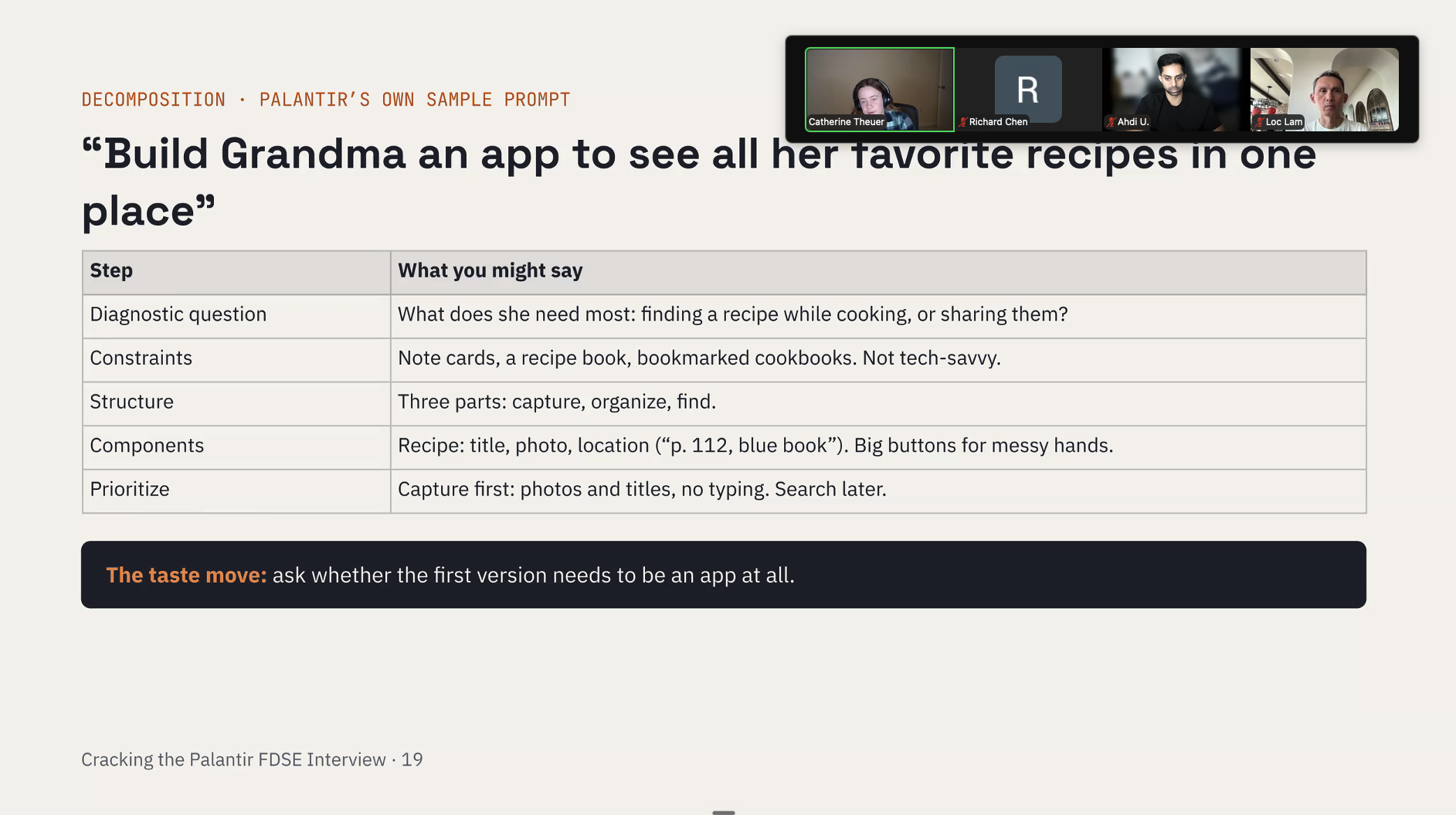
The “grandma’s recipes” example from the webinar captures the spirit of this perfectly: sometimes the right answer is the non-technical one. Before you design a database, ask what she’s actually trying to do with those recipes.
Overbuilding is a failure mode here.
Delta vs. Echo: The Difference That Matters
A question came up in the webinar about Palantir’s role structure.
Here’s the short version:
- Delta = Forward-Deployed Engineer. This is the builder. They go on-site at the client, diagnose the real technical problem, and build solutions in the environment. They code. They adapt. They ship.
- Echo = Deployment Strategist. This is closer to a technical PM or pre-sales role. They go in first, map the problem space, and set up what the Delta will build. Less coding, more strategy and client navigation.
For FDE candidates: you should prepare for both sides of the job.
An FDE frequently discovers that what the Deployment Strategist told the client is feasible — isn’t. You need to be ready to have that conversation.
The Four Things Palantir Actually Scores You On
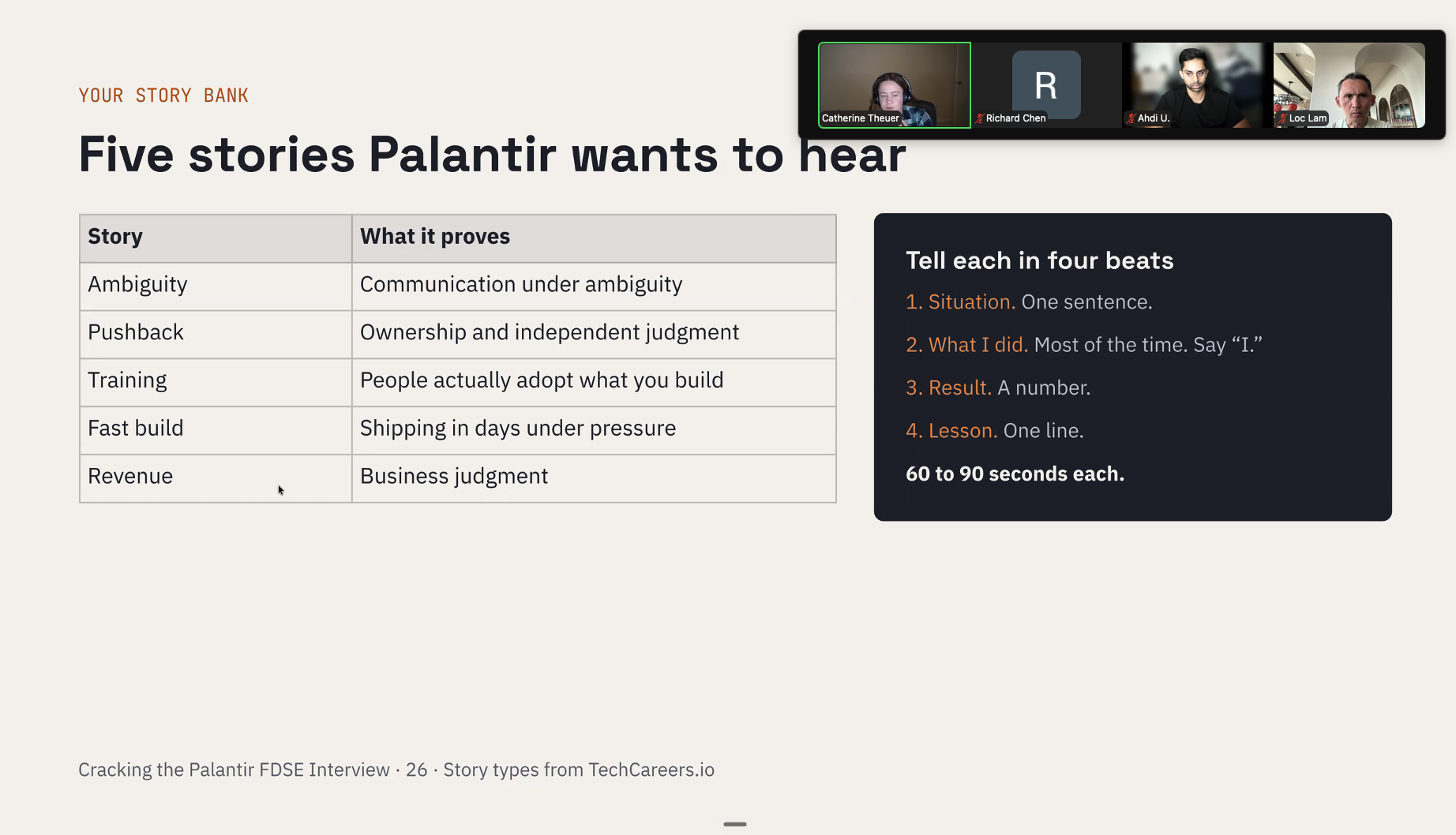
- Technical Ownership — Can you write code from scratch, own the outcome, and talk about what it actually accomplished? Not what you built — what changed because you built it.
- Communication Under Ambiguity — The decomp round is primarily a test of this. Can you walk into the unknown and create structure in real time?
- Mission Alignment — Why Palantir? Not a generic answer. Something specific, something that shows you’ve done the work, something that’s only true of them. Catherine admits she underperformed on this in her first round and is going back to sharpen it.
- Revenue and Business Judgment — Whatever you build, tie it to commercial impact. Palantir measures itself by how much it improves their clients’ performance. Your stories need to end in business results.
What’s She Doing Right Now?
Catherine closes the webinar with something worth sitting with: she is currently receiving recruiter outreach daily. She is not applying to most of the jobs she’s interviewing for. They are coming to her.
That is the outcome of a deliberate, compounding LinkedIn presence built over a few months — posting, reposting, showing up on GitHub, doing a podcast, starting a YouTube channel. None of it individually is revolutionary.
Together, it made her magnetic to the exact recruiters she wanted to find her.
She is not done with the Palantir process. She has the technical screen coming up. She is preparing in real time, and she is sharing that preparation openly with our community.
If You Want This for Yourself
The FDE path is one of the most compelling career trajectories in tech right now.
The founders of ElevenLabs, Decagon, and several other companies you know came through Palantir.
The Delta network is real.
The doors it opens are real.
TechCareers works with technical professionals who are ready to make this transition — not as a bootcamp, not as a job board, but as a strategic career partner. We help you build the positioning, the story, the technical preparation, and the network to land roles like this.
If you want to understand whether the FDE path is right for you and what it would take to get there, schedule a call with us.
The link is below.
https://consultation.techcareers.io/o-discover-fde/about
Catherine Theuer is a coach of the TechCareers community. This webinar was delivered live to our community. All insights are drawn from her real-time experience in the Palantir interview process.
PS
If you enjoyed this session, please come to our Tech Careers Luma to stay up to date on all of our live trainings.