
Palantir Forward Deployed Engineer vs Software Engineer: What Is Actually Different
The Question Every Software Engineer Is Asking Right Now
Something is happening inside the software engineering community that was not happening two years ago.
Engineers who have been happily writing code, shipping features, and managing backlogs for years are suddenly looking at the forward deployed engineering job postings flooding their LinkedIn feeds and asking a question they have never seriously considered before.
Is this role actually better than what I am doing right now?
It is a good question. And the honest answer is that it depends entirely on who you are, how you are wired, and what you actually want from your career. The FDE role is not universally better than software engineering. It is not universally worse. It is a fundamentally different job that rewards a fundamentally different set of characteristics.
What this blog is going to do is give you the clearest, most honest comparison available anywhere. What the two roles actually look like day to day. What they pay. Where they go long term. What kind of person thrives in each. And how to know which one is actually right for you.
We are going to start with something Palantir published themselves, because they invented the distinction and they described it better than anyone else has.
How Palantir Defines the Difference: Devs Versus Deltas
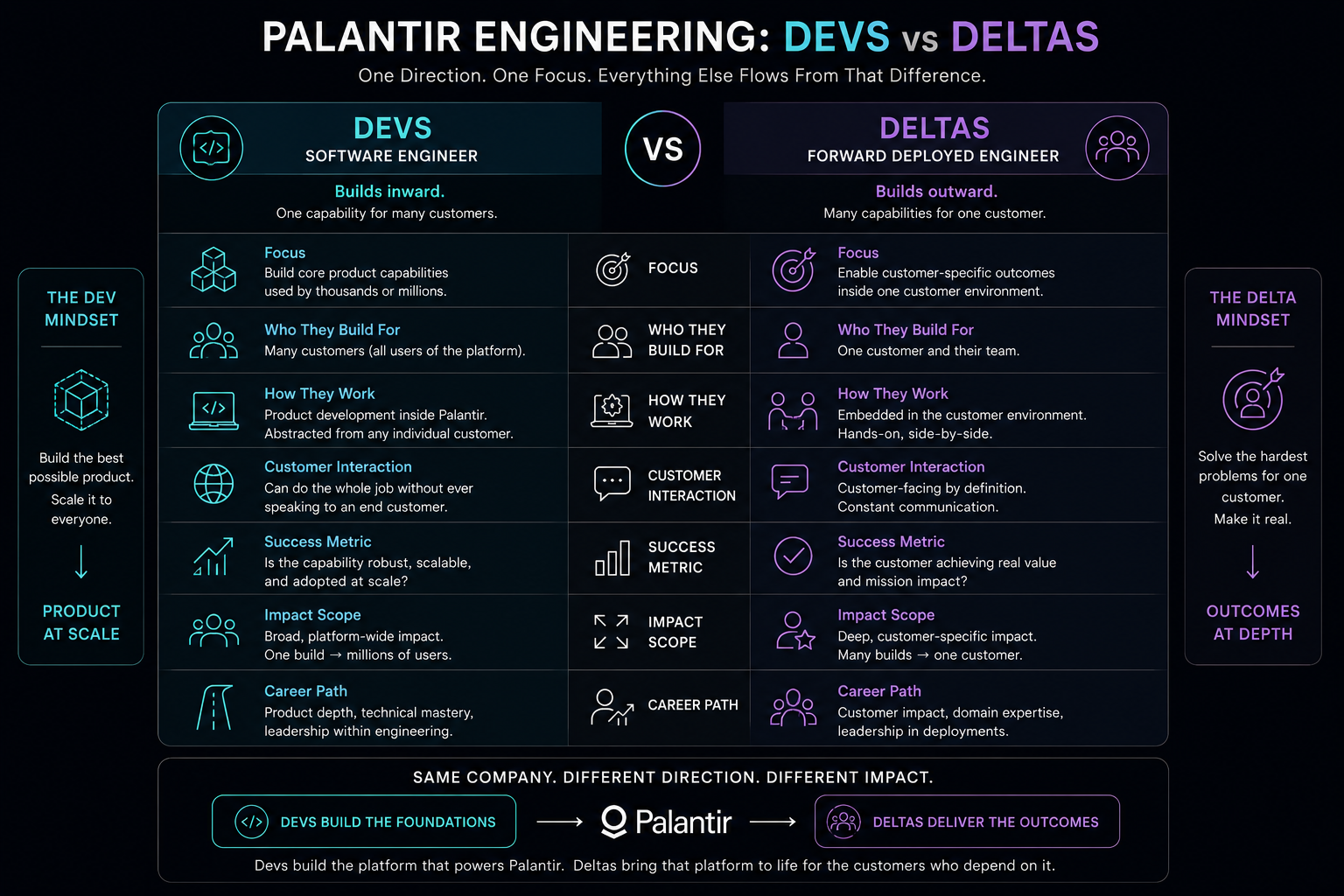
Palantir uses two internal terms for its two engineering tracks. Software engineers are called Devs. Forward deployed software engineers are called Deltas.
The distinction Palantir draws between them is the clearest definition of what separates these two roles at the fundamental level.
A traditional software engineer, or Dev, focuses on creating a single capability that can be used for many customers. A Forward Deployed Software Engineer, or Delta, focuses on enabling many capabilities for a single customer.
One direction. One focus. Everything else flows from that single difference.
The software engineer builds inward. They are building the product that everyone uses. Their work is abstracted from any individual customer. It is designed to scale across thousands or millions of users without any human involvement in the deployment.
The forward deployed engineer builds outward. They take the product that already exists and build something specific and production-grade for one customer, embedded inside that customer's environment, working alongside that customer's team, responsible for whether that specific customer sees real value from the deployment.
A software engineer can do the whole job without ever speaking to an end customer, while a forward deployed engineer is customer-facing by definition. A software engineer typically works within the company's own environment.
That is the core of it. Everything else — the day-to-day work, the skills required, the compensation, the career trajectory — is a consequence of that single directional difference.
What a Software Engineer Actually Does Day to Day
To understand the comparison properly you need a clear, honest picture of both sides.
A software engineer works inside the company's codebase. They receive requirements from product managers, translate them into technical specifications, write and review code, manage pull requests, participate in sprint ceremonies, handle production incidents, and iterate on features based on usage data and user feedback. Their primary relationships are with other engineers, product managers, and designers on their team.
The customer exists as an abstraction for most software engineers. They write code for users they will never meet, solving problems they understand through data and research rather than direct conversation. This is not a limitation. For many engineers it is specifically what they like about the role. The environment is controlled, the feedback loops are instrumented, and the codebase is a system they understand deeply over time.
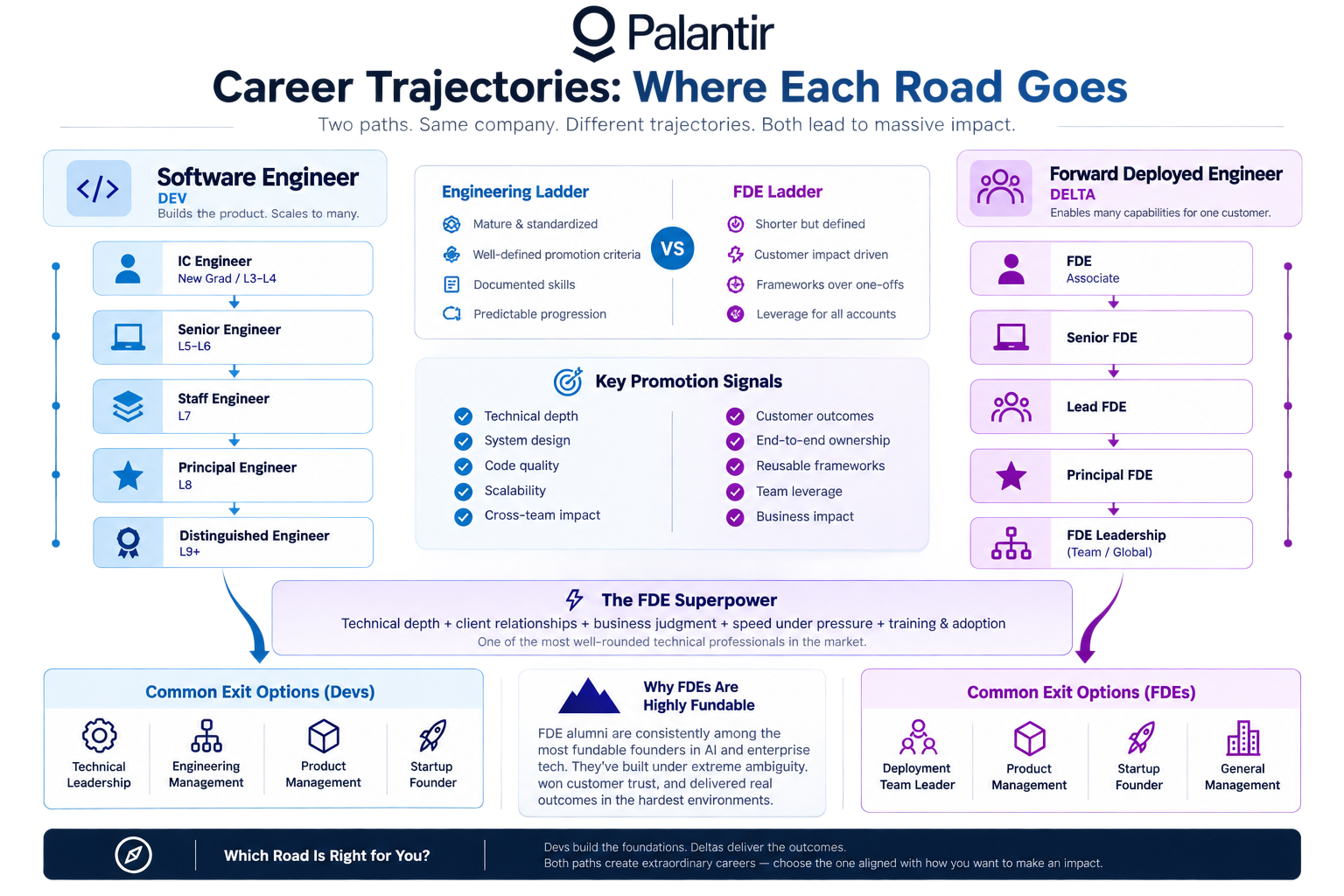
Software engineering careers progress through a well-established and well-understood ladder. Junior engineer, mid-level engineer, senior engineer, staff engineer, principal engineer, distinguished engineer. The promotions are driven by technical depth, scope of impact, and team leadership. The career path is mature, standardized, and well-documented across the industry.
What a Forward Deployed Engineer Actually Does Day to Day
A forward deployed engineer works inside the customer's environment. Not the company's codebase. The customer's environment — with their data schemas, their legacy systems, their organizational politics, their skeptical stakeholders, and their very specific definition of what success looks like.
A forward-deployed engineer inherits the client's environment — their data schema, their legacy systems, their internal politics — and configures, integrates, and troubleshouts until that specific customer sees value. Their definition of done is a go-live date, not a merged pull request. Palantir operationalized this model early, embedding engineers directly with enterprise customers because complex deployments could not be solved from a product backlog. Someone had to sit with the client and own the outcome.
On a typical day a forward deployed engineer might spend the morning in a working session with a client's data engineering team, understanding how their existing systems are structured and where the integration points need to be built. The afternoon is writing code — real production code, not prototypes — that connects those systems to the platform they are deploying. Early evening is preparing a presentation for the client's VP of Operations who needs to understand what was built and why it is going to reduce their costs by a measurable amount before they approve the next phase.
The customer is not an abstraction for a forward deployed engineer. The customer is sitting across the table. Their problems are specific and immediate. Their feedback is direct and often uncomfortable. And the FDE's ability to build trust with that customer — to become the technical advisor the client genuinely relies on — is as important to the outcome as the code they write.
Forward deployed engineering progression is newer but increasingly defined: FDE, then Senior FDE, then Lead FDE owning regional process and mentoring, and onward into leadership of deployment teams, product management, or founding companies. The FDE skill set of building under ambiguity with customer obsession maps directly to startup founding, and several notable founders are former Palantir FDEs.
The Salary Comparison: What the Data Actually Shows
This is the section most people read first. So here is the honest picture from current verified data.
| Role | Median Base Salary 2026 | Total Compensation Range | At Frontier AI Labs |
|---|---|---|---|
| Forward Deployed Engineer | $190,000 to $195,000 | $200,000 to $630,000+ | $350,000 to $550,000+ |
| Software Engineer (Generalist) | $140,000 to $175,000 | $160,000 to $350,000+ | $250,000 to $500,000+ |
| Staff Software Engineer | $190,000 to $230,000 | $250,000 to $500,000+ | $400,000 to $800,000+ |
The average total compensation for an FDE is now $238,000 at Palantir specifically, with the range typically between $205,000 and $486,000. Staff-level FDEs are clearing $630,000 and above. OpenAI and Anthropic total compensation packages have stabilized at $350,000 to $550,000 for mid-to-senior levels.
FDE compensation consistently outpaces that of a standard software engineer at comparable experience levels. This is not an anomaly. It is a structural reality of the role.
The premium exists for a specific reason. An FDE bridges the gap. They are engineers. They are also problem solvers, integrators, and sometimes the face of the product to a critical client. This blend of skills commands a higher price.
One important nuance: one analysis found FDEs earn slightly less than pure product software engineers on average, roughly nine percent, but gain something harder to price — sustained exposure to real-world problems across industries. At the same company, FDE and SWE compensation bands overlap heavily, and company and level drive the difference far more than title alone. The FDE compensation premium is most pronounced at frontier AI labs where engineers who are both strong builders and high-empathy communicators are genuinely scarce.
The honest takeaway: if maximizing pure base salary at a large technology company is the primary goal, a highly specialized software engineering track at a FAANG company may produce higher numbers at the senior and staff levels. If the goal is total compensation that reflects business impact and client-facing complexity — and specifically if the target is a frontier AI company — the FDE track produces extraordinary numbers that most software engineering paths cannot match.
The Skills Comparison: Where the Two Roles Diverge
Both roles require strong engineering fundamentals. That is where the overlap ends.
| Skill Dimension | Software Engineer | Forward Deployed Engineer |
|---|---|---|
| Core programming | Deep — single stack mastery | Broad — multiple languages, frameworks, and integration patterns |
| System design | Internal systems for scale | Client environment integration and deployment architecture |
| Customer interaction | Rare to none | Daily — client teams, executive stakeholders, end users |
| Ambiguity tolerance | Moderate — product requirements are defined | High — client problems are often vague and constantly evolving |
| Business judgment | Low requirement | High requirement — must connect technical work to revenue outcomes |
| Communication | Technical team only | Technical and non-technical across all levels of the client organization |
| Speed orientation | Feature delivery on sprint cadence | Go-live dates often measured in days to weeks not months |
| Training and adoption | Not part of the role | Central to the role — client adoption is how value is measured |
The traits that define high performers in product engineering are often liabilities in a forward deployed role: deep specialization in a single stack, product thinking, and a preference for building things correctly over building them fast. The failures are not technical. They happen when someone simply does not want to be customer-facing. An FDE who wants to architect an elegant solution while a client's go-live slips is solving the wrong problem.
This is the most important honest statement in this entire comparison. The engineering excellence that makes someone a great software engineer — the perfectionism, the preference for clean architecture, the comfort with long-term iterative improvement — can be a liability in a forward deployed environment where the client needs something working by Friday and good enough beats perfect every time.
The Career Trajectory Comparison: Where Each Road Goes
This is the part of the comparison that most people do not think about carefully enough when they are making the decision.
Software engineering has a mature, well-understood trajectory. The ladder is standardized across the industry. The skills that produce promotions are documented and consistently applied. The exit options are broad — technical leadership, engineering management, product management, startup founding. The path is predictable.
Forward deployed engineering has a shorter but increasingly defined trajectory. The exit options at the senior level are different in a way that matters. Forward deployed engineer progression leads toward leadership of deployment teams, product management, or founding companies. The FDE skill set of building under ambiguity with customer obsession maps directly to startup founding, and several notable founders are former Palantir FDEs. At senior and lead levels, FDEs are rewarded for building reusable frameworks that accelerate the whole team, going beyond one-off custom patches. The transition from fixing one account to building leverage for every account is the key promotion signal.
The FDE who thrives in the role and builds the full skill set — technical depth, client relationship management, business judgment, speed under pressure, training and adoption — emerges as one of the most well-rounded technical professionals in the market. They have done things most software engineers have never done. They have sat across from a CFO and made the case for a technical decision in business terms. They have shipped something in a client environment under conditions that would have stopped a traditional engineering team. They have built a company's trust from the ground up in a timeline that had no room for mistakes.
That track record is what VCs pay attention to when they are evaluating founding teams. It is why Palantir FDE alumni are consistently among the most fundable founders in the AI and enterprise technology ecosystems. And it is why the network that comes from spending three to five years as an FDE at Palantir or a similar organization compounds in ways that a traditional software engineering career rarely matches.
The Lifestyle Comparison: What Nobody Tells You
The lifestyle difference between these two roles is real and it matters. If you are evaluating the FDE path you need to go in with accurate expectations.
Software engineering is predominantly office or remote, with predictable hours and a relatively stable environment. The primary sources of stress are technical complexity, product deadlines, and organizational dynamics. You know where you are going to be on any given Monday. Your calendar is mostly under your control.
Forward deployed engineering involves significant travel. FDEs often spend 25 to 75 percent of their time on-site with customers, especially during the initial phases of a new deployment. You are operating in the client's environment, which means adapting to their culture, their schedule, and their level of organizational dysfunction. The sources of stress are technical complexity plus client relationship dynamics plus timeline pressure plus organizational politics that you have limited control over.
This is not a reason not to do the FDE role. For the right person it is one of the most energizing aspects of the job. The variety, the direct feedback, the sense of real-world impact — these are things that software engineers who move into FDE roles almost universally say they did not know they were missing until they had them.
But it is a real consideration. If you have personal commitments that make significant travel difficult, or if you genuinely prefer the stability and control of a traditional engineering environment, that is important and honest information about whether the FDE role is the right fit for your life, not just your career.
The Defining Question: Which Type of Engineer Are You?
The choice comes down to one question: do you want to go deep inside a codebase, or broad across a customer's problems?
Here is the clearer version of that question.
Do you find the customer interaction energizing or draining? Do you want to own an outcome end to end — including the messy, ambiguous, politically complicated parts that happen outside the codebase — or do you want to build excellent systems within a well-defined scope? Do you want your definition of done to be a go-live date with a real client celebrating the outcome, or a merged pull request that improves a product metric? Are you comfortable making important decisions with incomplete information, or do you do your best work when requirements are clear and the problem is well-defined?
Neither set of answers is wrong. Both are honest. And knowing which way you actually lean — not which way you think you should lean, but which way you actually do — is the most important input to this decision.
The software engineer who moves into an FDE role because the salary is higher and then discovers they hate being in client meetings every day is not going to last. The FDE who was always better suited for deep specialization and ends up frustrated by the breadth and messiness of client work is not going to thrive. The match between person and role matters more than the compensation difference.
Here is a quick self-assessment.
You are probably better suited for software engineering if: you prefer deep mastery of a specific technical domain, you do most of your best thinking alone or with a small technical team, you find customer interaction energizing in small doses but exhausting as a daily reality, and you want a career path with well-established progression criteria.
You are probably better suited for forward deployed engineering if: you are energized by variety and by working across different industries and problems, you genuinely enjoy being in rooms with non-technical people and helping them understand and adopt complex technology, you thrive under ambiguity and tight timelines, and the idea of building something and watching a real client organization change how they operate because of it is more motivating than building something that scales to millions of anonymous users.
Why This Decision Is More Urgent Right Now Than It Has Ever Been
One more thing that needs to be said directly.
The window for transitioning into forward deployed engineering at favorable terms is open right now. It will not stay open at these terms indefinitely.
FDE job listings have spiked 800 percent this year. Top-tier VC firms and tech media have dubbed it the hottest job in startups. The demand is real and structural. But the supply of qualified candidates is still dramatically insufficient to meet it. Christian and Timbers estimates there are approximately 2,000 engineers in the entire United States who have the specific combination of skills the role requires.
The software engineers who are reading this blog and deciding to make the transition right now are entering a market where companies are still figuring out what they want from FDE candidates, the credential bar is still low relative to what it will be in 12 to 18 months, and the early candidates are being treated as foundational hires with significant upside on both compensation and career trajectory.
The software engineers who wait — who decide to evaluate this for another year or two before committing — are going to enter a market where the requirements are more established, the credential bar is higher, the competition is larger, and the founding hire upside is gone because those roles have already been filled.
This is not urgency for urgency's sake. It is an honest read of a market that has a defined window, and that window is open right now.
How TechCareers.io Helps Software Engineers Make This Transition
If you are a software engineer who has read this blog and recognizes yourself in the FDE description more than the SWE description, here is the honest path forward.
The technical skills are not your gap. You have them. What you need to develop is the customer-facing layer — the communication skills, the business judgment, the ability to translate technical work into business outcomes, and the portfolio evidence that proves to a hiring manager that you can operate in a client environment before you have done it in a job.
We have real rejection feedback from candidates who have gone through these processes. We have the program infrastructure to help you build the communication skills, the portfolio, and the certification credentials that close the gap between where you are and where you need to be. And we have in-person training in New York City, where 35 percent of all forward deployed engineering job postings in the country are concentrated.
The strategy session is thirty minutes. It costs nothing. We look at your specific background and tell you honestly whether the FDE transition makes sense for your situation and what the fastest path looks like if it does.
Book your session here: https://consultation.techcareers.io/o-discover-fde/about
Frequently Asked Questions
What is the main difference between a forward deployed engineer and a software engineer?
A traditional software engineer focuses on creating a single capability that can be used for many customers. A forward deployed engineer focuses on enabling many capabilities for a single customer. Software engineers build inward, creating products that scale across broad user bases in the company's internal environment. Forward deployed engineers build outward, taking existing products and building custom production-grade solutions for one specific customer, embedded inside that customer's environment and responsible for whether that customer sees real value from the deployment.
Do forward deployed engineers make more than software engineers?
Forward deployed engineer compensation consistently outpaces that of a standard software engineer at comparable experience levels. The median base salary for a forward deployed engineer is approximately $195,000 in 2026. At frontier AI companies like OpenAI and Anthropic, total compensation for mid-to-senior FDE roles stabilizes between $350,000 and $550,000. At staff levels, total compensation can exceed $630,000. The premium reflects the hybrid skill set of engineering depth combined with direct client interaction, business judgment, and revenue impact.
Is forward deployed engineering real engineering?
Yes. Forward deployed engineers write production code, debug complex systems, and ship software that runs in real client environments with real consequences for real organizations. The work is the same craft as software engineering — writing, debugging, and shipping production code — but the context shifts from the company's internal codebase to the customer's live environment, with all the messiness that brings. The question of whether FDE is real engineering is most commonly asked by people who have never done it. The people who have done it rarely ask.
Can a software engineer become a forward deployed engineer?
Yes. Many forward deployed engineers start as software engineers. Professionals with strong coding skills, system design knowledge, and an interest in customer-facing problem solving can transition by gaining experience in deployment, integration, and stakeholder communication. The technical foundation transfers. What needs to be developed is the customer-facing layer — communication skills, business judgment, and the ability to operate effectively in ambiguous, politically complex client environments.
What is the Palantir Delta or FDSE role?
Palantir uses the internal terms Dev for software engineer and Delta for forward deployed software engineer. Software engineers and forward deployed software engineers are Palantir's biggest engineering roles by headcount. The Delta, or FDSE, embeds directly with customers to configure Palantir's existing software platforms to solve their specific problems. The Dev builds those platforms in Palantir's internal environment.
What kind of person thrives as a forward deployed engineer versus a software engineer?
The traits that define high performers in product engineering are often liabilities in a forward deployed role: deep specialization in a single stack, product thinking, and a preference for building things correctly over building things fast. The failures are not technical. They happen when someone simply does not want to be customer-facing. The FDE role rewards people who are energized by variety, comfortable with ambiguity, genuinely motivated by direct client impact, and able to communicate technical work clearly to non-technical stakeholders. The software engineering role rewards people who want to go deep on technical systems, prefer controlled environments with well-defined requirements, and find their motivation in technical excellence and scale.
What is the career path for a forward deployed engineer?
Forward deployed engineering progression leads toward leadership of deployment teams, product management, and founding companies. The FDE skill set of building under ambiguity with customer obsession maps directly to startup founding, and several notable founders are former Palantir FDEs. Senior FDEs who build reusable frameworks that accelerate the entire deployment team rather than solving one-off client problems are the ones who advance most rapidly. The long-term exit opportunities from a senior FDE role — particularly one at Palantir or a similar organization — include some of the highest-value career positions available in the technology industry.
How much travel does a forward deployed engineer do?
Travel expectations vary depending on the team, office location, and assigned clients, but forward deployed engineers should be prepared for significant travel. FDEs often spend 25 to 75 percent of their time on-site with customers, especially during the initial phases of a new deployment. Candidates who are unwilling or unable to travel significantly should factor this into their evaluation of whether the FDE role is the right fit for their current life circumstances.
Why is New York City particularly important for forward deployed engineers in 2026?
New York City now holds 35 percent of all forward deployed engineering job postings in the entire country, compared to San Francisco's 11 percent. The concentration reflects the density of financial services, healthcare, media, and enterprise clients in New York who are actively deploying AI and need FDEs embedded with their teams. For candidates based in New York or willing to relocate there, the proximity to this concentration of hiring activity and hiring managers is a significant practical advantage.