
Rippling vs Palantir Forward Deployed Engineer: How a Non-AI Company Built One of the Most Compelling FDE Programs in the Market
The Comparison Nobody Has Written Honestly
Every FDE comparison blog in the market compares Palantir to an AI company. Palantir vs Decagon. Palantir vs OpenAI. Palantir vs Anthropic.
This blog compares Palantir to Rippling — and it is the comparison that actually tells you the most important thing about the FDE market in 2026.
Because Rippling is not an AI company in the traditional sense. It is a compound startup — HR, IT, and Finance in a single platform built on top of what Kevin Bai, the person who built Rippling's FDE function, calls the employee graph. A living map of every company's organizational structure. The most sophisticated workforce automation platform in the market.
And yet Rippling built an FDE function. From zero. Using the exact model Kevin brought from Palantir. And grew it to 25 people in a single year.
That fact tells you something important that no amount of AI industry analysis captures: the FDE model is not a property of AI companies. It is a property of a specific structural problem. When you are selling something technically complicated to a buyer who cannot implement it themselves, the FDE function is the answer — regardless of whether your company builds AI or payroll software or anything else.
The Rippling FDE program is the most compelling proof of that universality. And comparing it to Palantir's program tells you more about what FDE actually is — and what kind of professional thrives in it — than any AI company comparison can.
What Each Company Is Actually Selling and Why That Determines Everything
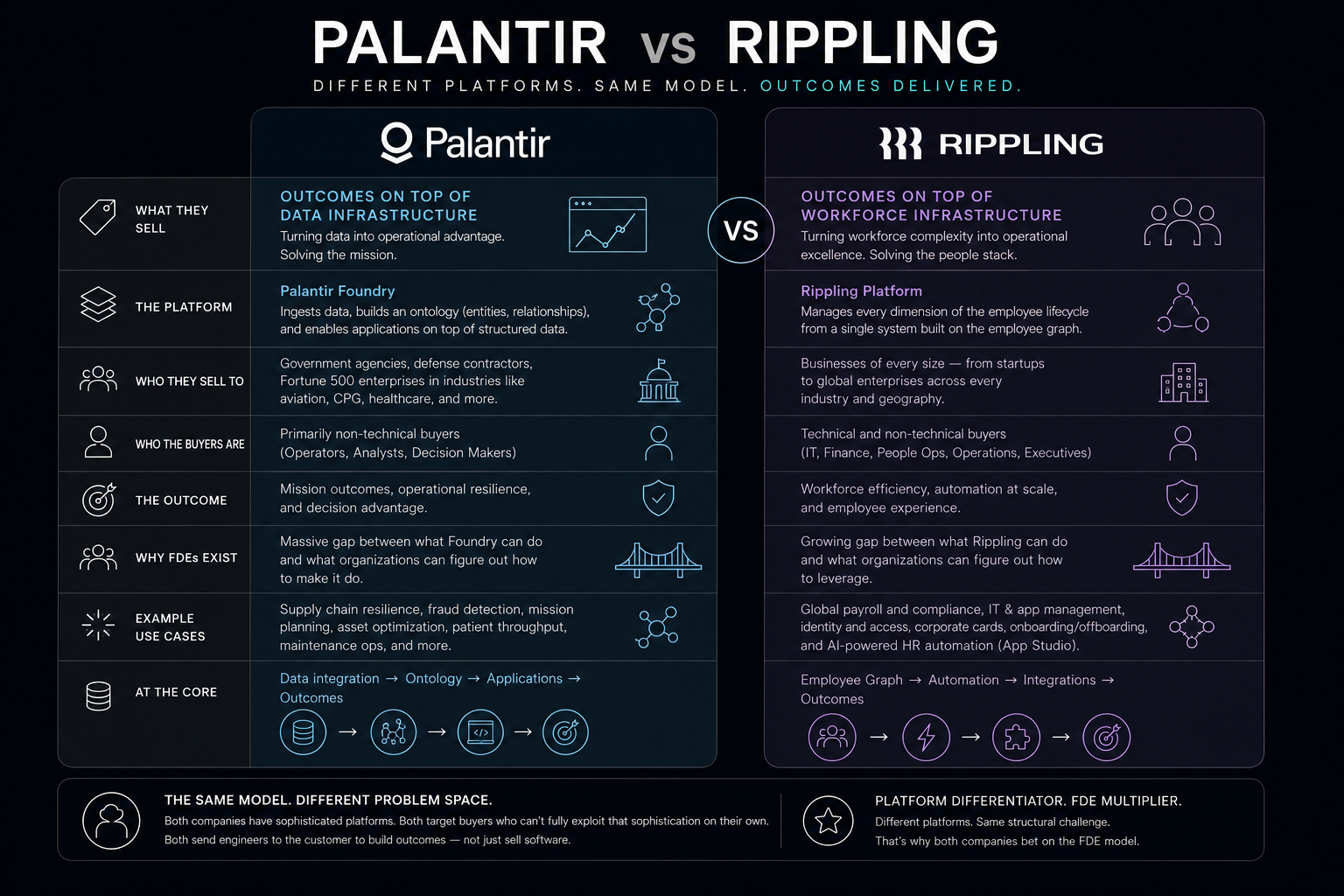
Palantir sells outcomes on top of data infrastructure.
Palantir's Foundry is a platform that ingests an organization's data, builds an ontology — turning raw tables into meaningful objects like warehouses, assets, and personnel — and enables the construction of applications on top of that structured data. The customers are government agencies, defense contractors, and Fortune 500 enterprises in industries like aviation, CPG, and healthcare. The buyers are non-technical. The platform is extraordinarily complex. The gap between what Foundry can do and what any given client organization can figure out how to make it do is the entire reason the FDE function exists.
Rippling sells outcomes on top of workforce infrastructure.
Rippling's platform manages every dimension of the employee lifecycle — payroll, benefits, IT, corporate cards, third-party application access, global hiring, compliance — from a single system built on the employee graph. The customers are businesses of every size, from small startups to large enterprises. The buyers range from technical to non-technical. And as the platform has expanded into increasingly sophisticated automation and integration capabilities — most recently with App Studio, which enables a new category of bespoke SaaS — the gap between what Rippling can do and what any given enterprise can figure out how to leverage has grown wide enough to justify an FDE function.
The structural similarity is precise. Kevin Bai identified it explicitly when he described the Palantir model to Rippling's leadership: both companies have a technically sophisticated platform, both target buyers who cannot fully exploit that sophistication on their own, and both benefit from sending engineers to the client to build outcomes rather than selling software and hoping the client figures it out.
The FDE model is the answer to that structural problem. The specific platform is different. The problem is identical.
The Role Comparison: What Each FDE Actually Does Day to Day
| Dimension | Palantir FDE | Rippling FDE |
|---|---|---|
| Platform built on | Foundry, Gotham, AIP — data integration, ontology, agent architecture | Employee graph — workforce automation, payroll, IT, Finance, App Studio |
| Primary customer domains | Government, defense, Fortune 500 enterprise across aviation, healthcare, CPG | Businesses of all sizes from startup to enterprise across every industry |
| Technical work | Data pipelines, Foundry ontology design, AIP workflows, agent systems | Workflow automation, cross-system integrations, App Studio applications, analytics |
| Client sophistication | Primarily non-technical buyers in complex regulated environments | Ranges from technical to non-technical buyers across varied industries |
| Travel intensity | High — 25 to 75 percent on-site at client locations | Moderate — up to 25 percent travel per the Manager of FDE job description |
| FDE model | Single FDE owns full engagement — consultant, PM, engineer simultaneously | Three-hat model identical to Palantir — Kevin brought it directly from there |
| Scale of function | Largest FDE program in the world — over 95 active FDE-family roles currently | Built from zero to 25 people in one year — actively scaling |
| Average contract value | $4 million per contract — highest ACV of any public SaaS company | Not publicly disclosed — enterprise focus with significant expansion potential |
The most important row in that table is the second to last. Palantir has the most established FDE program in the world. Rippling built its FDE program from zero using Palantir's model. If you understand how Palantir's FDE function works — the three-hat framework, the discovery methodology, the completeness standard — you understand how Rippling's FDE function works. Because they were built by the same person using the same principles.
The Interview Comparison: Overlaps and Divergences
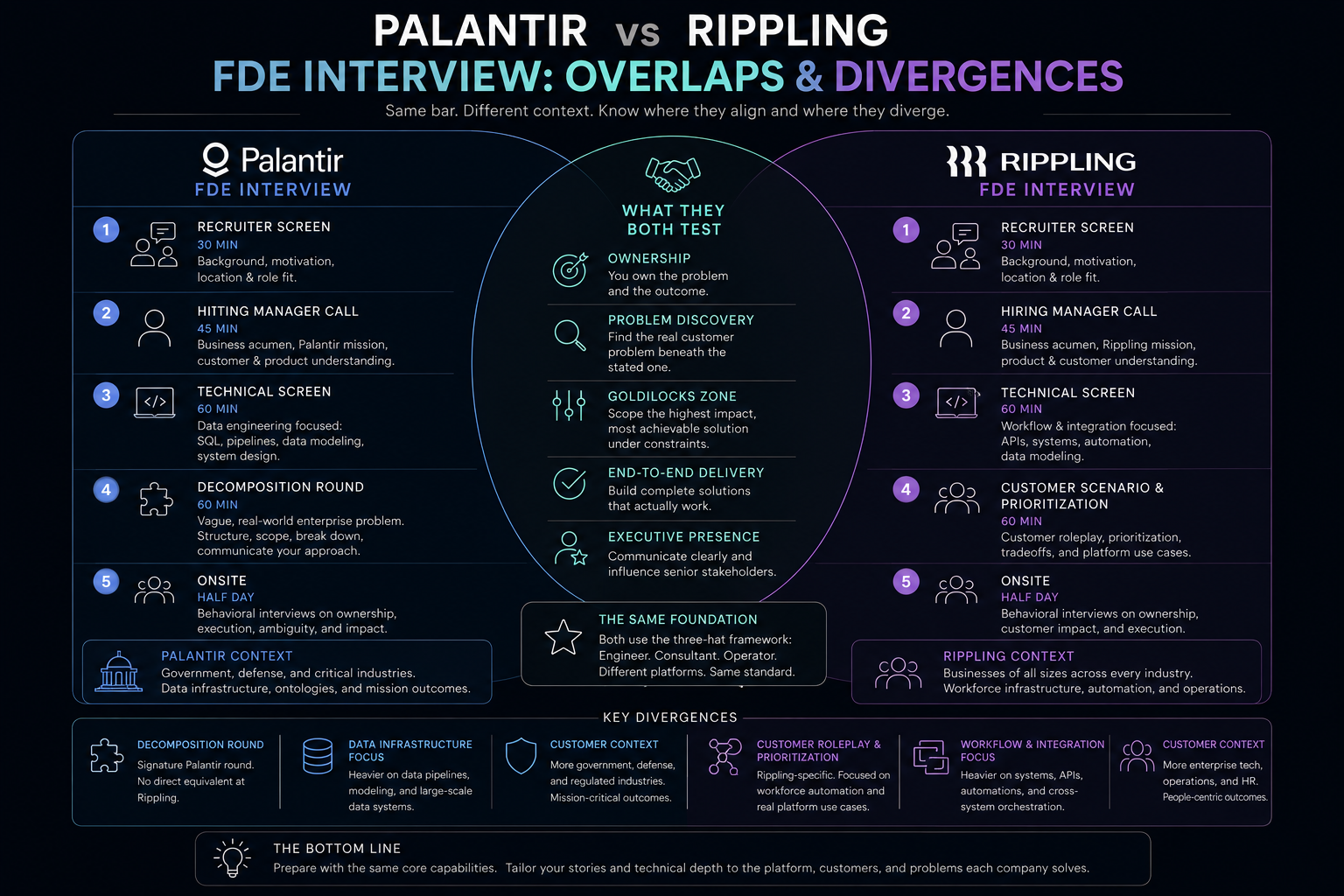
Both interviews test the same fundamental capabilities — the three-hat framework is the evaluation standard at both. The specific mechanics differ in ways that matter for preparation.
Where the Palantir and Rippling FDE interviews overlap:
Both evaluate whether you take ownership of the problem rather than the project. Both evaluate whether you can find the real customer problem beneath the stated one. Both evaluate whether you can scope the goldilocks zone under pressure — highest impact, most achievable, in the available time. Both evaluate end-to-end engineering delivery with a completeness standard rather than an elegance standard. Both evaluate executive presence and the ability to carry yourself in front of senior leadership.
These overlaps exist because the model is the same. The Rippling interview was designed by someone who went through the Palantir interview many times and built the Rippling function on Palantir's principles. If you have prepared for the Palantir FDE interview using our full Palantir blog library — twelve blogs covering every dimension of that process — you have prepared for the majority of what the Rippling interview tests.
Where they diverge:
The Palantir interview is famous for its decomposition round — a specific format with no direct equivalent at most other companies. You receive a vague real-world enterprise problem with no defined scope and must structure your approach, clarify constraints, break it into components, and communicate your reasoning over 60 minutes. This round has no confirmed equivalent in the Rippling interview process.
The Rippling interview is more oriented toward customer scenario roleplay and prioritization exercises that map directly to the platform's specific use cases — workforce automation, HR system integration, multi-system deployment across an enterprise's people operations. The customer context is less government and defense, more enterprise technology and operations. The technical orientation is less data pipeline heavy and more workflow and integration heavy.
The behavioral emphasis at Rippling reflects Kevin's specific philosophy: demonstrating problem ownership, genuine motivation, and the ability to wear all three hats simultaneously. The stories you prepare should be weighted toward situations where you owned an outcome end to end — not situations where you were a strong member of a team that owned the outcome.
The Salary and Equity Comparison: Honest Numbers
Both opportunities produce strong compensation. The profiles are meaningfully different.
Palantir FDE compensation:
Base salary $135,000 to $200,000. Total compensation $171,000 to $631,000 depending on level. Median total compensation approximately $215,000 to $245,000. Equity is on public PLTR stock — liquid from the moment it vests. The PLTR stock appreciation story is significant for engineers who joined in earlier years.
Rippling FDE compensation:
Based on the Manager of FDE job description, the pay range is $138,000 to $230,000 in base salary for US Tier 1 locations. Individual contributor FDE roles would likely range $120,000 to $200,000 at the entry to senior levels based on market comparables. Rippling has raised $1.4 billion from Kleiner Perkins, Founders Fund, Sequoia, Greenoaks, and Bedrock. Equity is pre-IPO — meaningful potential upside at a company that has demonstrated exceptional growth across a compound product model that spans HR, IT, and Finance simultaneously.
The honest financial comparison:
Palantir offers more predictable compensation with liquid equity and a long public market track record. Rippling offers pre-IPO equity at a company growing aggressively into enterprise with a business model that is expanding rather than concentrating. The financial choice depends on your equity risk tolerance and your view of Rippling's trajectory.
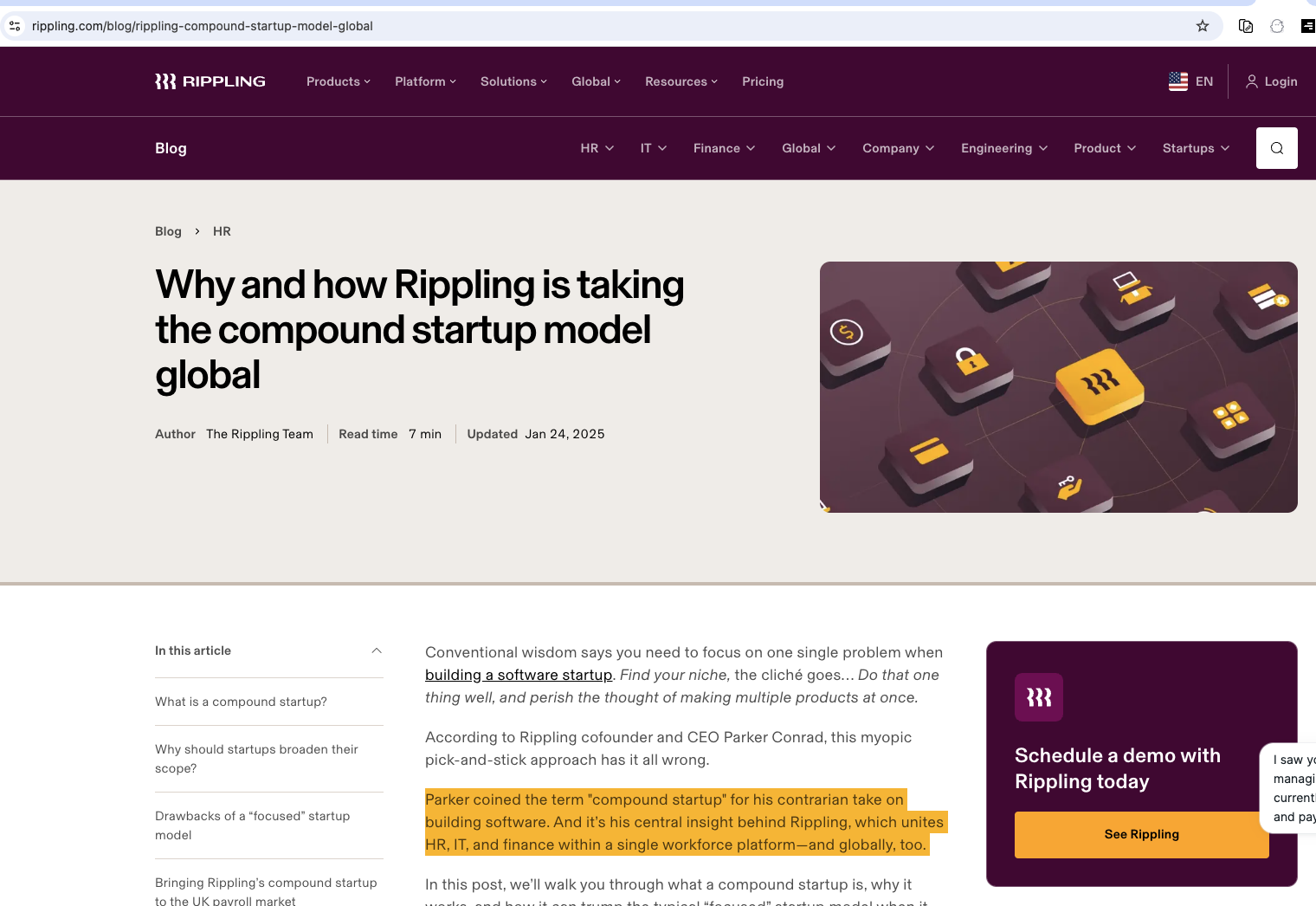
Parker Conrad has described Rippling as a compound startup that is building the most integrated workforce management platform in the market — and the App Studio launch suggests the platform is expanding its surface area in ways that could significantly increase the FDE function's scope and the company's value over the next three to five years.
https://www.rippling.com/blog/rippling-compound-startup-model-global
The Career Path Comparison: Where Each Role Takes You
Both roles produce extraordinary exits. The networks are different in important ways.
After Palantir FDE:
The Palantir FDE alumni network is the most productive founder factory in the AI era. 111 companies. $11.6 billion raised. Anduril at $61 billion. Kalshi at $22 billion. ElevenLabs at $6.6 billion. Garry Tan as president of Y Combinator. The Palantir FDE credential opens doors across every dimension of the AI ecosystem — at frontier labs, at VC-backed startups, and in founding team conversations where Palantir alumni investors recognize and actively fund Palantir alumni founders.
After Rippling FDE:
Kevin Bai's specific trajectory — Rippling founding FDE to Anthropic Applied AI — demonstrates the exit path that is available from the Rippling function. The Rippling FDE who has built complex enterprise workflows on one of the most sophisticated compound platforms in the market, managed Fortune 500 client relationships, and operated with the full three-hat capability exits into a profile that is highly competitive for Applied AI roles at frontier labs, for founding or early-stage FDE leadership roles at enterprise AI companies, and for the senior-level implementation and solutions leadership roles that every major AI company is scaling in 2026.
The specific network is less extensive than Palantir's because the function is newer. But the trajectory of the talent coming out of it — including Kevin's move to Anthropic directly from the founding FDE role — suggests the network will compound quickly as the function grows and more people follow that arc.
Which Role Is Right for Your Background
Here is the honest framework.
Pursue Palantir FDE if:
You want the most established FDE credential in the market and the most extensive alumni network. You are specifically interested in the data infrastructure and AI deployment work that Palantir's platform enables. You are prepared for the decomposition round and have done the preparation work that the specific Palantir interview format requires. You are comfortable with significant travel and the intensity of Palantir's work environment. You want liquid public equity with a company that has been profitable for years.
Pursue Rippling FDE if:
You are energized by the compound startup model — a company that is building the intersection of HR, IT, and Finance in a single platform and expanding its technical sophistication. You want pre-IPO equity at a company with strong investor backing and a growth trajectory that is expanding rather than stabilizing. You are specifically interested in workforce automation, enterprise system integration, and the App Studio platform as the technical domain for your FDE work. You want a function that is still in its scaling phase — where the founding team members will have disproportionate influence on how the practice develops and the culture gets built.
Pursue both — sequentially:
The overlap in the interview processes means that preparing for one is largely preparing for the other. The Palantir blog library we have built covers the three-hat framework, the customer discovery methodology, the prioritization discipline, and the completeness engineering standard that both interviews evaluate. A candidate who prepares thoroughly for Palantir and then targets Rippling — or vice versa — is prepared for the core of both processes.
We can also help you with both transitions.
The Strategic Insight the Comparison Reveals
Here is the thing the Rippling versus Palantir comparison makes clear that no other FDE comparison does.
The FDE model is not about AI. It is about the gap between technical sophistication and buyer capability. Wherever that gap exists — in data infrastructure, in workforce management, in any enterprise platform that non-technical buyers cannot fully exploit on their own — the FDE function is the answer.
This means the FDE career path is more durable than most market observers acknowledge. The companies that will need FDE functions in 2030 include not just AI labs and AI-native startups but every enterprise software company whose product has become sophisticated enough to require embedded technical expertise to produce real outcomes for non-technical buyers.
Rippling is the proof of concept for that broader market. And the FDE who understands this — who can articulate why the three-hat model is the answer to a structural problem rather than a trend — is the FDE who walks into every interview at every company in the ecosystem with a genuine and defensible perspective on the role they are pursuing.
That perspective is what genuine motivation sounds like. And Kevin Bai was explicit: genuine motivation is the thing that separates the candidates who get offers from the ones who do not.
Schedule Your Forward Deployed Engineering Strategy Session
If you are trying to decide between the Palantir FDE path and the Rippling FDE path — or if you want to understand which one is more immediately aligned with your background and how to prepare before the Rippling roles open — book a strategy session with our team.
We have Paraform recruiter access to both programs. We will look at your specific background, give you an honest assessment of where you are relative to each program's requirements, and map the preparation that closes the gap.
Book your session here: https://consultation.techcareers.io/o-discover-fde/about
Submit your profile for Paraform consideration here: https://www.paraform.com/forms/cms9ccu9n00070bjur3ljopm2

Frequently Asked Questions
How does the Rippling FDE role compare to the Palantir FDE role?
Both roles use the three-hat framework — consultant, product manager, software engineer — because Rippling's FDE function was built by Kevin Bai, a Palantir FDE alumni, using the Palantir model. The primary differences are the platform each FDE builds on — Palantir's Foundry and AIP for data and AI versus Rippling's employee graph and App Studio for workforce automation — and the customer context, which at Palantir is heavily government and defense and at Rippling is broader enterprise across all industries. The interview processes overlap significantly because they evaluate the same three-hat capability.
Which pays more — Palantir FDE or Rippling FDE?
Palantir FDE total compensation ranges from $171,000 to $631,000 with a median of approximately $215,000 to $245,000, paid in public PLTR equity that is liquid on vest. Rippling FDE compensation based on the Manager of FDE job description ranges from $138,000 to $230,000 in base salary, with pre-IPO equity at a company valued and backed by Kleiner Perkins, Founders Fund, and Sequoia. The financial comparison favors Palantir at the senior and staff levels due to RSU appreciation, but Rippling's pre-IPO equity has higher potential upside if the company's growth trajectory continues toward IPO.
Is the Rippling FDE interview similar to the Palantir FDE interview?
Both interviews evaluate the three-hat framework capability — customer listening and discovery, product scoping and prioritization, and software engineering with a completeness standard. The Palantir interview includes the distinctive decomposition round which has no confirmed equivalent at Rippling. The Rippling interview is more oriented toward customer scenario roleplay and prioritization exercises specific to workforce management and enterprise system integration. Preparation for one interview substantially prepares you for the other at the framework level.
Why did Rippling build an FDE function if it is not an AI company?
Kevin Bai identified the same structural problem at Rippling that he had solved at Palantir: a technically sophisticated platform being sold to buyers who cannot fully exploit it on their own. Rippling's compound product model — HR, IT, Finance, payroll, benefits, and global workforce management in a single platform — has become sophisticated enough that enterprise clients need embedded technical expertise to get full value from it. The FDE function is the answer to that structural problem regardless of whether the company builds AI. Rippling is the most compelling proof that the FDE model is not a property of AI companies specifically.
What does the Rippling FDE career path look like?
Kevin Bai's specific trajectory — founding FDE at Rippling to Member of Technical Staff at Anthropic Applied AI — demonstrates the exit path. The Rippling FDE who develops the three-hat capability over two to three years exits into a profile competitive for Applied AI roles at frontier labs, founding or early-stage FDE leadership at enterprise AI companies, and senior solutions and implementation leadership roles at the AI companies scaling those functions in 2026.