
Scale AI Forward Deployed Engineer Interview — What the Process Looks Like and How to Prepare
Why Scale AI Is a Different Kind of FDE Opportunity
Most forward deployed engineering roles ask you to deploy AI inside a client's environment. The Scale AI FDE role is built on something more fundamental than that.
Scale AI does not build consumer-facing AI products. Scale AI builds the data infrastructure that makes every other AI product possible. The RLHF pipelines. The human feedback systems. The model evaluation infrastructure. The data labeling and validation layer that trains and validates many of the frontier models you already use — OpenAI, Meta, Google, and the US Department of Defense among them.
When you become a Forward Deployed Engineer at Scale AI, you are not deploying a chatbot or an AI customer support agent. You are building the data and evaluation systems that determine whether the most consequential AI models in the world are safe, reliable, and ready for deployment.
That context changes everything about how you need to prepare for this interview.
The Scale AI FDE is a technical layer between Scale's core engineering organization and the customer — most concentrated in federal defense, intelligence, and large enterprise accounts. The role spans solution architecture, on-site prototyping, customer education, and deep technical debugging of messy real-world data unification problems.
If that description energizes you, this blog tells you exactly how to get there.
The Two Tracks: GenAI and Public Sector

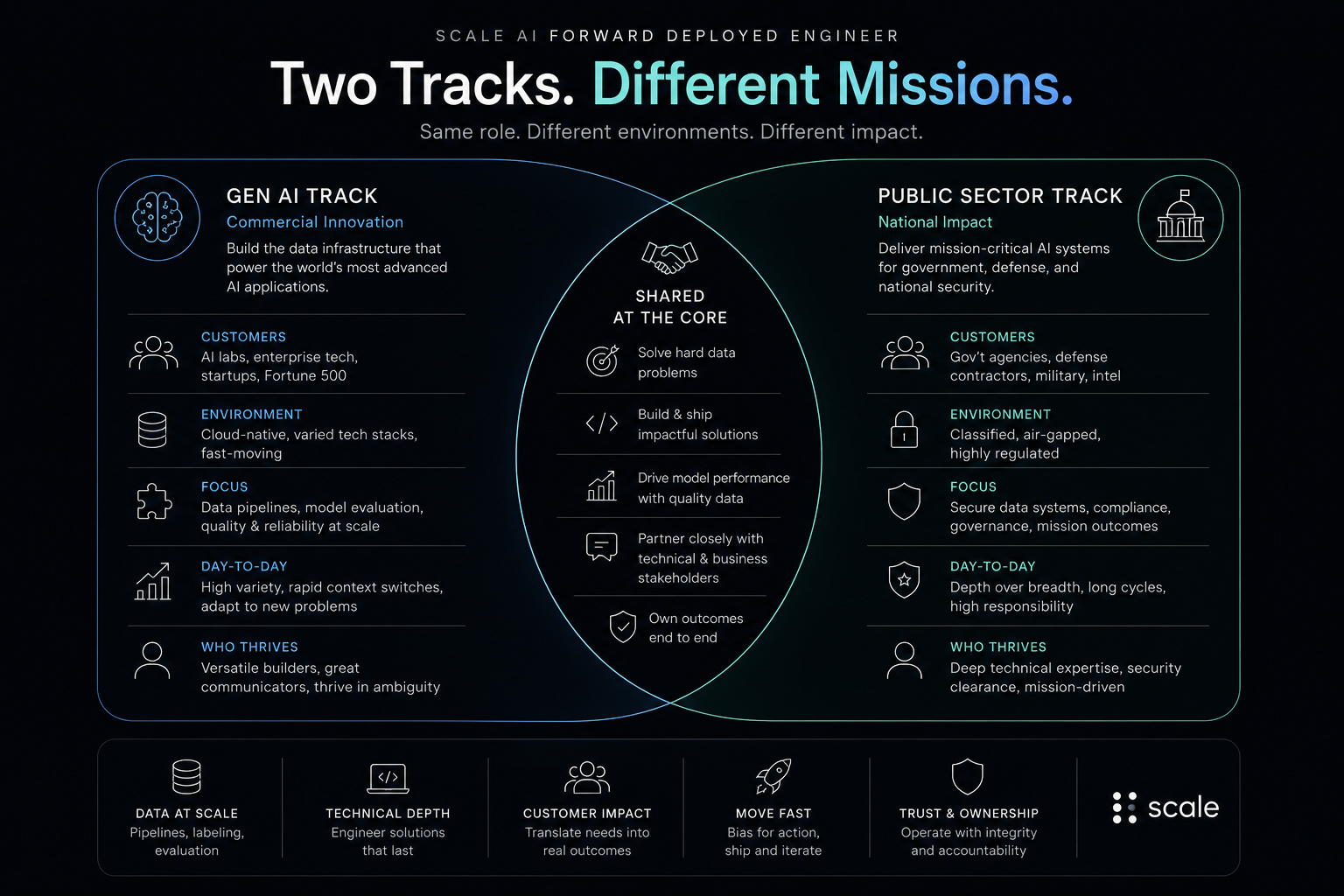
Scale AI hires Forward Deployed Engineers across two distinct tracks that have meaningfully different day-to-day realities and different candidate profiles.
The GenAI Track
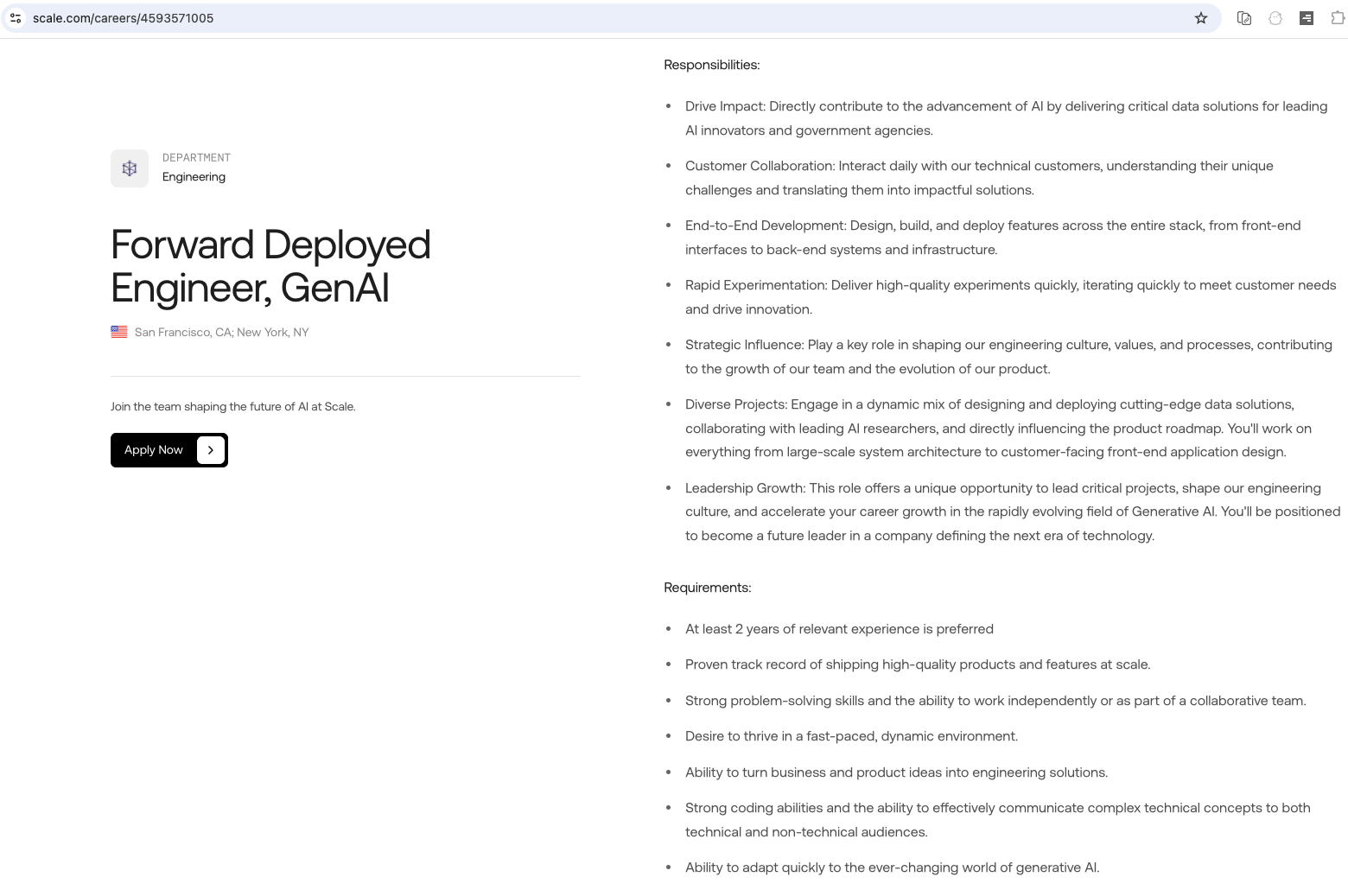
The GenAI FDE works with commercial customers building generative AI applications on top of Scale's data infrastructure. These customers are typically AI labs, enterprise technology companies, and large organizations deploying AI at scale. The technical work centers on understanding the customer's data environment, building the pipelines and evaluation systems that make their AI models more reliable, and ensuring the data infrastructure produces the quality of training and validation data that matters for their specific use case.
The GenAI track is more varied in the type of customer and the type of problem. Customers range from small AI startups to Fortune 500 enterprises, and the FDE needs to adapt quickly to very different technical environments, data architectures, and organizational structures.
https://scale.com/careers/4593571005
The Public Sector Track
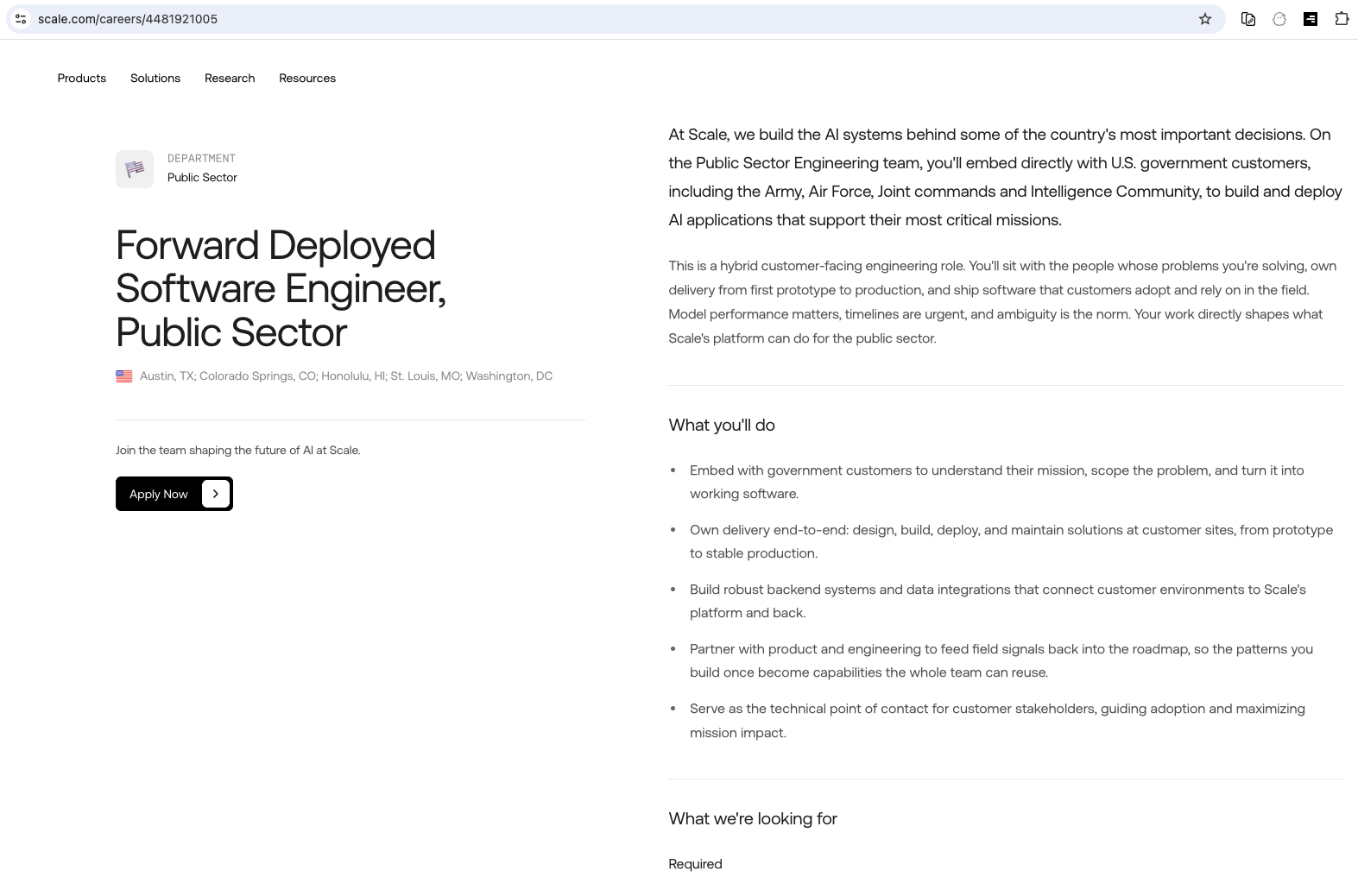
The Public Sector FDE works with government and defense customers — including intelligence agencies, defense contractors, and military organizations. This track requires or strongly benefits from security clearance. The technical work is similar in nature to the GenAI track but operates under substantially different constraints: classified environments, air-gapped networks, strict data governance requirements, and the specific compliance frameworks that govern government AI deployment.
The Public Sector track is where Scale AI's longest and most strategic customer relationships exist. Alexandr Wang built Scale AI in part by establishing the company as a trusted partner to the US government on AI safety and evaluation. The FDE who works on these accounts is operating at the intersection of frontier AI and national security — an environment that is intense, consequential, and unlike anything available in the commercial AI market.
Knowing which track you are targeting before you apply changes how you position yourself. The GenAI track prioritizes breadth of data engineering experience and customer-facing communication capability. The Public Sector track prioritizes technical depth, clearance eligibility, and demonstrated experience with government or regulated enterprise environments.
https://scale.com/careers/4481921005
What Scale AI FDEs Actually Do
The Scale AI FDE role is meaningfully different from most FDE roles in the market in one specific way: the technical work is heavily weighted toward data engineering, pipeline architecture, and evaluation systems rather than AI application development.
Most FDE roles at Decagon, OpenAI, or Anthropic center on deploying AI applications into client environments — configuring agent workflows, building integrations, and ensuring adoption. The Scale AI FDE is working one layer below that. They are building the data and evaluation infrastructure that determines whether the AI models powering those applications are trustworthy in the first place.
In practice the work involves building ETL pipelines that ingest and process the client's data into formats Scale's systems can use. Designing evaluation harnesses that test model outputs against the client's specific quality and safety requirements. Debugging data quality issues in messy real-world datasets that do not look anything like clean benchmark datasets. Architecting systems that can handle the scale and complexity of enterprise data environments — RLHF at production scale is not a small engineering problem.
Scale AI's customers are OpenAI, Meta, and the top AI labs. The hiring managers expect candidates to think with a frontier AI lens, not a typical consultant lens. You are not explaining AI to skeptical executives. You are working with some of the most technically sophisticated AI teams in the world on the hardest unsolved problems in AI data and evaluation.
The Scale AI FDE Interview Process: What to Actually Expect
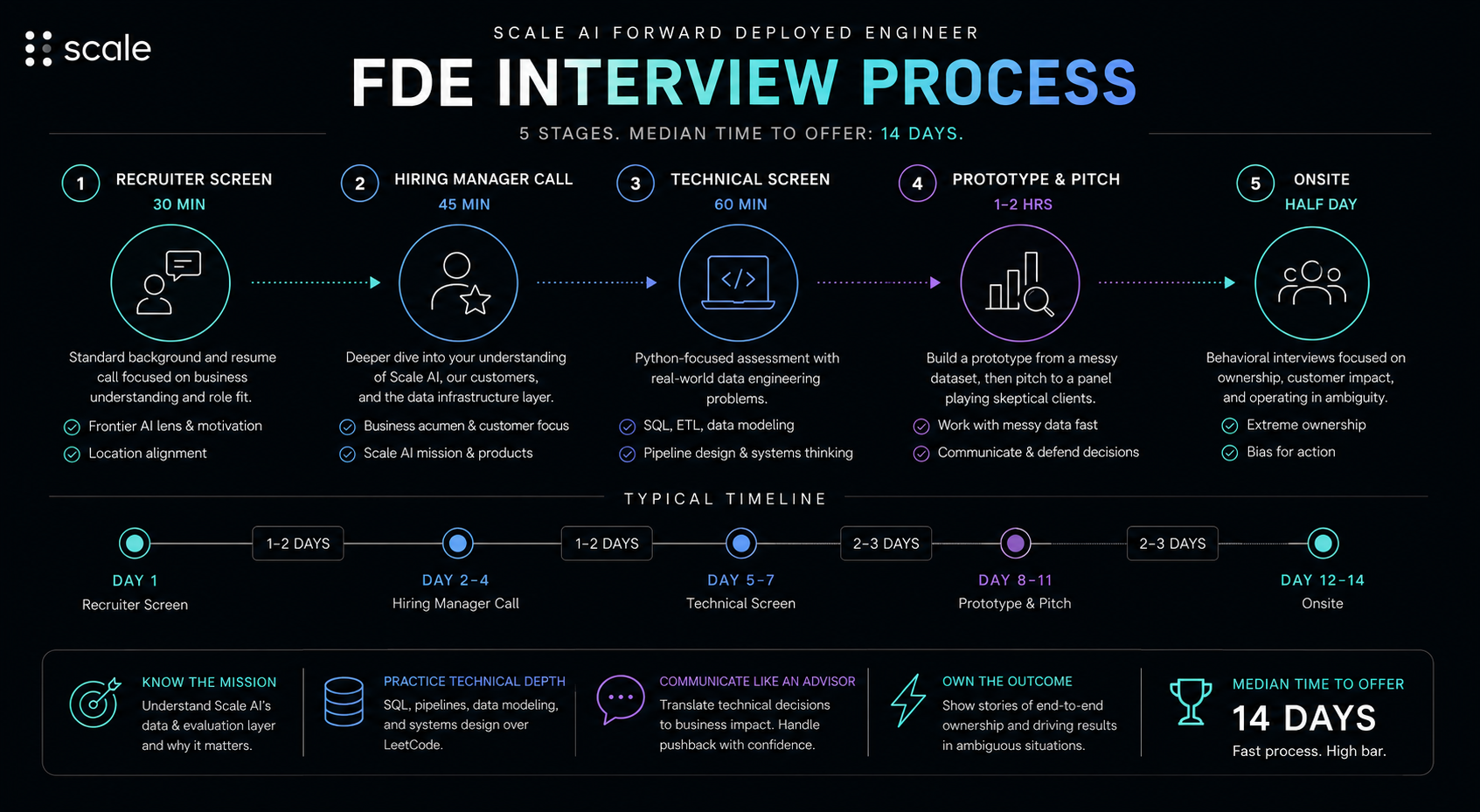
Scale AI runs one of the fastest interview loops in the AI market. The median time from recruiter to verbal offer is 14 days. Fast does not mean undemanding — the bar is high and the process is specifically designed to surface the combination of technical depth and customer communication that the role requires.
The process runs five stages.
Stage One: Recruiter Screen
A 30-minute standard background and resume call. The Scale AI recruiter is specifically probing for business understanding and role fit — not just technical background. Two things get candidates eliminated here.
First: candidates who frame their interest in Scale AI the way they would frame interest in any AI company. The hiring team explicitly expects candidates to think with a frontier AI lens. Coming in with a clear and specific perspective on what Scale AI does, why the data infrastructure layer matters, and why that specific problem is the one you want to work on is the difference between advancing and being politely declined.
Second: location misalignment. Scale AI's FDE roles are concentrated in New York and Seattle in addition to San Francisco. Research and engineering core roles are predominantly in San Francisco. Confirm your location alignment before the call rather than discovering the mismatch during it.
Stage Two: Hiring Manager Call
A 45-minute call where the hiring manager directly probes business understanding and role fit. This is the stage most candidates underestimate.
The Scale AI hiring manager is not running a standard behavioral interview. They are evaluating whether you understand what Scale AI's customers are trying to accomplish and whether you can operate as a strategic partner to those customers rather than as an implementation resource.
The preparation that matters most for this round: spend time with Scale AI's published content about their mission, their products, and their customer base. Understand the difference between data labeling, RLHF, model evaluation, and AI safety testing — because these are the specific technical domains the HM will probe. And be ready to articulate why Scale AI's layer of the AI stack is the one that matters most to you personally — not because it is prestigious, but because you have a genuine perspective on why the data and evaluation layer is where the real work of making AI trustworthy actually happens.
Stage Three: Technical Screen
A focused technical assessment covering the core engineering skills the FDE role requires. Candidates report Python-focused problems with real-world data engineering orientation — not pure LeetCode algorithm puzzles but problems that test whether you can think through data processing, pipeline design, and system architecture under time pressure.
The technical screen at Scale AI is meaningfully oriented toward data engineering rather than AI application development. Comfort with SQL, ETL processes, data modeling, and pipeline architecture is more directly relevant to this screen than LLM application development or agent design. This is a critical distinction from the Decagon or Palantir FDE interview preparation — the technical emphasis is different.
Stage Four: The Prototype and Pitch Round — The Stage That Decides Most Outcomes
This is the round that most candidates underestimate and most often fail. And it is the most distinctive element of the Scale AI FDE interview process.
You receive a deliberately messy dataset. You have a constrained time window — typically one to two hours — to build a working prototype that addresses a specific problem in that dataset. And then you pitch that prototype to a panel playing the role of skeptical clients.
This round is testing several things simultaneously. Can you work with messy real-world data quickly? Can you make sensible technical decisions under time pressure without perfect information? Can you build something working rather than something perfect within the window? And can you communicate what you built, why you made the decisions you made, and what the limitations are to a non-technical audience that is actively challenging your approach?
The prototype and pitch round is where Scale AI is specifically simulating what the FDE does in the field. The client's data is always messier than the specification described. The timeline is always shorter than ideal. And the client team is always skeptical about whether the solution will actually work in their specific environment.
The preparation that produces passing scores: practice working with imperfect datasets quickly. Find messy public datasets — government data releases, healthcare data, financial data — and practice building something useful from them in a constrained time window. Then practice explaining what you built to a non-technical audience with genuine pushback. The ability to field challenging questions about your prototype's limitations while maintaining the confidence and clarity of an advisor rather than an implementer is specifically what this round is designed to test.
Stage Five: Onsite
The Scale AI onsite for FDE candidates includes behavioral rounds covering ownership, customer relationship management, and how you operate in ambiguous environments. Come with specific stories that demonstrate end-to-end technical ownership, situations where you navigated difficult client dynamics, and examples of how you have adapted technical approaches when the initial approach failed.
The behavioral emphasis at Scale AI is on extreme ownership and a high bias for action. The company's culture is fast-paced and execution-oriented. The stories that land best are the ones where you identified a problem nobody asked you to solve, drove a solution through its full lifecycle, and took personal accountability for the outcome whether it succeeded or failed.
What the Scale AI FDE Role Actually Pays
Scale AI compensation is competitive within the FDE market with meaningful equity upside given the company's $13.8 billion valuation at its Series F round.
Based on current Scale AI job postings, base salaries for FDE roles run from $179,000 to $224,000 for standard positions and $188,000 to $226,000 for senior roles in San Francisco and New York. Total compensation including equity and benefits is meaningfully higher.
The equity structure is important context for anyone evaluating a Scale AI offer. Scale AI's equity is pre-IPO preferred stock at a $13.8 billion valuation — meaningful potential upside if the company continues its growth trajectory, but less liquid than Palantir's public stock and carrying the risks inherent in any pre-IPO equity position.
A significant leadership development occurred on August 10, 2026 when Francis deSouza became permanent CEO after over a year of interim leadership. This is generally a stabilizing signal for candidates evaluating Scale AI as an employer — the period of leadership uncertainty is ending at exactly the moment the company is scaling aggressively.
How Scale AI Compares to Palantir and Decagon for an FDE Candidate
Understanding where Scale AI fits in the broader FDE ecosystem helps you decide whether to pursue it now, later, or in parallel with other opportunities.
| Dimension | Scale AI FDE | Palantir FDE | Decagon ADE |
|---|---|---|---|
| Technical focus | Data engineering, evaluation systems, RLHF infrastructure | Foundry, AIP, agent architecture, data integration | AI agent architecture, AOP design, conversation systems |
| Customer type | AI labs, defense agencies, enterprise technology | Government, defense, Fortune 500 commercial | Enterprise technology, financial services, consumer tech |
| Interview differentiator | Prototype and pitch round with messy dataset | Decomposition case study | AOP case study, three-day take-home |
| Salary range | $179,000 to $226,000 base, pre-IPO equity | $135,000 to $200,000 base, public PLTR equity | $175,000 to $230,000 base, pre-IPO equity |
| Company stage | Private, $13.8 billion valuation, Series F | Public, $260 billion market cap | Private, $4.5 billion valuation, Series D |
| Network | AI lab and defense ecosystem | Palantir FDE Mafia — 111 companies, $11.6 billion raised | Building — significant upside if trajectory continues |
The Scale AI FDE is the right choice for candidates who are specifically energized by the data infrastructure and model evaluation layer of AI — not AI application deployment but the foundational layer that makes those applications trustworthy. Candidates with strong data engineering backgrounds who want to work at the intersection of frontier AI and government and defense missions should put Scale AI at the top of their list.
The Paraform Advantage for Scale AI
TechCareers.io is an approved recruiter on the Paraform platform, which places FDE candidates at Scale AI among its portfolio of companies. This gives you access to the same category of intelligence for Scale AI that drives our Decagon preparation advantage — hiring manager relationships, current requirements intelligence, and direct profile submission that bypasses the general application portal.
Scale AI's FDE roles are actively recruiting through channels that reward referred and recruited candidates over cold applications. Being submitted through the Paraform recruiter network puts your candidacy in front of the right person with context rather than into an automated screening system.
Book your session here: https://consultation.techcareers.io/o-discover-fde/about
Submit your profile for Paraform consideration here: https://www.paraform.com/forms/cms9ccu9n00070bjur3ljopm2

Frequently Asked Questions
What does a Scale AI Forward Deployed Engineer actually do?
Scale AI FDEs are the technical layer between Scale's core engineering organization and its customers — primarily federal defense, intelligence, and large enterprise accounts. The role spans solution architecture, on-site prototyping, customer education, and deep technical debugging of messy real-world data unification problems. The technical work centers on ETL pipeline architecture, model evaluation systems, RLHF infrastructure, and data quality engineering rather than AI application development. Scale AI FDEs are building the data and evaluation infrastructure that determines whether frontier AI models are trustworthy — not deploying AI applications on top of those models.
What are the two tracks in the Scale AI FDE program?
Scale AI hires FDEs across a GenAI track and a Public Sector track. The GenAI track works with commercial customers building generative AI applications — AI labs, enterprise technology companies, and large organizations deploying AI at scale. The Public Sector track works with government and defense customers including intelligence agencies, defense contractors, and military organizations, often in classified environments with strict data governance requirements. The Public Sector track may require or strongly benefit from security clearance.
What is the Scale AI FDE interview prototype and pitch round?
The prototype and pitch round is the most distinctive and most decisive stage in the Scale AI FDE interview process. You receive a deliberately messy dataset and have a constrained time window — typically one to two hours — to build a working prototype addressing a specific problem in that data. You then pitch that prototype to a panel playing the role of skeptical clients who actively challenge your approach and probe the limitations of your solution. This round simulates the core FDE work of making good technical decisions under time pressure with imperfect information and communicating those decisions clearly to a non-technical audience.
What technical skills does the Scale AI FDE interview test?
The Scale AI FDE interview emphasizes data engineering skills over AI application development skills. This is a meaningful distinction from most FDE interview preparation. Comfort with SQL, ETL processes, data modeling, pipeline architecture, and evaluation system design is more directly relevant than LLM prompt engineering or agent workflow design. The technical screen and prototype round both test your ability to work with messy real-world datasets quickly and produce working solutions under time pressure.
What does Scale AI pay forward deployed engineers?
Based on current Scale AI job postings, base salaries for FDE roles run from $179,000 to $224,000 for standard positions and $188,000 to $226,000 for senior roles in San Francisco and New York. Total compensation including pre-IPO equity at Scale's $13.8 billion Series F valuation and benefits is meaningfully higher. Senior FDE total compensation in the market range is approximately $240,000 to $320,000 plus equity.
How does Scale AI compare to Palantir and Decagon for FDE candidates?
Scale AI FDE work centers on data infrastructure and model evaluation at the foundational layer of AI. Palantir FDE work centers on enterprise data integration and increasingly AI agent deployment with AIP. Decagon ADE work centers specifically on AI agent architecture for customer support. Candidates with strong data engineering backgrounds who are energized by the infrastructure layer should prioritize Scale AI. Candidates who want to deploy AI applications into client environments and manage the full client relationship should prioritize Palantir. Candidates who want to go deep on AI agent architecture in a paired technical model should prioritize Decagon.