How Software Engineers Can Transition to Forward Deployed Engineering in 90 Days: The Step-by-Step Roadmap
The Engineer Who Is Already Halfway There
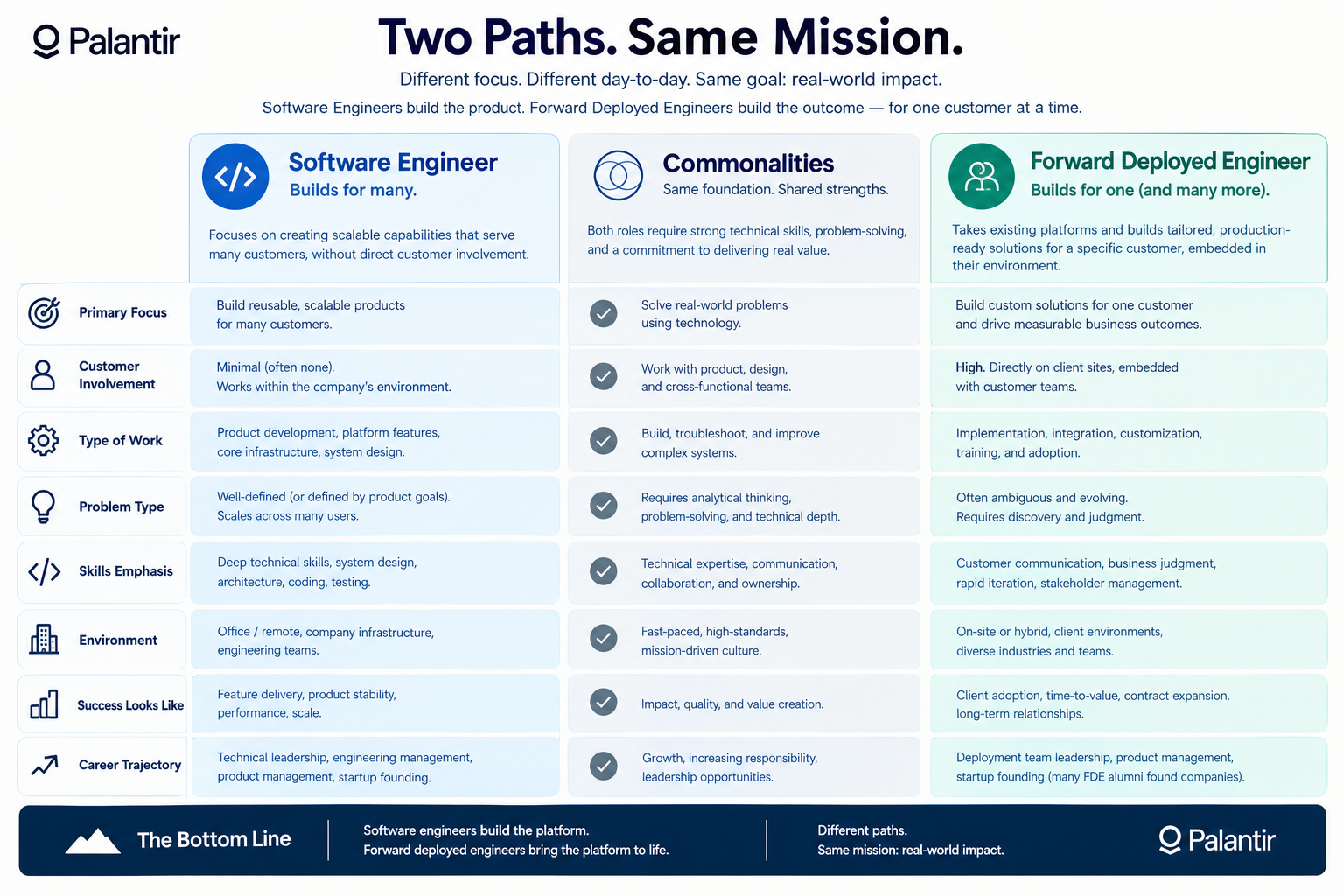
If you are a software engineer reading this, you already have the hardest part.
You can build. You understand systems. You know what production code looks like versus prototype code. You have debugged things that broke in ways nobody anticipated. You have worked in codebases you did not write and made progress anyway.
The forward deployed engineering role requires all of that. And it requires two more things that most software engineers have never deliberately developed: the ability to understand a customer's business problem deeply enough to build the right thing without a specification, and the ability to communicate what you built to people who did not study computer science.
That is the gap. Two capabilities. Not a complete reinvention of your career — an extension of it.
The 90-day roadmap in this blog is designed specifically for the software engineer who has the technical foundation and needs to build the customer-facing layer on top of it. Not from scratch. From a solid base that most candidates in the FDE market do not have when they start.
One honest note before the roadmap begins. Ninety days is the minimum timeline for becoming competitive for FDE roles at earlier-stage companies in the ecosystem. For tier-one programs at Palantir, Decagon, or Scale AI, the preparation window is often four to six months for most software engineering candidates because the interview processes at those companies are specifically designed to be hard to pass without extensive practice. Use the 90-day roadmap to get moving. Use the momentum you build to calibrate whether you are ready for the tier you are targeting or need additional time.
Why Software Engineers Specifically Struggle With the FDE Transition — And Why It Is Not What You Think
The most common assumption software engineers make when they consider the FDE transition is that the technical gap is the problem. They worry that their data engineering is not deep enough, or that they do not know the specific platform well enough, or that their Python is not production-ready enough.
Those concerns are usually overcalibrated. The technical gap is almost never what ends a software engineer's FDE candidacy.
What ends it is usually one of three things.
The first is jumping to solutions before understanding the problem. Software engineers are trained to receive specifications and build to them. The FDE role requires generating the specification through discovery — listening to a customer who does not know exactly what they need and asking the questions that surface the real problem beneath the stated one. Most engineers have never practiced this deliberately and the gap shows immediately in the interview.
The second is describing work as participation rather than ownership. Software engineers who have worked in large teams on large codebases often describe their work accurately — but accurately is not the same as compellingly for an FDE interview. Saying "we built a pipeline that processed X data" when you personally wrote the core logic and owned the delivery is underselling your actual ownership in a way that FDE interviewers specifically screen for. They are looking for candidates who say "I built" not "we built" — because the FDE role will put you in environments where there is no we to fall back on.
The third is the communication gap that shows up under pressure. In a software engineering interview you can think silently while you write code. In an FDE interview you have to narrate your reasoning while you work through a problem in real time, in front of a human being who is evaluating how you would perform in a client boardroom. Software engineers who have never practiced this find the FDE interview significantly more demanding than the technical screen that preceded it.
The 90-day roadmap addresses all three. Here is how.
The 90-Day Roadmap: Week by Week
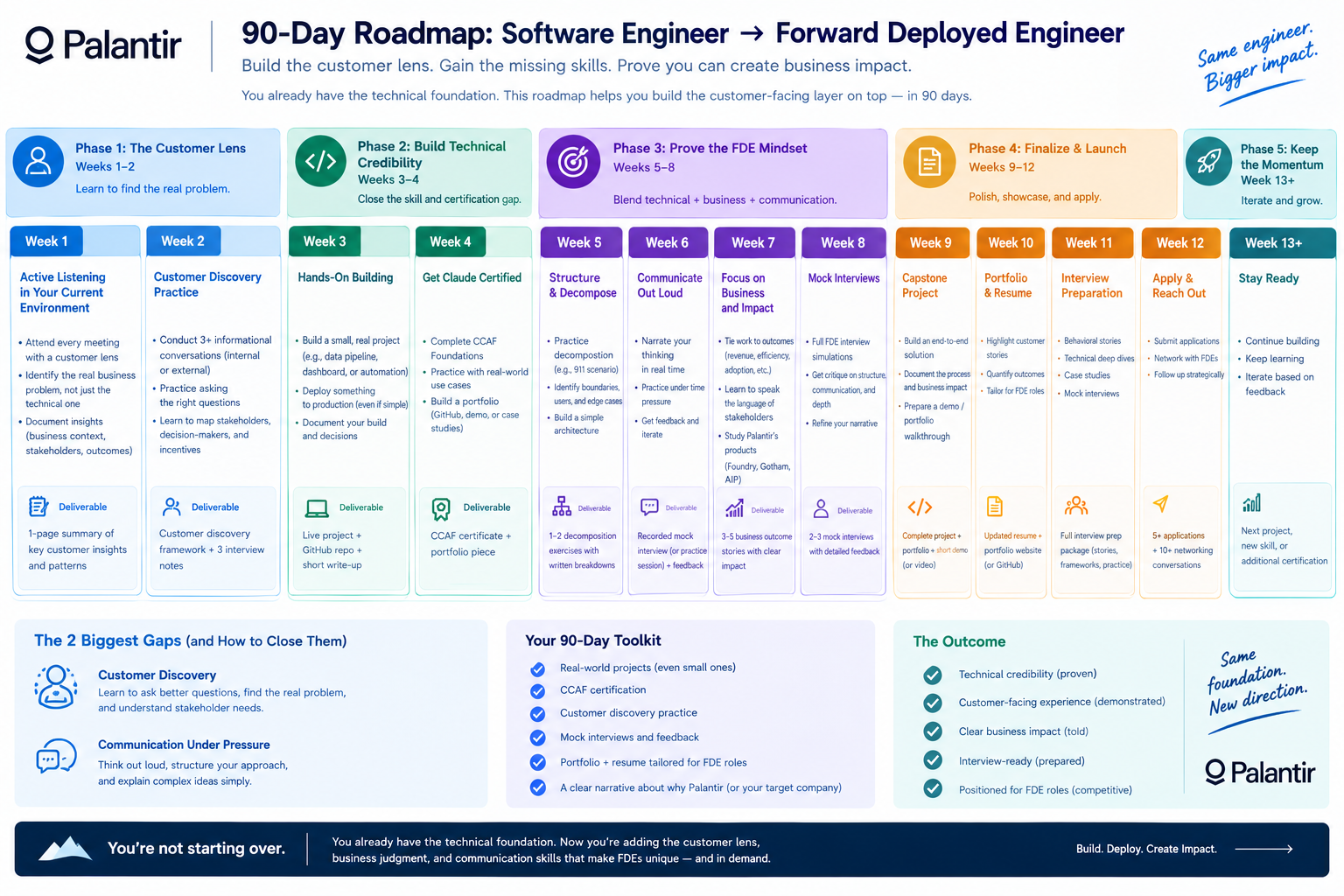
Weeks 1 and 2: The Customer Lens — Developing the Skill You Have Never Had to Practice
Before you touch any new technical skill or certification, spend the first two weeks developing the customer discovery capability that is the hardest to build and the most important to have.
Week 1: Active listening in your current environment
You do not need to leave your current job to practice this. Start in your existing work environment. In every meeting this week — engineering standups, planning sessions, stakeholder reviews — practice listening for the real problem beneath the stated one. When someone describes a technical problem, ask yourself: what business outcome are they actually trying to achieve? What would be different in their world if this problem were solved? What decision does this information support?
Write down what you observe after every meeting. Not the technical content — the business context. What does this team actually care about? What would make their lives better? What problem is really keeping their manager up at night that is different from the ticket on the board?
This sounds simple. It is not. Most engineers have never deliberately paid attention to this layer of their work environment because the job did not require it. The practice of noticing it is the first step toward being able to do it in a client engagement.
Week 2: The diagnostic question practice
The single most important skill in the FDE discovery process is asking the right first question. Not the question that gets you the most information. The question that gets you the most important information — the one that surfaces the decision that needs to be made and who makes it.
Practice this for one week in every conversation where someone presents you with a problem. Before you respond with anything — before you suggest a solution, before you ask for more details — ask: what decision does this support and who makes it?
Practice it until it is your automatic response to any ambiguous problem. Because in the decomposition round at Palantir and in every FDE client engagement you will ever have, the first question you ask is the most important thing you do.
Weeks 3 and 4: Customer Storytelling — Reframing Everything You Have Already Done
You have technical experience. You have delivered things. You have solved real problems. But the way you describe that experience is almost certainly optimized for a software engineering audience — and it will not land the same way with an FDE hiring manager.
This phase is about reframing your existing experience for the FDE context without changing what happened. You are not inventing new stories. You are finding the business outcome layer that was always there but never foregrounded.
Week 3: The ownership audit
Go through every significant project in your career history. For each one, write down three things. What business problem did this solve — not what technical problem, the business problem? Who was the end user or customer, what did they need, and how did what you built change their situation? What was your specific contribution — not the team's, yours — and what would have been different if you had not been involved?
Most engineers discover two things during this audit. First, that the business impact of their work was real and significant and they have never articulated it in those terms. Second, that their actual individual contribution was more substantial than the way they describe it suggests.
Week 4: Metric extraction and story structuring
Take the three most significant projects from your ownership audit and extract every possible metric from each one. Time saved. Cost reduced. Revenue generated or protected. Error rate reduced. Adoption rate achieved. User satisfaction improved. Whatever is measurable, measure it.
Then structure each project as a two-minute story that answers five questions: what was the real business problem, who was the customer, what did you specifically build and why did you make those specific technical decisions, what happened after you shipped including evidence that it worked, and what would you do differently.
Practice each story out loud. Time it. Record it. Listen back. If any answer to any of the five questions sounds like it could have been said by anyone on your team rather than specifically by you about your specific work, rewrite it until it cannot.
Weeks 5 and 6: Technical Broadening — Filling the Gaps That Actually Matter
Now the technical work. Not a comprehensive upskilling program — a targeted gap-filling exercise based on what FDE work actually requires.
Week 5: The FDE technical stack audit
The forward deployed engineer's technical toolkit is different from the typical software engineer's. It emphasizes breadth over depth. The ability to work across Python, SQL, APIs, and increasingly AI implementation — switching between them as the engagement demands — rather than deep specialization in any one.
Spend week 5 honestly assessing where your gaps are. If you are a backend engineer, your SQL and API skills are probably solid. Your frontend may be weaker. Your AI implementation skills may be limited to what you have read rather than what you have built. If you are a frontend engineer, the gap is likely in data engineering and backend integration. If you are a data engineer, the gap is likely in application development and client-facing communication about your work.
Identify the one or two specific technical gaps most likely to surface in the FDE interview for the company you are targeting. That targeted identification is more valuable than a broad upskilling program.
Week 6: Build the integration project
Build one real end-to-end integration between two systems you have never connected before. Connect a CRM API to a data warehouse. Build an automation that monitors one platform and triggers actions in another. Create a pipeline that pulls messy data from one source, transforms it into something useful, and pushes it somewhere it creates value.
The integration does not need to be sophisticated. It needs to work, handle at least one failure case you did not anticipate, and produce something you could demonstrate to a non-technical person in five minutes. Document every decision you made. Document every failure you encountered and how you resolved it. That documentation is as important as the code itself for FDE portfolio purposes.
Weeks 7 and 8: The AI Implementation Layer
The FDE role in 2026 increasingly requires genuine AI implementation capability — not familiarity with AI concepts, but the ability to build something real using LLM APIs or agent frameworks in a production context.
Week 7: Build a RAG system or simple agent
Build a RAG system that answers questions against a real document corpus. Or build a simple agent that uses tool calls to accomplish a multi-step task. The goal is not a sophisticated system — it is demonstrating that you understand the difference between AI as a demo novelty and AI as a production component of a real workflow.
The most valuable addition to any AI implementation project for FDE purposes is an evaluation harness — a set of test cases that verify the AI component is behaving correctly. Build this even if it is simple. It demonstrates the evaluation instinct that Scale AI specifically prizes and that Palantir's AIP team is increasingly evaluating.
Week 8: The Claude Certified Architect Foundations exam
Week 8 is when you sit for the CCAF exam. Not the week you decide whether to. The week you actually take it.
Andy Leonard described watching James Won cram for this exam, play a round of golf, and take it — and that attitude was what motivated Andy to compress his own preparation to a week and just get it done. That is the right approach. Set the date. Prepare for the week. Take the exam. If you pass, it goes on your LinkedIn and your resume before you submit any applications. If you need a retake, you retake it. The paralysis of waiting until you feel perfectly ready costs you more than a retake ever would.
We run CCAF exam preparation sessions every Tuesday and Thursday at 1PM Pacific and 4PM Eastern. These sessions are open to our community. Come to one before you sit for the exam.
Weeks 9 and 10: The Portfolio — Building in Public
The portfolio is where software engineers have the most natural advantage over non-technical FDE candidates. You can actually build things. Use that advantage.
Week 9: The portfolio project
Build one substantial portfolio project that demonstrates the FDE capability in a single artifact. A real business problem. A working technical solution. Evidence that a real person used it and found it valuable. Clear documentation of the decisions you made, the edge cases you handled, and the limitations you acknowledge.
This project should include at least one AI component, at least one integration between two real systems, and clear documentation that would allow a non-technical hiring manager to understand what you built and why it matters without reading a single line of code.
The MCP component is worth adding if you have time. A simple Model Context Protocol server that connects Claude to a real data source demonstrates frontier AI literacy that most candidates have not developed and that immediately signals readiness for the AIP team at Palantir, the ADE function at Decagon, and the GenAI track at Scale AI.
Week 10: Building in public
Andy was explicit about this. Companies are not looking for private profiles or AI-generated resumes claiming you know Claude or Codex. They want to see something you built. They want to see passion about what you are jumping into.
This week: publish everything. The integration project. The AI implementation project. The portfolio project. On GitHub with clear READMEs that explain the business problem and the decisions. On LinkedIn with a post that explains what you built, why you built it, and what you learned. If you can record a short video demonstrating it — even three minutes — record it. The engineer who has a public trail of things they built in the last 90 days is a dramatically more credible FDE candidate than the one with a clean GitHub and a resume claiming AI experience.
Weeks 11 and 12: The Palantir-Specific Preparation Layer
Weeks 11 and 12 are specifically calibrated for Palantir FDE candidates. If you are targeting Decagon, Scale AI, or Rippling primarily, adjust this phase to the company-specific preparation guides in Blogs 13 through 20.
Week 11: The Shyam Sankar and Joe Lonsdale podcast
Watch this in full. Take notes. Watch it again. This is the primary source on what Palantir values in FDE candidates and it is available publicly. Understanding the philosophy behind the role — the gap between technical capability and business outcome, the mission orientation of the organization, the culture of delivery under pressure — is what distinguishes candidates who sound like they have done real research from candidates who sound like they read a career guide.
Come out of this week with a specific, genuine answer to "why Palantir" — not a generic answer about wanting to work on hard problems, but an answer that connects your specific background to a specific Palantir product in a specific domain and explains why this mission genuinely matters to you.
Week 12: Decomposition round intensive
Spend week 12 specifically on the decomposition round preparation. Read Blog 11 in full. Practice the five-step framework daily. And do your first two full decomposition mock sessions with a real partner — not alone, not in writing, but out loud in real time with a human being who will challenge your approach and introduce constraint shifts.
The goal coming out of week 12 is to have the diagnostic question — "what is the primary decision being made and who makes it?" — as your automatic first response to any ambiguous problem. Not something you have to remember to say. Something you say because it is how you think.
Weeks 13: Submission, Mock Interview Intensive, and Application
The Paraform submission
Submit your profile to the Paraform platform immediately. Not after you feel perfectly ready. Now. The profile submission gives our team visibility into your background, allows us to assess where you stand relative to the specific companies you are targeting, and positions you for direct submission to hiring managers through the recruiting infrastructure when your profile is ready.
Submit here: https://www.paraform.com/forms/cms9ccu9n00070bjur3ljopm2
The mock interview intensive
In the final week before any application goes out, complete your third through fifth mock interview sessions. These sessions should cover the decomposition round or the company-specific signature round, the behavioral interview with the four essential stories, and at least one complete practice run of the "why this company" answer.
The standard is three to five mock hours with three to five different partners before any real interview. If you are at week 13 and have not yet completed this standard, delay the application by one week and complete the sessions. Going into the interview under-practiced is the single most common preparation mistake we see from software engineers making this transition — and it is the one that is most clearly preventable.
The application targeting
Apply first to companies in the Palantir FDE alumni ecosystem where the interview process is most similar to what you have prepared for but the stakes are slightly lower than the tier-one programs. Use those interviews to develop the real-interview reps that mock sessions cannot fully replicate. Then apply to your primary targets when you have the actual interview experience that turns practiced answers into genuinely fluent ones.
This is the Army captain strategy. Save the best for last. Get your reps against the alumni companies first. Walk into Palantir or Decagon or Scale AI as someone who has already been in the interview environment, gotten feedback on where they fell short, and corrected it before the most important interview of the process.
What the 90 Days Actually Produces
Here is the honest accounting of where a software engineer with a solid technical foundation ends up at the end of this roadmap executed consistently.
A LinkedIn profile that leads with FDE-specific language and surfaces customer-facing evidence prominently rather than buried.
A public portfolio with at least three projects that demonstrate the three-hat capability — something built for a real user, an integration that handles real-world messiness, and an AI implementation with an evaluation component.
The CCAF certification on your LinkedIn and resume, signaling AI implementation credibility to every hiring manager in the ecosystem.
A specific and defensible "why this company" narrative for each company you are targeting, connected to specific products and specific domains.
Three to five mock interview hours with the decomposition framework internalized through practice rather than study.
A Paraform profile submitted with recruiter context rather than entered cold through a job portal.
That combination is what produces interviews at companies in the FDE ecosystem. Not at every tier simultaneously — at the tier your profile is ready for right now, with a clear path to the tier above it as you develop the real interview reps.
The Specific Mistake Software Engineers Make Most Often in This Transition
We have worked with enough software engineers making this transition to know the pattern that ends the most candidacies before they should end.
They prepare for a software engineering interview with FDE characteristics rather than preparing for an FDE interview.
They spend 80 percent of their preparation time on technical skills and 20 percent on everything else. They practice coding problems. They review system design frameworks. They refresh their data structures. And when they walk into the behavioral component of the FDE interview and get asked "tell me about a time when the problem the customer described turned out to be different from the problem that actually needed to be solved" — they have no story ready because they have never practiced customer discovery in their life.
The FDE interview tests technical capability as the baseline. What it actually evaluates is whether you have the three-hat capability fully developed. For software engineers, the technical baseline is already there. The preparation investment needs to be weighted toward the customer hat and the PM hat — the two that most engineers have never deliberately practiced.
Flip the preparation ratio. Spend 40 percent on technical sharpening, 40 percent on customer story development and mock behavioral sessions, and 20 percent on company-specific research and platform literacy. That weighting is what produces different outcomes from the same preparation time investment.
Why the Engineering Instinct for Self-Sufficiency Works Against You Here
Software engineers are trained to solve problems alone. To figure things out. To debug without asking for help until they have exhausted their own diagnostic process. To ship and then refactor based on what they learn.
That instinct is a strength in an engineering environment. In an FDE preparation context it is a liability.
The software engineer who prepares for the FDE transition alone — who reads the blogs, builds the portfolio projects, studies the companies, and rehearses answers in their head — arrives at the interview having done a significant amount of work and being significantly less prepared than they feel.
Because the FDE interview is not a written test that rewards study. It is a performance that rewards practice. And the only practice that prepares you for a performance is performing — out loud, in front of real people, under the kind of time pressure and challenge that the real interview creates.
This is exactly why Andy Leonard's advice was to find the community, plug in, and take action. Not to perfect your preparation privately until you feel ready. To get into the sessions, teach others what you are learning, build in public, take the exam when you set the date, and keep moving. The momentum is the preparation.
Schedule Your Forward Deployed Engineering Strategy Session
If you are a software engineer who has read this blog and recognizes yourself in the description of someone who is already halfway there — book a strategy session with our team.
We will look at your specific engineering background and tell you honestly which tier of FDE roles you are most competitive for right now, what the specific preparation gaps are for the companies you are targeting, and what the 90-day plan looks like calibrated to your specific starting point rather than a generic one.
The software engineer who executes this transition well ends up in a role that uses everything they know and adds everything they did not know they were missing. The one who waits until they feel perfectly ready ends up watching the window narrow as more candidates discover the path.
Book your session here: https://consultation.techcareers.io/o-discover-fde/about
Submit your profile here: https://www.paraform.com/forms/cms9ccu9n00070bjur3ljopm2
Frequently Asked Questions
Can a software engineer become a forward deployed engineer?
Yes — and software engineers are among the strongest FDE candidates because the technical hat is already developed. The primary gaps for software engineers transitioning to FDE are the customer discovery capability — listening to surface the real problem beneath the stated one — and the communication skills to present technical work to non-technical executive stakeholders. Both are developable through deliberate practice over 90 days. The technical baseline that most software engineers have is the hardest part for non-technical candidates to develop, which means the transition is structurally faster for engineers than for most other backgrounds.
What is the biggest mistake software engineers make when preparing for an FDE interview?
The most common and most costly mistake is treating the FDE interview preparation like software engineering interview preparation — spending 80 percent of time on technical skills and 20 percent on behavioral and communication preparation. The FDE interview tests technical capability as a baseline. What it actually evaluates is the three-hat capability. For software engineers, the technical baseline is already there. The preparation investment needs to be weighted toward customer story development, mock behavioral sessions, and the decomposition round practice — the dimensions that engineers have never had reason to develop before.
How long does it take for a software engineer to become competitive for FDE roles?
For a software engineer with two or more years of production experience, 90 days of focused preparation is a realistic timeline for becoming competitive for FDE roles at companies in the Palantir alumni ecosystem. For tier-one programs at Palantir, Decagon, or Scale AI specifically, four to six months is more realistic because the interview processes at those companies are specifically designed to be difficult to pass without extensive practice. The 90-day roadmap gets you moving and builds the preparation infrastructure. The reps you accumulate through actual interviews at alumni companies calibrate your readiness for the tier-one targets.
What technical skills does a software engineer need to develop for the FDE transition?
Most software engineers already have the core technical skills the FDE role requires — production coding, system design, debugging, and integration experience. The specific gaps vary by engineering background. Backend engineers typically need to strengthen frontend capability and AI implementation literacy. Frontend engineers typically need to strengthen data engineering and backend integration. Data engineers typically need to strengthen application development and client-facing communication about their work. The Claude Certified Architect Foundations certification is specifically valuable for establishing AI implementation credibility across all engineering backgrounds.
What is the difference between preparing for a software engineering interview and an FDE interview?
A software engineering interview primarily tests technical depth — coding problems, system design, and algorithmic thinking — with some behavioral questions added. The communication component is largely irrelevant to whether you pass. An FDE interview is a verbal and performance-based assessment where communication is the job. You are being evaluated on how you think out loud, how you carry yourself under pressure, how you handle ambiguity in real time, and how you come across to someone imagining you in front of their most important clients. Nervousness in a software engineering interview costs a few points. Nervousness in an FDE interview signals that you are not the executive-ready professional the role requires. The preparation has to match the assessment.