What Palantir Actually Looks for in a Forward Deployed Engineer and How to Position Yourself
The Thing That Kills More Palantir FDE Candidates Than Technical Failure
Here is something that does not appear in any job description Palantir has ever published.
Culture fit can override strong technical performance in the Palantir FDE interview.
Read that again. You can pass the coding round. You can pass the SQL assessment. You can handle the decomposition case study. And you can still not get the offer because the hiring team determined that you do not fit the culture of the organization.
Most candidates preparing for the Palantir forward deployed engineer interview spend ninety percent of their preparation time on technical skills and ten percent on everything else. The interview process is designed to do the opposite. Technical ability is the baseline. What Palantir is actually evaluating — the thing that differentiates the candidates who get offers from the ones who do not — is whether you genuinely understand what Palantir is, what it stands for, what it is trying to accomplish in the world, and whether you are the kind of person who belongs inside that operation.
This blog is about that other ninety percent. The part most guides skip. The part that determines whether a technically strong candidate gets an offer or goes home.
If you have not read our complete guide on how to pass the Palantir FDE interview, start there first. This blog goes deeper into positioning and culture specifically. Together they give you the complete picture.
What Palantir Is Actually Building and Why It Matters for Your Interview
You cannot position yourself accurately for a role at an organization you do not genuinely understand. And Palantir is one of the most widely misunderstood companies in all of technology.
Most candidates who apply to Palantir FDE roles have a surface-level understanding of the company. They know it works with governments and large enterprises. They know it is involved in defense and intelligence. They know it was founded by Peter Thiel, Alex Karp, and Joe Lonsdale. They know the name is from Tolkien.
What they do not know — and what the interview is specifically designed to surface — is whether they have a real perspective on what Palantir is doing and why it matters.
Four core values drive Palantir's culture: Innovation, Mission-Driven Impact, Meritocracy, and an unwavering commitment to privacy, civil liberties, and ethical technology deployment.
That last one is the one that trips people up. Palantir works with government agencies, defense contractors, and intelligence communities. It processes extraordinarily sensitive data about real people. And it has built a formal Privacy and Civil Liberties team that can veto contracts and product features that conflict with human rights standards. The tension between "we work with the government on sensitive data" and "we are committed to civil liberties" is real and Palantir does not shy away from it.
Cultural fit is screened seriously at Palantir. Be prepared to discuss why you want to work on Palantir's specific customer problems — including civil liberties and defense topics. Generic answers about wanting to solve hard problems fail.
In April 2026, Palantir published what has been widely referred to as the Technological Republic manifesto — a 22-point articulation of the company's philosophy that explicitly rejects mainstream tech culture in favor of a mission-driven, meritocratic, and unapologetically pro-Western stance. Whether you agree with every element of that philosophy or not is secondary to the following reality: Palantir uses its cultural identity as a filter. They are not trying to build a team that reflects the entire spectrum of professional opinion. They are building a specific kind of organization for a specific kind of mission and they want people who genuinely belong in it.
If you walk into a Palantir FDE interview without a clear, considered perspective on what the company is building and why you specifically want to be part of it, you will fail the culture dimension of the evaluation regardless of how strong your technical performance is.
This is not something you can fake. The interviewers at Palantir are experienced. They have seen thousands of candidates. They know the difference between someone who has genuinely thought about the company's mission and someone who is reciting something they read on the careers page the night before.
Think about it. Form a real opinion. Be able to defend it. And be willing to engage with the difficult questions the work raises — about data, about privacy, about the role of technology in national security — with intellectual seriousness rather than deflection.
The Four Things Palantir Is Actually Evaluating
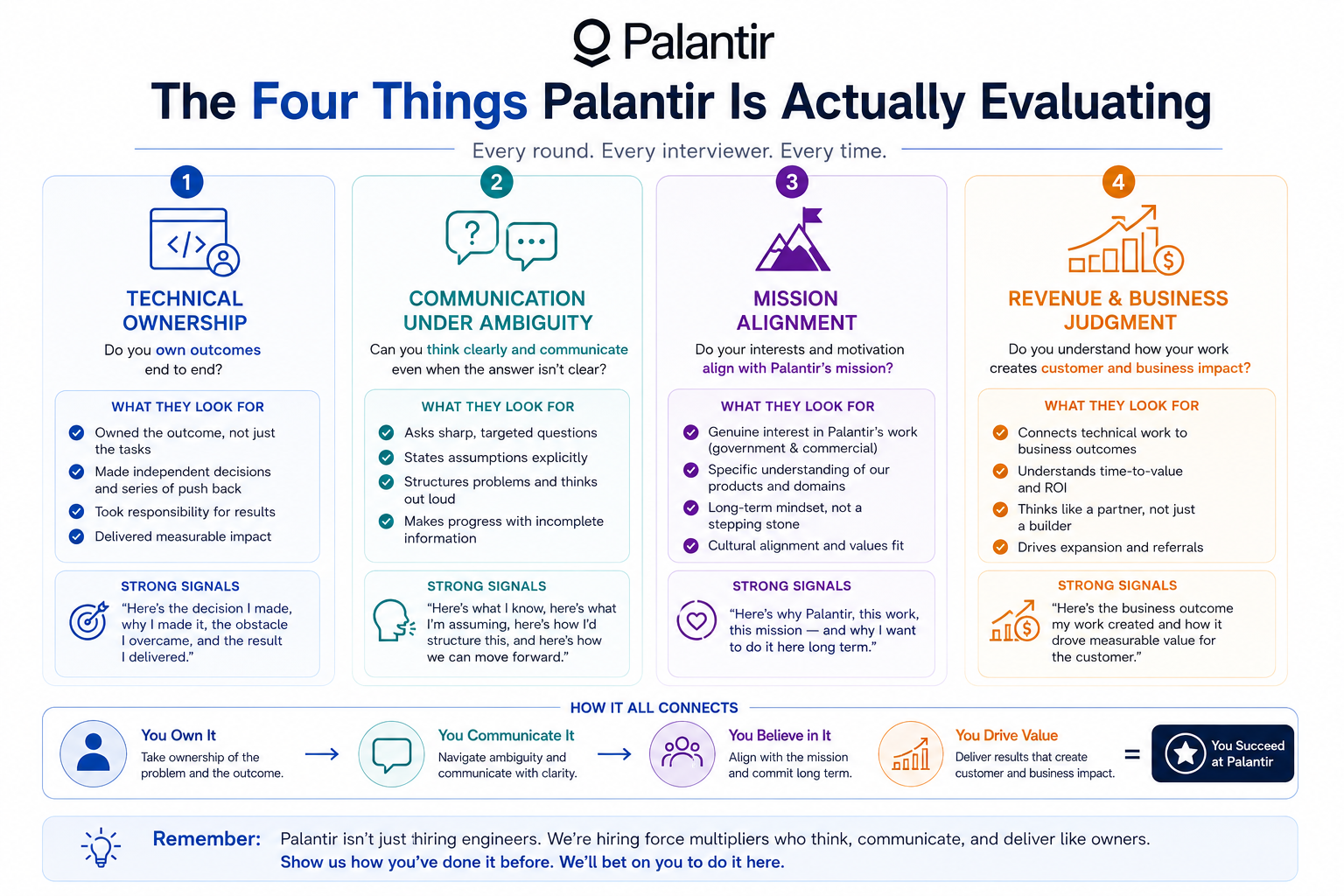
Every round of the Palantir FDE interview is measuring one or more of the following four things. Understanding this map changes how you prepare.
The First Thing: Technical Ownership
Palantir values high technical ownership, intellectual curiosity, and a mission-driven mindset. They look for candidates who are comfortable challenging assumptions and deeply committed to delivering practical utility to end-users.
Technical ownership at Palantir means something specific. It does not mean you wrote a lot of code. It means you owned an outcome end to end. You did not just implement what you were told to implement. You understood the problem deeply enough to make independent decisions about the best way to solve it. You pushed back when the approach was wrong. You took responsibility for whether the thing you built actually worked for the people who needed to use it.
The candidates who fail the technical rounds at Palantir are often not technically insufficient. They are technically passive. They describe work they participated in rather than work they owned. They talk about what the team built rather than what they personally decided and delivered.
Every story you tell in the Palantir FDE interview needs to be a story about what you owned, what decision you made, what obstacle you encountered and overcame, and what the measurable outcome was. Passive participation in impressive projects does not pass the ownership filter.
The Second Thing: Communication Under Ambiguity
Palantir's problems are often vague and non-standard. You need to demonstrate your ability to clarify requirements, make reasoned assumptions, and structure solutions even when information is incomplete.
The decomposition case study is the most direct test of this. But every round in the Palantir interview is also evaluating how you communicate when you do not have complete information.
Most candidates are comfortable communicating when they know the answer. They become visibly uncomfortable when they do not. That discomfort is exactly what Palantir is looking for — not to watch you suffer, but to see how you behave when the ground is uncertain. Do you freeze and wait for more information? Do you make up an answer and commit to it prematurely? Or do you ask sharp, targeted clarifying questions, lay out your assumptions explicitly, and build a structured framework that lets you make progress even with incomplete data?
The FDE role requires this every single day. You are walking into client environments that are complex, politically charged, and full of information you do not yet have. The candidate who can navigate that gracefully in an interview is the one who can navigate it on a client site.
Think out loud. Always. In every round. The interviewers are not just evaluating your answers. They are evaluating how you arrive at them.
The Third Thing: Mission Alignment
Mission alignment at Palantir means how well your interests map to Palantir's work in government and commercial deployments, and whether you show signs of wanting to stay and grow rather than treating the role as a stepping stone.
This is where most candidates make the error that ends their candidacy before the technical rounds even begin.
The recruiter call is not a warmup. It is a serious evaluation of whether you understand and genuinely care about the work Palantir does. The single most important answer in the recruiter call is why you want to do FDE work and not standard software engineering. Strong candidates connect customer-facing technical work to their personal motivation. Weak candidates describe FDE as consulting but technical or say they want to work at a famous company.
A strong answer to "why Palantir" is specific, grounded, and connected to something you actually care about. It references a specific Palantir product — Foundry, Gotham, AIP — or a specific domain where Palantir operates and where you have genuine interest. It demonstrates that you have thought about what the work actually involves and why you want to do that work at this specific organization rather than at any of the dozens of other companies now hiring FDEs.
A weak answer to "why Palantir" is anything that could also be an answer to "why any company hiring FDEs." If your answer would work just as well in an interview at Decagon or Scale AI or Rippling, it is not specific enough for Palantir.
Palantir places enormous emphasis on cultural alignment. Prepare a compelling narrative about what specifically draws you to Palantir and its mission. Be ready to discuss your favorite and least favorite past projects, highlighting key learnings. Show willingness to engage with topics related to civil liberties and rights, as Palantir values this.
The Fourth Thing: Revenue and Business Judgment
This is the one that most interview prep guides leave out entirely. And it is increasingly central to what Palantir is looking for in 2026.
A forward deployed engineer at Palantir is not just a builder who happens to sit near the customer. They are a business development asset. Palantir embeds forward deployed engineers with customers to co-build solutions on-site, ensuring software meets mission needs quickly and pragmatically, with typical engagements converting proof-of-value into production in days to weeks rather than months.
The FDE who drives that kind of rapid time-to-value is the FDE who generates more business for Palantir, because clients who see fast ROI expand their contracts and refer other clients. Understanding this dynamic — and being able to speak to it in an interview — positions you as someone who sees the full picture of the role rather than just the technical implementation layer.
In your interview stories, wherever possible, connect the work you did to a business outcome. Not just "I built a pipeline that processed X data" but "I built a pipeline that reduced the client's reporting time from three days to four hours, which allowed their analytics team to reallocate 20 hours per week to higher-value work, which contributed to a contract expansion six months later." The revenue and business judgment dimension of the FDE role needs to be visible in how you talk about your past work.
How to Position Yourself Based on Your Background
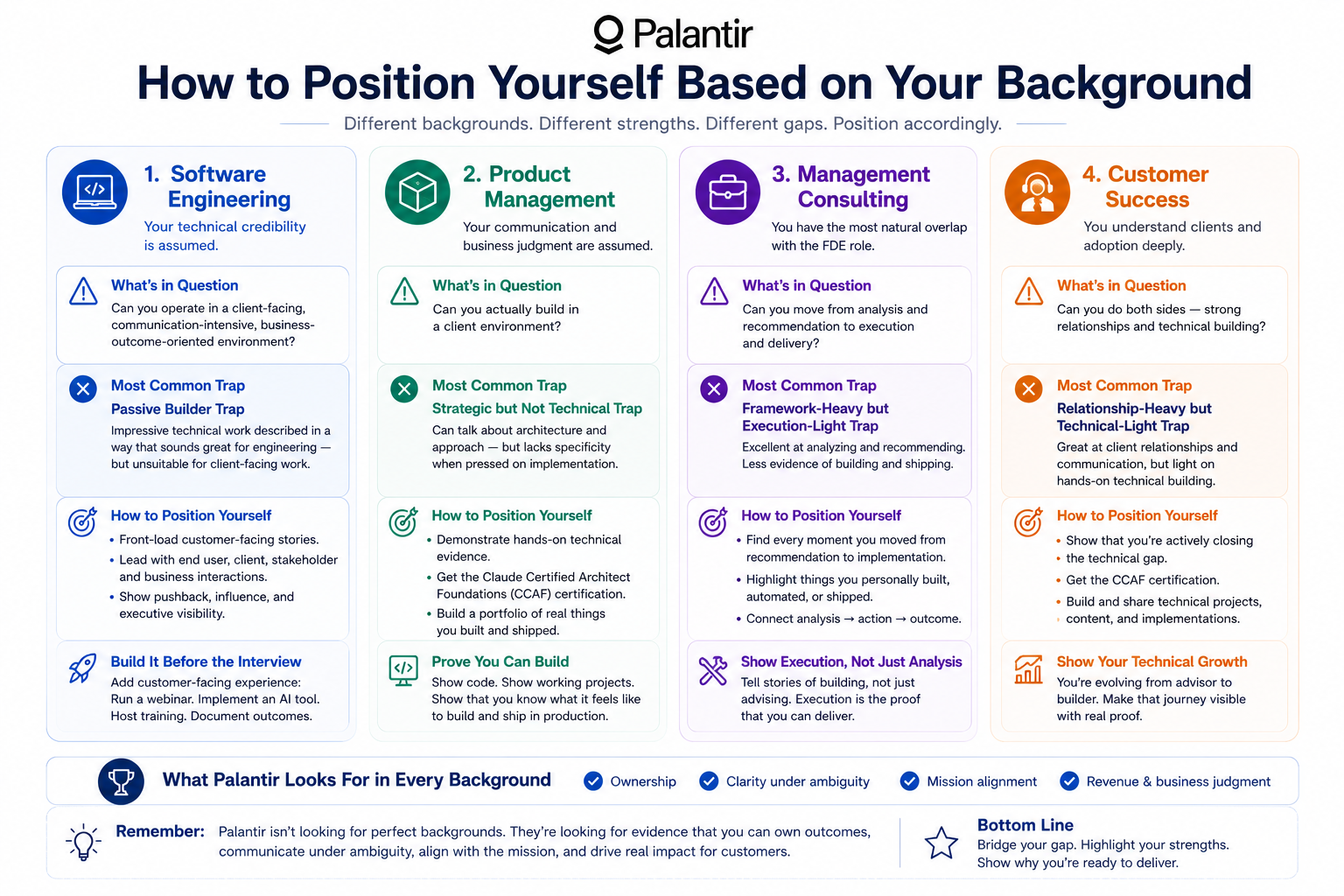
The positioning strategy is different depending on where you are coming from. Here is the honest assessment for each background type.
If You Are Coming From Software Engineering
Your technical credibility is not in question. What is in question is whether you can operate in a client-facing, communication-intensive, business-outcome-oriented environment.
The most common rejection pattern for software engineering candidates at Palantir is what we call the passive builder trap. They describe technically impressive work in ways that make them sound like excellent individual contributors who would be great in a traditional engineering environment — and completely unsuitable for an environment where they will need to manage client relationships, push back on bad technical decisions made by non-technical stakeholders, and be comfortable with visibility and accountability at the executive level.
Position yourself by front-loading your customer-facing stories. Every interaction you have had with end users, clients, stakeholders, or business decision-makers belongs at the top of your narrative. Technical depth is the baseline they are already assuming you have. Customer and business judgment is what you need to prove.
If your resume is light on customer-facing experience, address this directly before the interview by finding ways to add it. Run a live webinar. Implement an AI tool for a small business and document the outcome. Host an in-person training session. These are not just nice-to-haves for your portfolio. They are evidence that you can do the part of the FDE role that software engineers most commonly struggle to demonstrate.
If You Are Coming From Product Management
Your communication skills and business judgment are not in question. What is in question is whether you can actually build in a client environment.
The most common rejection pattern for PM candidates is the strategic but not technical trap. They can talk about systems architecture and implementation approaches in ways that sound credible. But when the interviewer pushes to the next level of specificity — what language, what framework, what would you do if the API returned an unexpected response — the answers become vague in ways that signal the candidate has not actually done the technical work they are describing.
Position yourself by demonstrating hands-on technical evidence before and during the interview. The Claude Certified Architect Foundations certification is particularly valuable here because it shows you have done the work to develop real technical competency rather than just strategic familiarity with technical concepts. A portfolio of actual things you built — even small things, even simple things — that demonstrates you know what it feels like to write code that runs in a production environment is more convincing than any amount of strategic narrative.
If You Are Coming From Management Consulting
You have the most natural overlap with the FDE role of any non-technical background. You already know how to embed in a client organization, navigate stakeholder dynamics, and translate complex analysis into executive-level recommendations. The vocabulary of consulting and the vocabulary of forward deployed engineering are remarkably similar.
The most common rejection pattern for consulting candidates is the framework-heavy but execution-light trap. Consultants are trained to analyze problems and present recommendations. Forward deployed engineers are trained to build solutions and deliver them. The interview is looking for evidence of execution — of things you personally built and shipped, not just things you analyzed and recommended.
Position yourself by finding every moment in your consulting background where you moved from recommendation to implementation. Where did you build something, even informally? Where did you write a script to automate a process? Where did you design a data system rather than just recommend one? Those moments need to be central to your interview narrative.
If You Are Coming From Customer Success
You have deep client relationship skills and a genuine understanding of what it takes to make a client organization actually adopt and use a technical product. That is valuable and relevant.
The most common rejection pattern for customer success candidates is the relationship-heavy but technical-light trap. CSM work is relationship-intensive and often involves technical communication but rarely involves technical building. The interview is going to probe whether you can do both sides.
Position yourself by demonstrating that you have already begun closing the technical gap. The CCAF certification, YouTube portfolio content demonstrating AI implementation, and any evidence of technical skill-building you have done should be prominent in your positioning.
The Specific Stories Palantir Wants to Hear
Based on what we know from hiring manager intelligence on the Paraform platform and real rejection feedback from candidates who have gone through this process, here are the story types that consistently perform well in Palantir FDE interviews.
The Ambiguity Story
A situation where you were given an unclear problem with insufficient information, you asked the right clarifying questions to define the boundaries, you built a structured framework for approaching it, and you delivered something that worked even though the requirements kept changing. This maps directly to the decomposition case study and the learning round.
The Pushback Story
A situation where a client, stakeholder, or manager wanted you to build something the wrong way — because it was easier, because it was what they were used to, or because they did not fully understand the technical tradeoffs — and you pushed back respectfully, made the case for a better approach, and ultimately delivered something more valuable than what was originally requested. This demonstrates the independent judgment and technical ownership that Palantir specifically values.
The Training Story
A situation where you built something and then had to ensure that the people who needed to use it actually understood it, adopted it, and got value from it. Not just a handoff with documentation. An active effort to make a technical product accessible to non-technical users. This maps to the training and adoption dimension of the FDE role that is increasingly central to what Palantir evaluates.
The Fast Build Story
A situation where you had very little time, an urgent client need, and you shipped something that worked in days rather than weeks. Speed and delivery under pressure are core to the FDE ethos. Candidates who can demonstrate that they have operated in fast-moving, high-stakes environments where the expectation was to build and ship rather than plan and document are candidates who fit the Palantir FDE mold.
The Revenue Story
A situation where something you built directly contributed to a measurable business outcome — cost reduction, revenue generation, efficiency improvement, contract expansion. Forward deployed engineering at Palantir is ultimately measured by client outcomes and business impact. Candidates who can connect their technical work to business results in clear, specific terms are the ones who demonstrate full-spectrum FDE capability.
The Positioning Mistake That Ends More Candidacies Than Any Technical Failure
Here is the honest version of what we see most often when candidates fail the Palantir FDE process despite having the technical skills to do the job.
They position themselves as people who want to join Palantir.
Palantir is looking for people who are ready to serve Palantir's clients.
That difference is subtle and it is everything.
The candidate who talks about what working at Palantir would mean for their career, what they would learn, what the name would do for their resume — that candidate is oriented toward their own benefit. They are thinking about what the role gives them.
The candidate who talks about specific client problems in domains they genuinely care about, about the outcomes they want to drive for the organizations Palantir serves, about the impact they want to have through the work — that candidate is oriented toward the mission. They are thinking about what they give the role.
Palantir's FDE model replaces traditional sales-heavy approaches with hands-on problem-solving. FDE engagements convert proof-of-value into production in days to weeks rather than months. The people who thrive in that environment are not people who are optimizing for their own trajectory. They are people who are genuinely energized by the problem of making powerful software produce real outcomes for real organizations.
Position yourself as that person. Not because it is what the interviewer wants to hear. Because it is what the role actually requires. And if it is not genuinely how you feel about the work, that is important information about whether Palantir is actually the right fit for you.
Why TechCareers.io Gives You a Positioning Advantage Nobody Else Can Offer
Everything in this blog is directionally accurate based on publicly available information about the Palantir FDE interview process. But here is what we know from being inside the recruiting infrastructure.
The publicly available information about what Palantir is looking for is always three to twelve months behind where the role actually is.
The job description was written at a specific point in time. The Glassdoor reviews are from candidates who interviewed months ago. The YouTube videos are based on research that was current when it was produced. The role has evolved. The specific teams have evolved. What each team needs from an FDE in 2026 is not necessarily what the teams needed in 2025.
We have access to current hiring manager intelligence. We know what specific teams are specifically looking for right now. We know what the most recent rejection patterns look like. We know where the role has shifted and where the old guidance is no longer accurate.
We also know something that is specific to your situation, not just the general situation: we can cross-reference everything the hiring team is looking for against your specific background, identify exactly where you are going to fall short in the interview before you walk in, and help you build the stories and metrics that address those gaps directly.
The gap between your background and what Palantir needs is not fixed. It is a set of specific things that can be identified, addressed, and prepared for. That is what the program does. And it is something no generic interview prep platform can offer because they do not have access to the hiring manager intelligence that makes the preparation specific rather than general.
Schedule Your Forward Deployed Engineering Strategy Session
If you want to understand exactly how your background stacks up against what Palantir is looking for right now, and what the specific path looks like from where you are to where you need to be, book a strategy session with our team.
We are approved recruiters on the Paraform platform. We have direct access to hiring manager intelligence. We have real rejection feedback. We have the in-person infrastructure in New York City where 35 percent of all FDE jobs are located. And we have helped candidates from software engineering, product management, consulting, and customer success backgrounds successfully navigate this transition.
You can do this alone. The information is out there. But the candidates who move through this with access to specific intelligence, specific preparation, and specific coaching arrive at the interview in a fundamentally different position than the ones who prepare with generic resources.
Book your strategy session here: https://consultation.techcareers.io/o-discover-fde/about
Frequently Asked Questions
What does Palantir look for in a forward deployed engineer?
Palantir looks for high technical ownership, intellectual curiosity, and a mission-driven mindset in forward deployed engineer candidates. They specifically seek candidates who are comfortable challenging assumptions and deeply committed to delivering practical utility to end-users. Beyond technical skills, Palantir evaluates communication under ambiguity, genuine mission alignment with the organization's work in government and commercial deployments, and the business judgment to connect technical implementation to measurable client outcomes.
How important is culture fit in the Palantir FDE interview?
Culture fit can override strong technical performance in the Palantir FDE interview. Behavioral questions are embedded inside nearly every round rather than isolated in a dedicated interview, meaning culture is being evaluated throughout the entire process, not just in one designated stage. Candidates who pass every technical round but fail to demonstrate genuine alignment with Palantir's mission and values will not receive an offer.
What is the best answer to "why Palantir" in the FDE interview?
The strongest answers to why Palantir tie specifically to a product like Gotham or Foundry or a domain the candidate genuinely cares about. Generic answers about wanting to solve hard problems or work at a well-known company consistently fail. The answer needs to demonstrate that the candidate has genuinely thought about what Palantir is building, why the work matters, and why they specifically want to contribute to it rather than to one of the many other companies now hiring forward deployed engineers.
Does Palantir care about civil liberties topics in FDE interviews?
Yes. Palantir places enormous emphasis on cultural alignment and candidates should be prepared to engage with topics related to civil liberties and rights throughout the interview process, not just in a single dedicated round. Palantir works with governments, defense agencies, and intelligence communities and processes sensitive data about real people. Candidates who have not thought carefully about the ethical dimensions of that work and how they personally relate to it will struggle with the culture dimension of the evaluation.
What is the Palantir Foundry Ontology mental model and why does it matter?
Familiarity with how Palantir's Foundry and Ontology data products drive decisions across domains including supply chain, fraud detection, intelligence, and healthcare is part of the preparation Palantir expects from serious FDE candidates. Understanding the Ontology model — how Palantir structures data to make it queryable and actionable across complex enterprise environments — demonstrates that a candidate has done more than surface-level research on the company and genuinely understands the technical architecture they would be deploying in a client environment.
How does Palantir evaluate business judgment in the FDE interview?
Business judgment at Palantir is evaluated through how candidates connect technical decisions to client outcomes in their interview stories. Candidates who describe what they built without connecting it to a measurable business result are demonstrating technical skill without business judgment. Palantir ties FDE engagements to short-cycle metrics including time-to-value, deployment velocity, and user adoption. Interview stories that include these dimensions — how quickly something was delivered, how broadly it was adopted, and what business outcome it drove — demonstrate the full-spectrum capability that Palantir's FDE evaluation is designed to surface.
What is the travel expectation for a Palantir forward deployed engineer?
Travel expectations vary depending on the team, office location, and assigned clients, but forward deployed engineers at Palantir should be prepared for significant travel. FDEs often spend 25 to 75 percent of their time on-site with customers, especially during the initial phases of a new deployment. Candidates who are unwilling or unable to travel significantly should reconsider whether the Palantir FDE role is the right fit, as the on-site client engagement is central to how the role creates value.
How long does it take to hear back after a Palantir FDE interview?
The average timeline from first call to decision for a Palantir FDE role is approximately 28 days. The full process typically spans four to five stages conducted over three to six weeks. Candidates should follow up at each stage if they have not heard back within the expected timeframe, as hiring teams at large organizations can move slowly on communications even when they are actively interested in a candidate.
What are the most common reasons candidates fail the Palantir FDE interview?
Based on rejection feedback from candidates who have gone through the process, the most common failure patterns are as follows. Failing the culture dimension despite strong technical performance — usually because the candidate gave a generic answer to why Palantir or failed to demonstrate genuine mission alignment. Failing the decomposition round by jumping to solutions before fully clarifying the problem. Failing to connect technical stories to business outcomes. Describing impressive technical work in passive terms that suggest participation rather than ownership. And walking into the interview with insufficient mock interview practice so that communication under pressure is rough rather than confident.